

What is the appeal of the Cinema 21:9 aspect ratio?

Messages
6,253
Name
Sean
Edit My Images
Yes
It's KIND of photography, but if mods feel it's in the wrong place, feel free to move it.

so, I was reading an article on Phillips' new 21:9 aspect ratio HD tv, and I'm just curious as to the appeal of an aspect ratio 2.5x wider than it is high.

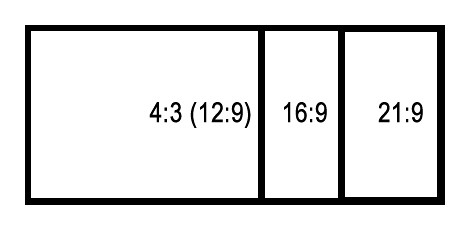
Just so you guys know, here's an example of the aspect ratios.
Cinema is seen at the 21:9 aspect ratio, most LCD TV's (i believe) are in 16:9 ratio, and 4:3 is the old format ratio.
3493594621_d0da5da98d.jpg


I understand the appeal of being wider than it is longer, since a square image would be peculiar. However, surely by being in a 4:3 format you capture the most?

It just seems strange how the viewing area is restricted by so much when you could have the full screen, and instead you have a letterbox.

I'm used to it, and I don't have a problem with it so long as it doesn't directly affect the flow of the film, but I'm just curious, that's all.

Anyone else with me? Or are you all not as film nerdy as me and didn't even notice it?
 
Generally speaking, movies are shot in either 1:1.85 (16:9) or in a wider format 1:2.35 - which is 21:9 or thereabouts. The only advantage I can think in having a television this wide is that you won't get the black bars at the top and bottom when viewing a film in its widest ratio.

However, if you were to watch a film in 1:1.85, you would get the black bars on the left and right hand side of the picture unless you 'stretched' it horizontally to fill the screen.

It is similar to watching a 4:3 ratio from an old non-widescreen picture on a 16:9 widescreen television - you'd either zoom into the picture or stretch it. The problem here is when you zoom in you will lose part of the top and bottom and if it's stretched out, it'll appear distorted.
 
I understand that carl, but thanks for explaining it.

The thing I don't get is, what is the appeal of the wider format?

Surely you're reducing the area of filming, by effectively halving the height?

For example, you want a super close of up two people speaking...

The 4:3 ratio will give you a better shot of the head shots, for example, whereas, as you said, with the 21:9 ratio you'd need to zoom right in or you'd have empty space either side.

I suppose it's just that perhaps the 21:9 ratio is more aesthetically pleasing?
I mean, these guys in the film industry generally know what they're doing :p
 
Ideally different ratios for different scenes but that would be silly. Maybe shooting in whatever you would be using most? or if some scenes dictate super wide 21:9 then shoot it all in 21:9
 
The height shouldn't really be affected. If I can use your example, if you see a shot of 2 people speaking and it fills a 4:3 screen and it then zooms out to its original 1:2.35 ratio, you shouldn't lose any of the picture area height-wise because the top and bottom edge of the film frame would have been in line with the top and bottom of your screen. All that will have happened is the picture has been "pushed back" (if I can put it like that) in order to fit the wide frame onto the screen.

It can sometimes depend on how the film has been formatted too. I have DVD's of films in their original 1:2.35 ratios and sometimes when the same film has been broadcast on TV, it appears to have been cropped slightly so you lose a slight amount of the picture vertically.

I hope I'm making sense here.
 
I would say that in general there is more of interest in a scene (not just TV/film but in real life) around us to the left and right rather than above and below. e.g. when you walk into a room do you scan left and right to see the people and furnishings within it or up and down to study the ceiling and carpet? Outdoors, do you look around you to see the scenery (trees, muntains, lakes) or up/down? When you leave your house do you look left and right, "up" and "down" the road, or scan the ground at your feet and the sky above? You can only include so much sky in a scene and make it a valuable addition to the view but often there are things left and right that are of interest or add useful context.

I love 16:9 compared to 4:3 for TV and much prefer 3:2 to 4:3 for stills photography. Personally I can't stand that boxy 4:3 ratio. A lot of my images end up cropped to 16:9 to fill my 40" LCD display, corner to corner.

The problem with 2.35:1 is that to retain decent picture height you will end up with a very wide screen and there is very little programming (none at all?), other than DVDs, to make full use of it. e.g. a 40" 16:9 screen has visible picture dimensions of approx 35"x20". To retain a 20" picture height for a 2.35:1 screen you would end up with a visible picture width of 47" and a total diagonal of 51". That's pretty massive, and I'm sure expensive, compared to a 40" 16:9 TV.
 
Sorry, I forgot to mention one of your questions about the appeal of a wider format. Well for me personally, when I go to the pictures I'm not bothered what the ratio is but I think you are quite right, it's probably done to be more aesthetically pleasing to the viewer.
 
Our eyes tend to see wider than they see high. Our natural field of view is "widescreen", which is why we've never had square tellies.

When you look out at a landscape you see a wider horizon than the height of the landscape / sky in your view. This is probably a result of the way eyeballs have evolved and what's useful for us to see on a flattish planet.

16:9 is certainly a more natural view for our eyes than 4:3 is. Directors take advantage of widescreen for artistic purposes, and it gives them a more useful area in which to direct our eyes, have out-of-focus backgrounds and/or give context to the main action. Widescreens just "fit" the viewer better.

Personally, I don't really care whether directors choose 16:9, 1:2.35 or whatever. If I buy the DVD I will try to get the version which matches most closely the format the director did choose, because presumably they have their own reasons for doing so. Whatever aspect of telly we choose, we're going to suffer letterboxing on some content.

The thing I don't get is, what is the appeal of the wider format?

<cynical>
Presumably, for Phillips, this new 21:9 aspect ratio allows them to sell tellies with larger diagonal sizes yet smaller areas. Thus they're cheaper to produce but consumers think they're getting better value.

All the widescreen computer monitors that have become so cheap & ubiquitous over the last couple of years comply to this formula. Previously we were buying bigger & hi-resolution 4:3 screens - widescreen monitors are, IMO, poorer value.
</cynical>

Stroller.
 
Back
Top