Which is the best solution?

SMT

Messages
767
Name
Simon
Edit My Images
No
I currently have a 5D MkII and a 100-400L.

I have been looking at getting a 1.4x convertor, but was also considering the possibility of a 50D or 7D body instead of the convertor. More expensive I know, but the additional body would also serve as a back up body and would also extend the focal length of my 50mm F1.8.

Which combination would give the best image results?

Thanks - Simon.
 
Now that's the thing, I dont understand if the focal length does change, from what I've seen when comparing my 1D (MK 2)to my 50D I see the same image just less of it on the 50D screen, which sort of makes me feel that the focal length hasnt actually changed at all. So the main part of the image is still the same, say a portrait head shot but I have less around the head on the 50D image than with the 1D image, the head is no bigger, therefore in my view the focal length hasnt changed.

However, I can crop the 50D image more and get a bigger head on the paper with less 'magnification' because it has more pixels.

I'd stay with the 5D and a converter, image quality of the 5D should give a nicer picture than the same lens no converter crop body image.
When I crop my 1D images to the same paper size as those on the 50D the image from the 1D looks 'nicer' and I would have thought that would be even more pronounced on a FF body.

Matt
 
5D2 + 100-400 + 1.4X TC means no AF. You can try the pin taping trick but I don't know how successful that would be. I gave up trying that approach with my own 40D and 50D, and I doubt the 5D2 will be any better.

If you are using a tripod and can AF or MF with Live View then no problem, but for shooting action I doubt you'll find that combo to be satisfactory.
 
I currently have a 5D MkII and a 100-400L.

I have been looking at getting a 1.4x convertor, but was also considering the possibility of a 50D or 7D body instead of the convertor. More expensive I know, but the additional body would also serve as a back up body and would also extend the focal length of my 50mm F1.8.

Which combination would give the best image results?

Thanks - Simon.

That's a common misconception, a crop body doesn't extend the focal length of your lenses, all it does is, as the name suggests, crop a section from the centre of the full image, giving you the field of view you would have had you used the longer lens on a full frame body
 
Oh o.k. you learn something new every day!

So would a cropped 5DMKII image with 100-400L (without the 1.4x convertor) offer a better quality image than a 50D or 7D at full size?

Matt indicates that the cropped 5DMKII would produce the better image even after being cropped to the same size as a 50D or 7D?

Thanks again...
 
Tim - good point, forgot AF goes out of the window at F8
FITP - thanks for confirming what I thought.

My 1D images lcertainly ook better than my 50D images when the 'image' is the same paper size, not quite as detailed but better tone/gradation/feel.

Matt
 
Actually I would go for the 7D option as I have a 1Ds MkII and a 50D and use the 50D with my 70-200 rather than 1Ds MkII with a 1.4X or 2X. Firstly you will find it lighter & therefore less prone to camera shake, this is of course made worse by lossing a stop if using a shadow DOF. Secondly the Autofocus will work faster & finally in your case the if you go for the 7D it has some good performance advantages.
 
Oh o.k. you learn something new every day!

So would a cropped 5DMKII image with 100-400L (without the 1.4x convertor) offer a better quality image than a 50D or 7D at full size?

Matt indicates that the cropped 5DMKII would produce the better image even after being cropped to the same size as a 50D or 7D?

Thanks again...

The 5D2 has a pixel density equivalent to a 30D, but with each individual pixel being higher in quality than a 30D's pixels. The 50D and 7D do have a much higher pixel density, but each individual pixel is not as lush as those from the 5D2. At very low ISO (100 or 200) then you can potentially squeeze more detail out of the 50D and 7D, but at higher ISOs the per pixel noise renders the advantage rather less clear.

Other factors to consider are whether you can eliminate shake/blur/misfocus/diffraction at the pixel level, which is probably fairly easy when shooting static subjects from a tripod, but not so easy when shooting BIF, for example, hand held. The end result depends on many things beyond simply counting the pixels on the sensor. I've shot BIF with my 100-400 mounted to a 50D, 1D3, 7D and 5D2 and, whether it is my technique or the lens itself, I can't personally get any more useful reach from the cameras with high pixel density due to shake/blur/noise/misfocus.

The thing with a camera like the 7D is that when conditions are right (good light, sharp, well focused lens, stable shooting platform, low ISO) it can squeeze out that extra detail, which is simply impossible for the big guns (1D3 and 5D2) to achieve. But when the going gets tought there are other factors that neuter the advantage. That doesn't mean such cameras become inferior, but simply that the questionable passtime of pixel peeping becomes an exercise in disappointment.

The real value of the cameras with larger sensors materialises when you have the glass to fill the frame. There's no doubt that 21 rich, juicy megapixels from the 5D2 will outperform 18 tiddly, weedy megapixels from the 7D, but only if you make use of them and don't crop half of them away.

I don't know whether this thread will help, but it might be worth a look. I've posted similar BIF shots from my 5D2 and my 7D there.

(EDIT : Added link) - http://www.talkphotography.co.uk/forums/showthread.php?t=206848
 
Oops. Here it is - http://www.talkphotography.co.uk/forums/showthread.php?t=206848. It was about wildlife rather than BIF specifically.

Here are a couple of my most recent 5D2 BIF shots....

20100317_121429_2022_LR.jpg


20100317_121648_2032_LR.jpg
 
Thanks...

The 7D 100% crop of the Robin in the other thread is pretty impressive! I really don't know what to do now!
 
The robin was shot from a tripod, which meant I was able to keep the shutter speed low - 1/250 - and the ISO low - 200 - while still being able to stop down to f/8 to improve lens IQ. While there was some daylight you may note (both from the EXIF and the catchlights) that I also used flash. The result is pretty good IQ and plenty of detail, also helped by getting in close and making the bird large in the frame. Of course, mounted on a tripod the issue of shake was not a factor, and neither in this case was subject blur.

This is not the sort of IQ I would expect when shooting BIF and needing maybe 800 ISO and f/5.6 in order to achieve a shutter speed of 1/1000, for example, for a wobbly hand held tracking shot.

I'll have a rummage for my best (sharpest) 7D BIF shot at 100% and post a crop for comparison.

EDIT : Here you go - This is pretty representative of a fairly sharp (at least by my abilities) capture of an undemanding BIF....

Slightly cropped, for display on a 16:9 TV....

20100406_124902_5179_LR.jpg


100% crop....

20100406_124902_5179_LR.jpg


Viewed at 100% there is a lot lof noise in the water and the bird is far from sharp. In my hands I have not been able to record any more real detail with this image than I might have managed with a 5D2 and its big, fat pixels. Between noise and blur the pixel level quality is just not good enough. Viewing the same shot at 100%, had it been taken with a 5D2, of course it would look smaller, but it would also look better, since the noise and softness would be less obvious. More importantly, when ignoring the pixels completely, but simply seeing whch camera produced the better picture, at equal sizes, I doubt you would spot a difference.

Here is another example, this time a bit sharper, but still not pin sharp, and again, in my opinion, failing to capitalise on any advantage in detail that the 7D might offer.....

20100406_130031_5200_LR.jpg


20100406_130031_5200_LR.jpg


Here is a 100% crop of a greylag taken while it was floating about. Even this is not pin sharp, but it is a darned sight better than the BIF example. Perhaps I just can't do BIF. :(

20100305_122700_4962_LR.jpg


p.s. Of course, viewing a 7D file at 100% is a huge magnification, and I think it's pretty unrealistic to expect pin sharp images of moving things without excellent technique, great glass, and possibly high shutter speeds. Quite honestly, if you can get an image that looks sharp when viewed on screen at 50% then you are doing well, but then if you are viewing the image from a 7D at 50% you've effectively turned your 18MP image into a 4.5MP image, so did you really need 18MP to begin with, or would you have been equally well off with 15, or 12, or 10, or 8, maybe even less? Now, if you print, then that's another story, but I don't print.

p.p.s. if anyone can show me pin sharp 100% crops of BIF, not just a cherry picked fluke, but routinely accomplished, with a 7D and 100-400 I'd be delighted to see the potential I hold in my hands.

 
I found this in one of my photography books. I have to assume all three photographs were taken from the same position. It doesn't say otherwise? In the photograph taken with the 1.6x cropped frame the image of the Deer is clearly much larger than the one taken with the FF camera, so it's not just the size of the frame that is cropped is it?

crop_frame.jpg


I'm confused!
 
That's a common misconception, a crop body doesn't extend the focal length of your lenses, all it does is, as the name suggests, crop a section from the centre of the full image, giving you the field of view you would have had you used the longer lens on a full frame body

Best explanation yet! :clap:
 
I found this in one of my photography books. I have to assume all three photographs were taken from the same position. It doesn't say otherwise? In the photograph taken with the 1.6x cropped frame the image of the Deer is clearly much larger than the one taken with the FF camera, so it's not just the size of the frame that is cropped is it?

crop_frame.jpg


I'm confused!

I'd like to know how three identical shots were taken using three cameras with identical lens giving the same picture of a 'shy' animal. The view position etc looks to be identical in all three shots.
It looks to me like one shot was taken on the FF then 'manipulated' to represent a 1.3/1.6 crop.
I could be wrong.

Matt
 
I found this in one of my photography books. I have to assume all three photographs were taken from the same position. It doesn't say otherwise? In the photograph taken with the 1.6x cropped frame the image of the Deer is clearly much larger than the one taken with the FF camera, so it's not just the size of the frame that is cropped is it?

I'm confused!

It's utter piffle. That's why you're confused. There is FA difference whether the camera makes a hardware crop when you take the picture or if you crop an equivalent part of the image from a larger sensor using software later on. The deer "looks" larger in the frame from the 1.6X cropper because the crop was already made in the camera. Quite simply, all they have done here is to apply a greater degree of enlargement to the image from the 1.6X cropper. It's all smoke and mirrors (and possibly lies). All that a crop sensor does is to narrow the field of view. It does not increase magnification. Only the lens contributes to magnification. The sensor has no role to play in that. It just sits there and collects whatever light the lens throws at it.

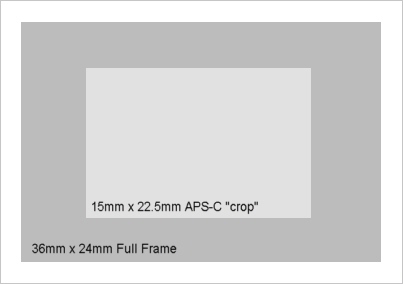
This illustration, borrowed from Bob Atkins' website, shows how an APS-C sensor compares with a 35mm sensor.

crop_sensor.jpg


For any given focal length the 35mm sensor captures a larger part of the scene - the bit that is darker grey. If you are focal length limited and needing to crop then that extra area of the scene is a complete waste. But, having that extra bit of the scene recorded does not in any way reduce the size of your subject in absolute terms. The magnification of the lens did not magically alter simply because the camera had a smaller sensor.

What may make a difference is pixel density and the quality of each of those individual pixels. If you have enough light to make a good quality image then you can chop the image up into smaller pieces (pixels) and then spread them a bit further. i.e. you can enlarge the captured image a bit more. However, if the pixel quality is not so great, due to noise/blur etc. then if you try to press your luck you will see the weakness in the original capture. Good quality captures can be enlarged more than low quality captures. It's that simple. There is no free lunch. The "problem" with small pixels is that people can be over ambitious in their efforts to stretch them too far (viewing at 100%, for example) when the quality was simply not there in the first place.
 
Here is an analysis that shows how apparent IQ compares between several cameras, including the 5D2 and 7D, in scenarios where (a) you can fill the frame; (b) you are focal length limited.....

http://www.clarkvision.com/articles/digital.sensor.performance.summary/

I hope you can make sense of at least some of the data, but if not, the bottom line (if I understand it correctly) is that if you can fill the 5D2's sensor then that will yield the best IQ, but if you are struggling to fill the sensor of even the 7D then the 7D will give the better result.
 
Back
Top