Wide angle lens desgined to be sharp at low f numbers?

Messages
2,443
Name
Stuart
Edit My Images
Yes
Tonight was my first time playing about with 30 second exposures. Then my camera ran out of battery!

The images are pleasing but slightly soft which could be my cheap tripod or the diffraction from the small aperture but I was thinking " who the hell wants a fast landscape lens?"

So are there landscape lenses designed to work well at f22 rather than f2.8? Does anybody review such lenses?

Cheers
Stuart
 
Most lenses are designed to be best around f/8. Performance varies, but normally f/22 looks horribly soft due to diffraction. There are expensive lenses that work well at f/2.8, but not as good as their peak performance. Also, it is time to get spare batteries (ebay ones seem to be pretty good).
 
Do you really need f22?

I suppose it depends what zoom length you're using but if you can hyperfocal you may be able to use an aperture a lot wider than f22 and so cut down on nasty effects.

For example at 20mm and f16 everything from just over 2ft to infinity will be in focus with a hyperfocal point 5ft away, if you use 9ft as the hyperfocal distance everything from a little over 4ft will be in focus at f8.

Do you need f22? Or is the small aperture needed to give you 30 seconds?

Soz if you know all this already.
 
I understand that I could use f16, but it was a windy day and I was photographing the Clyde. I managed to squeeze three shots off before the battery went. the longer the exposure the better it looked.

Cheers Stuart
 
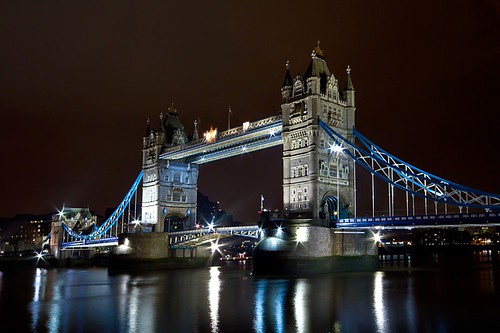
I took a shot of tower bridge at f20 with the sigma 10-20 and I think it came out really sharp, here's the shot and the 100% crop. I printed this to a4 and it is still excellent quality

4284167193_5dbc6e0c98.jpg


4308875528_904ec9c4c3_o.jpg
 
I suppose that this hinges on a few things, zoom length, what you want to be reasonably sharp and any time considerations.

With a night time shot a longer exposure can bring out more colour in the scene and there are many personal decisions to be made but I personally tend to use the widest possible aperture which will give the depth of field I need. For example there's no point having a point two feet from me in sharp focus if there's nothing there and my field of view doesn't include anything closer than 9 feet. Time considerations excepted.
 
Why would a good ND filter degrade an image?

thats what I am asking you, I understand that you do get some amount of image quality loss with an ND filter, obviously the better the filter the less quality loss, but even the best filter must have some amount of image quality loss right?
 
I suppose another question could be what will a 30 second shot get me that 8 seconds wouldn't. Once all things have been considered choices can be made but these things are at least worth thinking about.
 
30 seconds vs 8 seconds would, largely, be a factor of your light-trails if you have traffic in the shot, or smoothing out the movement of water or trees in the wind should there be any.

As for "bringing out more colour" with a longer exposure, I'm unsure if there's any scientific reasoning behind this. The image on the sensor is not the result of a chemical process which would benefit from a longer development time (Smaller crystals, etc etc yadda yadda). For CCD based sensors, long exposures are more problematic due to thermo-electric noise generated by the heating up of the sensor. Unsure if CMOS heats up in the same way as a CCD though, but it might be something worth testing.

One thing that 30 seconds would help with would be averaging out any instantaneous vibration in the shot. If you're not (For some crazy reason) shooting with mirror lockup, then a 30 second exposure will lessen the effect of the mirror vibration across the shot, as the vibration settle-down time will comprise a smaller percentage of the whole exposure.
 
"As for "bringing out more colour" with a longer exposure, I'm unsure if there's any scientific reasoning behind this."

Have you actually done it though? I can't post any examples as I'm at work but I am sure in my own mind that a longer exposure than is absolutely necessary to get a smack in the middle of the scale exposure does bring out, for example, any blue in a night sky (or anything else) which may not be visible to the human eye.

The reason for this is relatively obvious, it takes time for the lower light level to register on the sensor.
 
thats what I am asking you, I understand that you do get some amount of image quality loss with an ND filter, obviously the better the filter the less quality loss, but even the best filter must have some amount of image quality loss right?

Well you can't get back the softness you've lost via diffraction, no amount of sharpening is going to help you. It's highly doubtful an ND filter is going to significantly adversely affect your image, unless you have one made of wobbly mediaeval glass!
 
I think there are a number of issues, first I would consider your tripod, light/flimsy tripods are no good for such long exposures.

I shoot at F22 regularly, and a lot of recognised landscape photographers shoot at these apertures (f16-f22), so it can be done, but, and it's a big but, good glass is needed to achieve this.

As for 'bringing out more colour', I don't understand the science behind it, but you do seem to get more richer colours with a long exposure, the colours seem to build up during the exposure although you sometimes you can get unsightly colour shifts.

I'd keep practicing, get a stable base, shoot at say F11-f16 if your lens is not at the top end, use a cable release (or self timer) and mirror lock-up.

You will get there in the end :)
 
As for "bringing out more colour" with a longer exposure
Generally speaking, lower light levels or faster exposure increase saturation. Try it with a flash. Throw some kind of coloured filter over the front, shoot at full power, then gradually bring it down on each shot. You'll see an increase in saturation as the light goes down. Remember, saturation isn't the same as brightness. More light will obviously produce brighter colours, but not necessarily "more colour". Eventually, no matter how dark, if your exposure is too long for your chosen ISO & aperture, it will still blow out.

woof woof said:
I suppose another question could be what will a 30 second shot get me that 8 seconds wouldn't.
Depending on what you're trying to achieve, longer exposures with ND filters over the front can produce some very neat effects. A cool trick doing this is to help get crowdless streets. On a long exposure like this, if you have a few people walking through your shot, because they're in the same place for such a relatively short space of time, they don't register on the shot.

I did a shot at the Shambles in York like this. Ended up throwing on a 2 stop polariser on (I didn't have an ND filter handy), f/22, ISO100, and ended up going with about a minute exposure. At least a dozen people walked through my shot in that time, but none of them showed up in the final exposure.

I read about somebody doing this back in the film days with about a 20 minute exposure and whole bunch of ND filters, and the results were incredible. I just had to try it out. :)

joescrivens said:
thats what I am asking you, I understand that you do get some amount of image quality loss with an ND filter, obviously the better the filter the less quality loss, but even the best filter must have some amount of image quality loss right?
You pretty much answered your own question. Throwing any extra glass on the end of your lens (even a perfectly clear UV or skylight filter to protect the end lens element) is going to degrade the image quality to a degree. It might not be noticable until you load it up into Photoshop @ 1600% and do a direct comparison of an identical shot without a filter (it may not be noticable to your eye even then), but it will degrade it. How much it degrades depends on the quality of the ND filter, and the reliability of your body. It may degrade the image quality no more than the random fluctuations in your body's sensor anyway.

The long exposures hasn't been something I've had a chance to try out recently, so I'm not sure what the best prices are for really good ones, but I am getting ready to needing some soon, so I'll probably start my quest looking at B+W and Hoya Pro ND filters.

 
Les - "unsightly colour shifts."

Ah, but I'd call it artistic interpretation. :lol:

A relatively short exposure may capture the scene as you see it but a relatively longer exposure can look very nice if not exactly what your eyes saw at the time. That's the great thing with digital, once you take the shot you can review it and if you don't like it you can change something and take the shot again.
 
Generally speaking, lower light levels or faster exposure increase saturation. Try it with a flash. Throw some kind of coloured filter over the front, shoot at full power, then gradually bring it down on each shot. You'll see an increase in saturation as the light goes down. Remember, saturation isn't the same as brightness. More light will obviously produce brighter colours, but not necessarily "more colour". Eventually, no matter how dark, if your exposure is too long for your chosen ISO & aperture, it will still blow out.


Depending on what you're trying to achieve, longer exposures with ND filters over the front can produce some very neat effects. A cool trick doing this is to help get crowdless streets. On a long exposure like this, if you have a few people walking through your shot, because they're in the same place for such a relatively short space of time, they don't register on the shot.

I did a shot at the Shambles in York like this. Ended up throwing on a 2 stop polariser on (I didn't have an ND filter handy), f/22, ISO100, and ended up going with about a minute exposure. At least a dozen people walked through my shot in that time, but none of them showed up in the final exposure.

I read about somebody doing this back in the film days with about a 20 minute exposure and whole bunch of ND filters, and the results were incredible. I just had to try it out. :)


You pretty much answered your own question. Throwing any extra glass on the end of your lens (even a perfectly clear UV or skylight filter to protect the end lens element) is going to degrade the image quality to a degree. It might not be noticable until you load it up into Photoshop @ 1600% and do a direct comparison of an identical shot without a filter (it may not be noticable to your eye even then), but it will degrade it. How much it degrades depends on the quality of the ND filter, and the reliability of your body. It may degrade the image quality no more than the random fluctuations in your body's sensor anyway.

The long exposures hasn't been something I've had a chance to try out recently, so I'm not sure what the best prices are for really good ones, but I am getting ready to needing some soon, so I'll probably start my quest looking at B+W and Hoya Pro ND filters.


cheers, thats what I thought
 
use a cable release (or self timer) and mirror lock-up.
Bump for this, I love my MC-20. With regard to mirror lock-up, in Nikon speak, they call this "Exposure Delay Mode" in the menus (menu D10 on the D300s, I don't recall what it is on my D200). What it does is pop up the mirror, then wait half a second before starting the exposure. This helps to prevent any camera shake from "mirror slap".

Also, make sure to cover the eye piece too. My D200 and D300s came with a little cover that replaces the regular eyepiece on the body to prevent any light getting in via the viewfinder.

With something like a D90, D300s or other liveview body, it's not such a big deal as you can still frame up without the viewfinder, but on something like the D200, it can be a pain sometimes. My old N90s actually has a lever on the back that brings up blades inside the viewfinder to cover the hole and prevent light coming inside.

If whatever body you use doesn't support either of these, you can just tape a piece of cardboard over the viewfinder once you've framed up. Just make sure to test the tape on something else beforehand to make sure it doesn't leave a sticky residue all over your camera. I use Gaffer tape, the proper stuff they use on sets for securing cables, or holding down backdrops, etc. You can get this from pretty much any online theatre or production set supplies company. Don't use cheaper duct tape, this can leave a horrible residue. I wouldn't use masking tape either as its residue leaving properties can vary greatly from one brand to another, and even from one room temperature to another.
 
That's the great thing with digital, once you take the shot you can review it and if you don't like it you can change something and take the shot again.
Definitely. The learning curve might be a lot steeper with digital than it was with film, but it's a lot easier to climb once you start to figure out the process, understand your histogram, etc. (and cheaper too!). :D

Even if it's not what I'm after, I'll shoot so that my raw file contains the maximum tonal range possible. Even if I want the image dark, I'll generally try shoot it to expose for the scene, then darken in post (less noise/grain then, better quality).
 
I shoot at F22 regularly, and a lot of recognised landscape photographers shoot at these apertures (f16-f22), so it can be done, but, and it's a big but, good glass is needed to achieve this.
Les - you have a full frame sensor which suffers less than a cropped sensor.
According to this table, full frame sensors are good for a sharp 8"x11" print using f22.
The large film size in the view cameras preferred by landscape photographers means diffraction is not a problem until HUGE apertures :)
 
Les - you have a full frame sensor which suffers less than a cropped sensor.
According to this table, full frame sensors are good for a sharp 8"x11" print using f22.
The large film size in the view cameras preferred by landscape photographers means diffraction is not a problem until HUGE apertures :)

Yes, I was aware of the difference between cropped/FF sensors :)

My point regarding recognised landscape photographers was in reference to Digital SLR's, in another thread we had a discussion regarding using small apertures, and I referenced a current copy of Amateur Photographer, which had articles featuring Charlie Waite and Adam Burton, in the images accompanying the articles, most of the images (landscapes) were shot between f16 and f22, but they were using good glass and high end (FF) digital cameras.
 
I'm still struggling to see an advantage (other than time and ghost effect / people in frame / light trails as previously mentioned) in using small apertures. If f8-16 gives me a dof of less than 3 feet to infinity what will I gain by using f22? on APS-C anyway, I accept that smaller apertures may be needed for FF.
 
I'm still struggling to see an advantage (other than time and ghost effect / people in frame / light trails as previously mentioned) in using small apertures. If f8-16 gives me a dof of less than 3 feet to infinity what will I gain by using f22? on APS-C anyway, I accept that smaller apertures may be needed for FF.

lol isn't that enough?

thats like saying:

"other than the build quality, acceleration, fuel consumption and style of a VW golf, I fail to see why it is better than a citroen saxo"
 
Well...they are creative choices which might not be used in many shots. All are time related.

Look in any photo mag or on any forum and you'll see examples of extreme small apertures being used for reasons that may be hard to figure out. I think that there may be a school of thought that f-extreme gives some advantage that I can't figure out by looking at the shot.
 
Yes, I was aware of the difference between cropped/FF sensors :)

My point regarding recognised landscape photographers was in reference to Digital SLR's, in another thread we had a discussion regarding using small apertures, and I referenced a current copy of Amateur Photographer, which had articles featuring Charlie Waite and Adam Burton, in the images accompanying the articles, most of the images (landscapes) were shot between f16 and f22, but they were using good glass and high end (FF) digital cameras.

I suspected you were - love your images :)
It seemed an excellent opportunity to quote that link and reinforce that sensor size comes into the image quality equation.
 
Have you actually done it though? I can't post any examples as I'm at work but I am sure in my own mind that a longer exposure than is absolutely necessary to get a smack in the middle of the scale exposure does bring out, for example, any blue in a night sky (or anything else) which may not be visible to the human eye.

The reason for this is relatively obvious, it takes time for the lower light level to register on the sensor.

If I make an exposure of 60 seconds at f11 (ignoring reciprocity failure if on film, sensor linearity if digital, non-linearity of light wavelength response, thermal noise, background noise, changes in ambient conditions, etc.) one would expect the level of light recorded to be the same as an exposure made at 15 seconds at f5.6. Isn't that how the relationship between time and aperture works? To suggest that you would somehow see a different result with a longer exposure would somehow suggest a difference in the rate of influx of light into the camera, or some discrepancy in the ratio between the shutter time and the aperture. That is to say "Some colours are slower than others" :)

Whilst I'm not going to dispute that such timing will not make a difference without testing it for myself, I do seek a physical explanation for a difference in colour / saturation between those two example exposures should one exist.


Generally speaking, lower light levels or faster exposure increase saturation. Try it with a flash. Throw some kind of coloured filter over the front, shoot at full power, then gradually bring it down on each shot. You'll see an increase in saturation as the light goes down. Remember, saturation isn't the same as brightness. More light will obviously produce brighter colours, but not necessarily "more colour". Eventually, no matter how dark, if your exposure is too long for your chosen ISO & aperture, it will still blow out.

I've observed the effect you speak of shooting gel's, and you are quite correct that you have to shoot at lower power levels to achieve "saturation", however I'm unsure if that's simply because when shooting at higher powers what comes through the filter is relatively much brighter than other things in the scene and therefore appears to lack colour.

The test for this is obviously to shoot through a gel at 1/1 power and wind down the aperture to see if one can achieve reasonably saturated colour, or if the 1/1 flash power will always yield washed out colour due to filter material saturation. I suspect one will not be able to, as I have vague memories of fighting this very effect myself, I will test this tonight.

Regardless of the test outcome I'm still lacking a physical reason as to why this is the case. As a crude example if a gel filter has a physical capacity to absorb N photon's worth of light at a specific wavelength, and you throw 2N at it, won't N photon's worth of unfiltered light get through ? If that's the case then what you're seeing in your image is 50% blue light, and 50% white light. I lack sufficient physics knowledge to be able to explain it at that level, but would very much like for someone to chime in because I much prefer to understand fundamentals than to live with "That's just how it is" :)

Anyone up on their optical physics?
 
If I make an exposure of 60 seconds at f11 (ignoring reciprocity failure if on film, sensor linearity if digital, non-linearity of light wavelength response, thermal noise, background noise, changes in ambient conditions, etc.)
FYI - Some cameras seem to be more linear than others
My 20D suffered a kind of reciprocity failure that needed to be taken into consideration with exposures over approx 20s.
Longest exposure I've done with the 5DII is 11mins and it appeared to be nicely linear.
 
"To suggest that you would somehow see a different result with a longer exposure would somehow suggest a difference in the rate of influx of light into the camera, or some discrepancy in the ratio between the shutter time and the aperture. That is to say "Some colours are slower than others" "

It's an interesting question and I don't think that I know the answer.

I've never tried long exposure shots with film so I don't know what the effect would be but it would be interesting to know if the same happens with film and if not why not.

I had just assumed that the fact that more colour is brought out in night shots by leaving the shutter open longer was just due to the light from the dim / invisible to the eye colour part of the image to have more time to register.

All I know is that with digital I can take a shot which will pretty accurately record what I see with my own eyes or I can take a longer exposure shot in which any residual colour will be more prominent, perhaps even to the undesirable colour shifts that Les mentioned.

Anyone know?????? Answers on a postcard please. :)
 
All I know is that with digital I can take a shot which will pretty accurately record what I see with my own eyes or I can take a longer exposure shot in which any residual colour will be more prominent

If you don't adjust the aperture, sure.

Theoretically, you'd get the exact same image going from 1 second @ f/2 as you would with 64 seconds @ f/16 with a constant ISO. The only difference would be the depth of field, and anything that moved within the scene during the duration of the exposure (people, clouds, vehicles, etc).
 
All I know is that with digital I can take a shot which will pretty accurately record what I see with my own eyes or I can take a longer exposure shot in which any residual colour will be more prominent, perhaps even to the undesirable colour shifts that Les mentioned.

Anyone know?????? Answers on a postcard please. :)

Well your eye is an "instantaneous" device, as it were. It's recording light as it happens *now* (Approximately 25fps, but that's a wildly speculative and not really correct measure). Therefore at night or dusk, there's a finite amount of light available in that 1/25th second window (Don't forget, the human eye has adjustable ISO :D )

A camera, however, can be recording light over a much longer period, "building up" the light level, as it were. That's how you appear to get more colour than your eye can see, because in the instantaneous 'now' of the human eye, you can't actually see it, it's too dim.

The query I had was the contention that f5.6@15s would somehow look different in terms of colour/brightness to f11@60s (Assuming linearity, noise, spherical cows, etc).

I'm interested to test the flash gel thing also to see if I can resolve anything, though I have to paint a doorframe first. Damn the mundane! Hopefully I shall have time.
 
"The query I had was the contention that f5.6@15s would somehow look different in terms of colour/brightness to f11@60s (Assuming linearity, noise, spherical cows, etc)."

As the shutter would be open for different lengths of time maybe they would look different, at least in a night time shot as that's how we got into all this.

I don't think that we really need to understand the physics behind this, all we need to do is recognise what seems to be a fact, as I originally said - you can "bring out" more colour (if there's any there) in a night time shot with a longer exposure.
 
I don't think that we really need to understand the physics behind this, all we need to do is recognise what seems to be a fact, as I originally said - you can "bring out" more colour (if there's any there) in a night time shot with a longer exposure.

Please show me some evidence of this "fact". I'm not trying to dispute your claim, I just have never experienced it myself.

Whether we need to understand the underlying physics behind it or not, I'd like to see visual results... and then I'd like to go research the underlying physics behind it. :)
 
There is no truth in the theory that longer exposure times, in themselves, somehow increase colour. They don't. Digital sensors don't behave like that, they have good reciprocity in that sense. Film is entirely different.

However, different exposure levels do produce quite dramatically different results, depending on where each particular tone sits on the histogram. The further to the right they are, the more accurate and pure they will be. Digital sensors are not linear (they are not technically digital!) and there is far more data recorded in the highlight end. This is one of the reasons to 'expose to the right'.

The other thing that happens at the low end is noise, which has a big impact. I'm guessing that the different ways cameras process noise could also be a contributor.

Back to the OP, diffraction is the factor limiting sharpness at higher f/numbers. It is an optical problem unrelated to lens design or manufacture - it's caused by the phyisical size of the lens aperture in relation to format. In practise, with crop format cameras it can be detected at f/numbers higher than f/5.6, and around f/8 on full frame. However, it doesn't get really bad until f/11 or so. It is pretty terrible at f/22 on a crop camera and there is nothing you can do about it, other than use a lower f/number with an ND filter.

The problem with all filters is not really sharpness, but flare. Uncoated filters are bad for this, coated filters are much better and multicoated ones are quite hard to provoke into serious image degradation, although it can be done if you try.

I have had one an issue with using ND filters on a super-wide lens (Canon 10-22) and that is optical vignetting - not to be confused with mechanical vignetting which is when the filter ring itself intrudes into the corners of the picture.

This optical vignetting is because at very wide field of view the lens is looking out of the sides of the filter at an angle, so the light has to pass through a greater thickness of glass. It is quite marked, but easily corrected in software. TBH, a little bit of vignetting often looks quite nice ;)
 
Cheers for all the reply guys. This is an interesting thread.

The only truth I can think of regrading long exposure bringing more colour would be if the digital camera had a week IR filter and you where observing a bleed though of IR light over time? Probably the blue filter as it is closest to IR.

Stuart
 
Kaouthia, all I can say is what works for me, and at least Les reports something similar so it's not just my camera or technique. If you don't believe me then there's no need for me to prove the "fact" just go and try it for yourself. If you shoot digital a little experimentation wont cost you anything but time.

Have a nice day.
 
Kaouthia, all I can say is what works for me, and at least Les reports something similar so it's not just my camera or technique. If you don't believe me then there's no need for me to prove the "fact" just go and try it for yourself.

I have in the past, and as I said, 1 second @ f/2 shouldn't be any different to 60 seconds @ f/16, except for your depth of field and objects moving within the scene, with all else being equal. Same with your example of 15 seconds @ f/5.6 vs 60 seconds @ f/11.

This isn't the same as "exposing to the right" in order to help prevent noise in the darker areas. I often expose to the right, and then darken back down in post. That's just increasing the shutter speed, without changing aperture, to allow in more light.

So, please show me some examples. Obviously my experiments aren't giving the same results as yours, and I'm not quite sure what I should be expecting to see.
 
Back
Top