Width of Field

Messages
865
Name
Anand
Edit My Images
Yes
Hi all,

Back to basics :)

As usual not sure if this question sounds stupid, but I would rather ask..

Just wanted to know is there a relationship between width of a field (hope that's the right terminology) and the following in a normal lens (not wide angle lens) -

1. Aperture size
2. Focal length
3. and Distance (I guess with distance greater the distace greater would be the field of view?)

But not sure about first two...?

A related question to that would be, if am clicking a group shot with people spread out horizontally - what should be my ideal settings?

Thanks in advance.
 
I'm not sure what you mean by 'width of field'.

If it's field of view, otherwise known as angle of view, that is defined by a) focal length, and b) the size of the sensor.

The angle of view remains constant, but obviously the field gets large with distance. F/number has no effect.
 
I'm not sure what you mean by 'width of field'.

If it's field of view, otherwise known as angle of view, that is defined by a) focal length, and b) the size of the sensor.

The angle of view remains constant, but obviously the field gets large with distance. F/number has no effect.

depth if field I think he means

Thanks Richard...Sorry, Yes I did mean field of view...

So aperture has no effect on field of view..but unsure what you meant by "angle of view, that is defined....." how is field of view related to focal length and sensor size (I mean are they directly or inversely related)

Also, if I am clicking a horizontal group shot what should be my lens setting and focus point to get maximum sharpness across?

Thanks..I am sorry if I am sounding a bit daft.
 
I'm confused now.

Do you mean field of view (angle of view) which is how much you get in the picture side to side. Or depth of field, which is how much of the subject is in sharp focus, front to back.

Or possibly both :thinking:
 
HoppyUK said:
I'm confused now.

Do you mean field of view (angle of view) which is how much you get in the picture side to side. Or depth of field, which is how much of the subject is in sharp focus, front to back.

Or possibly both :thinking:

Field of view (angle of view) definitely..do understand DoF...

I'll try and explain the example above if it helps..

In a group shot of say 8-10 people spread more or less horizontally in a line, let's say I use an aperture size of 5.6 and focus on the centre person, would i get all people next to him sharper, or will they be slightly less sharp?

Hope I am making sense this time...???
 
If you focus on a subject say 4m away, then everything else 4m away will also be in focus, regardless of where it is in the frame.

If you have a line of people side by side, then those at the end of the line will be slightly further away, and may not be properly sharp if they are not within the zone of depth of field.
 
Refering to 5.6 you are really asking Depth Of Field not field of view. If they are more or less on a horizontal line or on the same 'focal plane' then they should be equally sharp (more or less)

On that link, you can see where the focal plane is, and the near and far limits of the depth of field.
 
Thanks Richard - that kind of answers my question..everything at 4m will be in foucus..

HoppyUK said:
If you have a line of people side by side, then those at the end of the line will be slightly further away, and may not be properly sharp if they are not within the zone of depth of field.

Not sure about this though..so are we saying DoF and field of view are related..if that's the case surely f/number and focal length should have influence...can I also please clarify zone of DoF..thought DoF is always front to back or vice-versa??
 
AndyB1976 said:
Refering to 5.6 you are really asking Depth Of Field not field of view. If they are more or less on a horizontal line or on the same 'focal plane' then they should be equally sharp (more or less)

On that link, you can see where the focal plane is, and the near and far limits of the depth of field.

Thanks Andy...will check it..:-)
 
If you focus on a subject say 4m away, then everything else 4m away will also be in focus, regardless of where it is in the frame.

If you have a line of people side by side, then those at the end of the line will be slightly further away, and may not be properly sharp if they are not within the zone of depth of field.

Agreed

Imagine a length of string stretched between the end of the camera and the person in the middle of the straight row or people.

Imagine moving that length of string (still attached to your camera) towards the end person in the row and it wouldn't reach.

The middle person might be 5 meters away yet the people on either end might be 6 meters away.

For ALL of them sharp you would want an aperture setting that allowed 1m of depth to be in focus or arrange your line of people in a curve.
 
Last edited:
depth if field I think he means
Thanks Richard...Sorry, Yes I did mean field of view...

:lol:

does he mean Plain of focus, a term I only saw once on a diagram?

Sorry, I shouldn't laugh ;)

As a newbie, I'm beginning to get frustrated with the limitations of my D200 and 18-70mm lens.
Whenever I read about achieving what I percieve to be great shots, I see that I would need to pay out a small fortune for other kit :bang:
Right now, I'm weighing up the pros and cons for paying £16.99 at Lidl for their tripod, that looks remarkably similar to the Hama Star 61 - flimsy bit of kit I know, but might just keep me interested a while longer.
 
Last edited:
A tripod costing £16.99 is going to be no use whatsoever! It's a toy I'm afraid.
 
Right now, I'm weighing up the pros and cons for paying £16.99 at Lidl for their tripod, that looks remarkably similar to the Hama Star 61 - flimsy bit of kit I know, but might just keep me interested a while longer.

It is the Hama Star tripod, rebadged.. most Aldi/Lidl "specials" are rebranded items produced by better known manufacturers.

It's ok as a kickabout tripod to keep in the boot, or to think of as a disposable tripod. But you'd be better off paying a bit more, around £40 will get a better built secondhand Velbon.
 
...
 
A tripod costing £16.99 is going to be no use whatsoever! It's a toy I'm afraid.
It's ok as a kickabout tripod to keep in the boot, or to think of as a disposable tripod. But you'd be better off paying a bit more, around £40 will get a better built secondhand Velbon.
If i could get my hands on a good second hand tripod for £40 (or even just the legs as I've got a Calumet pistol grip kicking about somewhere) I'd take it.
Just having a toy to kick about for the time being, till I'm working fulltime again, might have to do.
The Redsnapper special offer has been tempting, but with the £15 delivery, I just cant do it right now.

Anyway, back to you ShutterWork ;)
 
I picked up a used Velbon Delta with pan-tilt head for £40 from a binocular/fieldscope dealer.. the Velbon is now surplus to requirements, but too bulky to be worth posting.

You don't say where you are new2me, but I could point you in the right direction if you did.
 
Agreed

Imagine a length of string stretched between the end of the camera and the person in the middle of the straight row or people.

Imagine moving that length of string (still attached to your camera) towards the end person in the row and it wouldn't reach.

The middle person might be 5 meters away yet the people on either end might be 6 meters away.

For ALL of them sharp you would want an aperture setting that allowed 1m of depth to be in focus or arrange your line of people in a curve.
I don't think that's correct as the string would form an arc. The way I understand it everything 4 metres away within the frame parallel to the sensor will be in focus.
 
I don't think that's correct as the string would form an arc. The way I understand it everything 4 metres away within the frame parallel to the sensor will be in focus.

That's exactly what he's saying. You're misreading it.
 
Sixtoes is the only person to have mentioned parallell to the sensor, as I read it Richard both yourself and Phil are clearly describing to an arc of 4m radius from the midpoint of the sensor which is very different to a plane 4m from and running parellel to the sensor. Simple geometry tells us that such a plane will be further from the camera the further you move along it.

You'd need a length of elastic, rather than a piece of string.


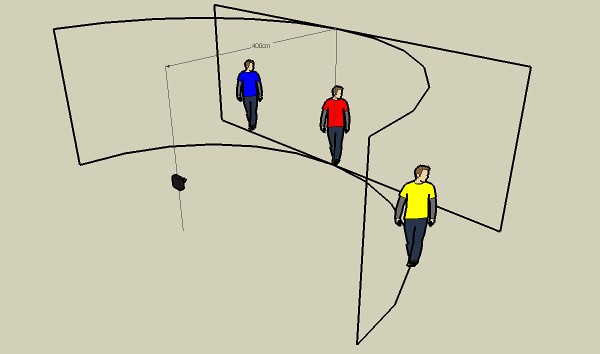
Red and Blue are in the same plane parallel to the plane of the sensor, but are different distances from the camera.

Red and Yellow are the same distance from the camera, but are in a different plane relative to the sensor.
 
All those years ago when we used to have school pictures taken we used to sit on benches arranged in a curve and the photographer had his camera on a pivot and swung it through a curve starting at one end and finishing at the other. We were all the same distance from the camera, but the smart ar$es amongst us managed to get on both ends of the picture by running behind the rest of the school!!
 
:lol:

does he mean Plain of focus, a term I only saw once on a diagram?

Sorry, I shouldn't laugh ;)

As a newbie, I'm beginning to get frustrated with the limitations of my D200 and 18-70mm lens.
Whenever I read about achieving what I percieve to be great shots, I see that I would need to pay out a small fortune for other kit :bang:
Right now, I'm weighing up the pros and cons for paying £16.99 at Lidl for their tripod, that looks remarkably similar to the Hama Star 61 - flimsy bit of kit I know, but might just keep me interested a while longer.

Yes I meant 'Plane' of focus ;), lol

Going a bit tangent, I have got a Hama Star (I think 63)..got it from Amazon for £13.00...Though I agree it's not robust, it kind of does the job for an amateur like me..no doubt I would like to try better ones to tell the difference..


Agreed

Imagine a length of string stretched between the end of the camera and the person in the middle of the straight row or people.

Imagine moving that length of string (still attached to your camera) towards the end person in the row and it wouldn't reach.

The middle person might be 5 meters away yet the people on either end might be 6 meters away.

For ALL of them sharp you would want an aperture setting that allowed 1m of depth to be in focus or arrange your line of people in a curve.


Red and Blue are in the same plane parallel to the plane of the sensor, but are different distances from the camera.

Red and Yellow are the same distance from the camera, but are in a different plane relative to the sensor.

All those years ago when we used to have school pictures taken we used to sit on benches arranged in a curve and the photographer had his camera on a pivot and swung it through a curve starting at one end and finishing at the other. We were all the same distance from the camera, but the smart ar$es amongst us managed to get on both ends of the picture by running behind the rest of the school!!

Thanks Phil, Alastair, and Mickledore..To be honest I am slightly confused now...Phil and Mickledore are suggesting in order to get a sharp image throughout, the group would have to be curved in order to maintain same individual distances from the camera...but on the other hand Alastair feels the curved group will not be in the same focal plan (as not parallel to sensor) and therefore people in the periphery may not be as sharp as the centre ones...???? Have I got this right :thinking:..thanks.
 
Last edited:
Unless I've misunderstood a fundamental, everything at the distance you've focused on in the plane parallel to the sensor will be in focus.

So in Alastair's image if you focused on Mr. Red, then Mr. Blue will also be in focus. If your aperture is small Mr. Yellow will be out of focus.
 
Unless I've misunderstood a fundamental, everything at the distance you've focused on in the plane parallel to the sensor will be in focus.

So in Alastair's image if you focused on Mr. Red, then Mr. Blue will also be in focus. If your aperture is small Mr. Yellow will be out of focus.

Thanks SixToes...would be interesting to hear from others as well...I do get your point and see the sense in it - , 'parallel to the sensor'
 
Unless I've misunderstood a fundamental, everything at the distance you've focused on in the plane parallel to the sensor will be in focus.

So in Alastair's image if you focused on Mr. Red, then Mr. Blue will also be in focus. If your aperture is small Mr. Yellow will be out of focus.

Yes, that's right. And my earlier post above suggesting the ends of the line would be out of focus is technically wrong, even though they are at a greater distance form the lens.

All normal lenses are rectilinear (everything except fish-eyes) and corrected for distortion and field flatness. In that sense they change the rules for depth of field a bit, but in practise you would have to be very close, with a very wide lens and a very low f/number for it to make much difference either way.

However, there is a more real problem when shooting groups like that because many lenses (especially wide angles) are less sharp at the edges due to aberrations, particularly at low f/numbers. Move back, increase focal length, keep important subjects away from the edges as far as possible, and use a higher f/number to clear up aberrations.
 
Think of two Parallel curved lines - one closer to the camera and one further away.

Depending on the aperture size (depth of field) these curved lines can be closer or further apart. The nearest curve is where acceptable sharpness begins and the farthest where it runs out.

If they're far enough apart - you can have a straight line between them.
 
Last edited:
Think of two Parallel curved lines - one closer to the camera and one further away.

Depending on the aperture size (depth of field) these curved lines can be closer or further apart. The nearest curve is where acceptable sharpness begins and the farthest where it runs out.

If they're far enough apart - you can have a straight line between them.

That's not how it works with a rectilinear lens. The plane of focus is flat - the natural field curvature is flatened - and runs parallel to the sensor. Magnification remains constant, and does not change in direct relationship to distance in the normal way.

Example - photograph the bathroom or kitchen tiles, square on, at closest distance with a wide-angle. The lens is much closer to the tiles in the middle than those at the sides, yet they are all reproduced exactly the same size.

It's largely a hypothetical issue, only having significance with very wide lenses, at close distance, and a low f/number - a rare situation.

Wide-angles play tricks with DoF around the edges. They also do funny things in the vertical and horizontal planes, because the aperture is an elipse when viewed from the side - it has different radial and tangential dimensions.
 
ShutterWork, this looks like one of those subjects that depends on what gear you have.

I suggest you set up an experiment to see for yourself ... mount your camera on the tripod and set some chairs or something out as in the diagrams. Shoot at different apertures and see what happens :thumbs:

It's all new to me too ;)
 
If we all agree.. then I'll tidy up the diagram and maybe someone can put some words to go with it and we can stick up up as a guide somewhere.

Richard mentions "beware of low" f-numbers with wide angle lenses.. equally, beware of high f-numbers with ultra-wide angle lenses. The workhorse Sigma 10-20 is well known for being soft when closed up.. but when you take the trouble to look up the depth of field available f9-16 you'll find you rarely need to stray outside of this zone.
 
Hello all,

Thanks a ton for loads of input on this question.

Glad we all agree that on a normal lens and in most situations everything lying in line with the focal plane would be sharp irrespective of their distances...Thanks for making me understand.. (Must say Alastair's diagram was an eye-opener for me...would have taken ages to understand if not). I am not even going anywhere close to a wide angle lens at the minute..;)

So just to summarise and to refer back to my OP - Focal plane (or width of angle as I have posted wrongly) is NOT influenced by aperture size, focal length, nor distance..The only influencing factor seems to be our point of focus which determines Focal Plane..Hope I have go this right..

@ Alastair - I do agree with posting the diagram as a sticky guide for dummies like me ;)...I am sure some experts here on TP may be happy to put some words in the guide as I feel I am far too novice and under-qualified in this area

@ new2me - Yes, probably you're right..will definitely do some field-work this weekend.

Once again thank you all for being patient teachers :)
 
I think it would make rather a confusing sticky, and covers a fairly hyothetical point, given that it would only ever apply in exceptional circumstances and 99% of the time would, in practise, be covered by depth of field anyway. The diagram posted earlier is exagerated to make the point - you never get angles like that in practise. Look at Mr Yellow - you'd need a fish-eye just to get him in the frame!

Having checked some figures and done a few tests, basically only subjects at the extreme edges of the frame, shot at close distance with a wide-angle at a very low f/number - like below f/2. And in that circumstance, depth of field is likely to be the least of your worries compared to all the lens aberrations going on.

It's also confusing because of the mixed terminology. It is the image or sensor plane that is usually referred to as the focal plane (as in 'focal plane shutter') whereas what is being dicussed here is the subject plane.
 
Last edited:
I think it would make rather a confusing sticky, and covers a fairly hyothetical point, given that it would only ever apply in exceptional circumstances and 99% of the time would, in practise, be covered by depth of field anyway. The diagram posted earlier is exagerated to make the point - you never get angles like that in practise. Look at Mr Yellow - you'd need a fish-eye just to get him in the frame!

Having checked some figures and done a few tests, basically only subjects at the extreme edges of the frame, shot at close distance with a wide-angle at a very low f/number - like below f/2. And in that circumstance, depth of field is likely to be the least of your worries compared to all the lens aberrations going on.

It's also confusing because of the mixed terminology. It is the image or sensor plane that is usually referred to as the focal plane (as in 'focal plane shutter') whereas what is being dicussed here is the subject plane.

That's fine Richard...We'll leave it as it is then if it's going to be confusing...once again, thanks a lot though..much appreciated.
 
Back
Top