Will This Work ?

Messages
3,540
Name
Wayne
Edit My Images
No
Poor mans Zone system

camera in auto with spot meter selected
take a reading of highlight and dark region
Calculate stop difference in scene
Switch to manual and select middle of the road for shutter speed.

I am quite pleased with myself for coming up with this.

I can see this being a bit more effective for very shady scenes. I think It is a step towards understanding the Zone system and implementing it.
 
Yes, but why not just meter from a mid tone in the first place? AKA zone 5

I am not experienced enough to confidently identify the midtone,

I have not even considered the luminance range of the scene before, always just used my incident meter, so seems a massive step forward for me.
 
just used my incident meter, so seems a massive step forward for me.

I will admit, I sometimes just meter from the pavement, grass or the palm of my hand ..... :ROFLMAO:
Indeed, I would use incident meter if I wasn't sure of the reflective accuracy. Otherwise, what he said or a grey card of course or a khaki Billingham bag.
If one side of the street is in sun and the other shade I take a reading from a mid tone in the sun if I want to see the sunny side of the street or off the shady side if that is the side that holds my interest.
 
Why select spot metering? The other metering modes already bias/average the exposure in some way. And no, it won't work; the Zone System is not (and never was) just about metering/exposure... theoretically, metering the exposure as you are suggesting could cause both the shadows and the highlight to clip.

To use the zone system:
  1. Meter the darkest region where you want to retain detail... the metered reading will place it in zone 5.
  2. Decide what zone you want it to be in instead, say it's zone 3 (visible detail).
  3. Shift the metered exposure towards underexposure as required (2 stops).
  4. Take picture.
  5. Meter the brightest area you want to retain; note the difference from the shadow exposure.
  6. If those highlights meter 3 stops higher, they would fall in zone 6.
  7. If you want the highlight to be in zone 7 instead, push the development 1 stops.
  8. If highlights metered above the desired zone you would pull the development time instead.
By doing this you decide which parts of the scene records as black/white (with detail), and the available tonal/dynamic range is then spread between those in the print. There are really only 5 zones that provide good detail (3-7)... which is probably why most camera meter scales only show 5 stops (middle, +/-2). If you are not doing all of that you are not using the zone system, just forget about it... people who purport that they are using the zone system with their metering are just wrong (I've seen the explanations/videos/etc).

What you can, and should do is adjust the metered exposure so that your subject is properly exposed. I.e. your subject is a black bird... it should be exposed about 2 stops below middle. If you are not pushing/pulling/dodging/burning then you can't do anything about the other parts of the exposure/image.
 
Last edited:
Thanks for advice and tips guys. Its the first time I have thought about this and did not wake up this morning an expert.

I have just shot half a dozen test shots, see if my middle guess ends up middle.
 
I am not experienced enough to confidently identify the midtone,

I have not even considered the luminance range of the scene before, always just used my incident meter, so seems a massive step forward for me.
I'm not convinced that it's easier to identify an appropriate shadow and highlight area than it is to identify a zone V area.

And there is no reason to assume that the mid-point between the two will give an appropriate exposure. This is going to depend on how far apart the highlight and shadow readings are AND where, within that range you want to have subject detail.

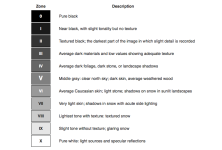
This is how Adams describes the zones

1779551224725.png

Bear in mind that while Zone X represents pure white on the print, in terms of meter readings in the field it might be 10, 11, 12, 13.... stops brighter than Zone 0. So the mid point may or may not be, anywhere near Zone V.

There are various ways to meter using the zone system, but the starting point is to select the part of the subject that you consider the most important for exposure.

So, for example, measuring a Caucasian flesh tone, which Adams suggests should be Zone VI on the print, then giving 1stop more than the meter says, ie 1 stop more than needed for a Zone V exposure.

Once you have decided on the exposure, you can then take meter readings from other areas in the scene to see where they will "fall" on the zone system at that exposure.

Depending on where these other Zones fall, you need to start making decisions,on how you deal with it. Accept the initial exposure decision, bias the exposure towards the shadows or highlights, or use colour filters, or adjust development times or the developer used.
 
I'm not convinced that it's easier to identify an appropriate shadow and highlight area than it is to identify a zone V area.

And there is no reason to assume that the mid-point between the two will give an appropriate exposure. This is going to depend on how far apart the highlight and shadow readings are AND where, within that range you want to have subject detail.

This is how Adams describes the zones

View attachment 483036

Bear in mind that while Zone X represents pure white on the print, in terms of meter readings in the field it might be 10, 11, 12, 13.... stops brighter than Zone 0. So the mid point may or may not be, anywhere near Zone V.

There are various ways to meter using the zone system, but the starting point is to select the part of the subject that you consider the most important for exposure.

So, for example, measuring a Caucasian flesh tone, which Adams suggests should be Zone VI on the print, then giving 1stop more than the meter says, ie 1 stop more than needed for a Zone V exposure.

Once you have decided on the exposure, you can then take meter readings from other areas in the scene to see where they will "fall" on the zone system at that exposure.

Depending on where these other Zones fall, you need to start making decisions,on how you deal with it. Accept the initial exposure decision, bias the exposure towards the shadows or highlights, or use colour filters, or adjust development times or the developer used.

Thanks for that, I had not considered that the highlight could be above X.

I will rethink it until I get it. The way you explain it makes it seem simple.
 
If I remember correctly this was targeted towards printing on fixed contrast paper. MG paper removes some of the problems and scanning even more so, always good to experiment though if you are enjoying it, I went crazy testing so now follow - I lost detail then expose more, my whites are all off - change dev next time
 
If I remember correctly this was targeted towards printing on fixed contrast paper. MG paper removes some of the problems and scanning even more so, always good to experiment though if you are enjoying it, I went crazy testing so now follow - I lost detail then expose more, my whites are all off - change dev next time
The fixed contrast paper still came in multiple contrast grades, and you would work in producing negatives with an optimum contrast for a Grade 2 paper (or whatever you decided upon). A grade 2 with one paper maker, might not have the same contrast as a grade 2 paper from another maker.

And then refine the contrast, by changing paper grade (grade 0 to grade 5, but not all papers were available in all grades).

Even fully implemented, the Zone system was never an "exact" science: not that any science is "exact", but that is a discussion for another day :-)
 
I've experimented with spot metering. I have reservations. I still meter the palm of my hand and give one stop more. It's been accurate enough for me for 60 years, and I don't see any need to change. But then, I'm very conservative - one developer, one or two films, one developing time for the films. It just means I always know what I'm going to get; experiments are almost by definition capable of giving unexpected results - although many dismiss unexpected results as experimental error if they go against the theory.
 
I've experimented with spot metering. I have reservations. I still meter the palm of my hand and give one stop more. It's been accurate enough for me for 60 years, and I don't see any need to change. But then, I'm very conservative - one developer, one or two films, one developing time for the films. It just means I always know what I'm going to get; experiments are almost by definition capable of giving unexpected results - although many dismiss unexpected results as experimental error if they go against the theory.
My every day exposure leaned heavily on incident metering, but like you, and all the professionals I knew, apart from the occasional experiment, I also stuck with the same couple of film types and one developer.

But "learning" the zone system gave me insights into exposure and development that I would never have achieved without spending the time on it.
 
I think the main thing to learn from the zone system is that how something meters, and how it appears to you at the moment, are not reality. I.e. something that is middle gray can appear/record anywhere from black to white based upon how much light it is reflecting, and how long the exposure is. And if it can appear as any tonal value based upon the intensity of light falling on it, and all of those tones can be "real," then the only thing that really matters is how you want it to appear in the photograph you are making.

I.e. photography as an art is not documentary, it is not about recording what you see... it is about timing and manipulating the exposures (light/duration/etc/etc) in order to generate the image you want to create. And that is one of the reasons Ansel (and the Zone technique) became famous; because he was one of the first to create images and not simply document what he saw. E.g. in some images the sky is unnaturally dark because he used a red color filter. He believed an image is created; not taken... and he helped establish (some) photography as an accepted fine art form.

There are certainly other areas of photography that I don't think qualify as art perse... those other areas are where I am strongest, because I am more of a technician than I am an artist (but I do try).
 
Last edited:
Why select spot metering? The other metering modes already bias/average the exposure in some way. And no, it won't work; the Zone System is not (and never was) just about metering/exposure... theoretically, metering the exposure as you are suggesting could cause both the shadows and the highlight to clip.

To use the zone system:
  1. Meter the darkest region where you want to retain detail... the metered reading will place it in zone 5.
  2. Decide what zone you want it to be in instead, say it's zone 3 (visible detail).
  3. Shift the metered exposure towards underexposure as required (2 stops).
  4. Take picture.
  5. Meter the brightest area you want to retain; note the difference from the shadow exposure.
  6. If those highlights meter 3 stops higher, they would fall in zone 6.
  7. If you want the highlight to be in zone 7 instead, push the development 1 stops.
  8. If highlights metered above the desired zone you would pull the development time instead.
By doing this you decide which parts of the scene records as black/white (with detail), and the available tonal/dynamic range is then spread between those in the print. There are really only 5 zones that provide good detail (3-7)... which is probably why most camera meter scales only show 5 stops (middle, +/-2). If you are not doing all of that you are not using the zone system, just forget about it... people who purport that they are using the zone system with their metering are just wrong (I've seen the explanations/videos/etc).

What you can, and should do is adjust the metered exposure so that your subject is properly exposed. I.e. your subject is a black bird... it should be exposed about 2 stops below middle. If you are not pushing/pulling/dodging/burning then you can't do anything about the other parts of the exposure/image.

There is a lot of information there Steve, thanks.

I had been wondering a couple of things and was reading through the thread again, when we are moving the exposure times up and down will the whole roll have to have the same treatment ? It strikes me that we wont be able to mix and match on the roll. I suppose for 4x5 exposures we could get by making individual notes.
 
If it's just exposure, you can do whatever you want as many different ways as you like on the same roll. If it's developing times, then everything gets the same treatment, appropriate or not.

Paraphrasing my book, if you photograph a step wedge, by adjusting the exposure, you can make the blackest square a pure white or the whitest square a pure black. By adjusting the developing time (since that affects the contrast) you can produce as many tones as you like, from 2 upwards. Or, in the case of long development and over exposure, just 1.

Not many people find photographing stop wedges creative, although I expect there's a market for the photos somewhere. On the other hand, if you prefer to master the smallest details, and prefer that to actually producing photographs...
 
Last edited:
There is a lot of information there Steve, thanks.

I had been wondering a couple of things and was reading through the thread again, when we are moving the exposure times up and down will the whole roll have to have the same treatment ? It strikes me that we wont be able to mix and match on the roll. I suppose for 4x5 exposures we could get by making individual notes.
With roll film cameras, many came with interchangeable film magazines, so you could keep one magazine for say+2 development and another for -2 (or whatever you wanted). You could do the same with 35mm bodies, and just change lenses between bodies.
 
With roll film cameras, many came with interchangeable film magazines, so you could keep one magazine for say+2 development and another for -2 (or whatever you wanted). You could do the same with 35mm bodies, and just change lenses between bodies.
I suppose you could also make note of the last exposed frame and then rewind/reload a roll (with enough care), or even cut a roll into segments for separate development...
But yeah, I guess that's a major reason why the zone system is more of a historical note rather than common practice.
 
Back
Top