- Messages
- 3,631
- Name
- Wayne
- Edit My Images
- No
I am sure that you enjoy photography, far more than I ever could.OK a harsh but pertinent comment, just stop shooting multiple formats for a short spell. You bare flailing around getting nowhere, you are just wasting time and film, and money, with no improvements.
You have to go right back to the basics of using film, it really is not difficult. At the moment it's like you are trying to sprint before you have barely learnt to walk, and you are just constantly falling over, helplessly.
Use a 35mm camera, really nail exposure, effective EI, and development, tightly, you can quickly see a huge increase in image quality. It's a no-brainer.
Ian
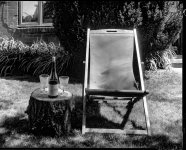
so if I had been considering the zone system instead of, how do i work this effing thing I should have exposed for the dark areas and knocked the development time right down.Just making sure, but underexposure in my comment was about lack of shadow detail, not how light or dark the image is. To my eyes the right hand side of the chair is the brightest detail, so it could come down to the antihalation backing of the film.
Based solely on how the image appears on my tablet, which isn't calibrated in any shape or form, I'd say that most of your results show underexposure and overdevelopment. This subject doesn't look tricky at all to me. And I never consider the zone system, as it doesn't help me. It could possibly solve problems I've never encountered, but at the expense of complicating my working methods. Rather as I know about the dangers about going into cellars in Cornwall, but it doesn't impact on what I do.
In your shoes at this scene, I'd have put the pslm of my hand in the sunlight, taken an incident reading from it, opened up one stop, exposed my FP4 at 80 (not 125) and developed in Rodinal 1:50 for the time in the massive development chart. Mainly because everything I photograph works fine with this method.
Indeed there are so many new things to think about with large format many of which can cause a total loss of image, I think that you have done well for a first 54.I have just tried that with digital camera using my meter as the guide and manual settings on the camera, the histogram was perfect.
Now that I am confident that I have not ballsed up the loading of the film into the dark slides (no mean feat) I will have another go tonight.
Despite the result not being perfect I am pleased with my first effort, I made a couple of lens boards, replaced a defective shutter and swapped over the lens, loaded the film correctly, figured out how to view and adjust focus on the screen of an upside down image and then adjusted all my chemistry to huge quantities and I actually got a picture!
Success !
There is a lot that can go wrong at each stage.![]()
How much dodging and burning are you doing when you make the print or on the scanned file before posting?so if I had been considering the zone system instead of, how do i work this effing thing I should have exposed for the dark areas and knocked the development time right down.
I deliberately chose a tricky scene so that I would learn more
Yes. You could use holders with no film in them, as some unnamed person did this weekend..There is a lot that can go wrong at each stage.![]()
Yes. You could use holders with no film in them, as some unnamed person did this weekend..
How much dodging and burning are you doing when you make the print or on the scanned file before posting?
Rather than going for perfection in the neg, I would go for a flatter neg, and bring the contrast back during the printing.
As I posted before, although I did use the zone system, a lot of the time, I just used an incident reading (Weston Master or Gossen Lunasix ), to get the equivalent of meter reading from a Zone V, and then bumped the exposure up or down a stop depending on the characteristics of the subject.
i.e if it was portrait, I would give a stop more than the meter said.
What would maybe have been useful in this picture would have been a spot reading from the highlight on the chair to see what zone that was going to fall on, at the exposure you chose to use
Which books have you read about the Zone system.
I've already suggested Ansel Adams Trilogy but the other "classic" texts from the time which gave step by step instructions were
The Zone System Manual by Minor White (1967) but with several printings.
The New Zone System Manual by White, Zakia and Lorenz (1976) My copy seems covered in chemical stains !
The Zone VI workshop by Fred Picker (1974) I can't find my copy of this, but I seem to remember it was one of the easiest to follow.
Even if you don't go through the tedium of doing all the work to fully use the Zone system, getting a proper understanding of what it involves is useful.

Strangely, I think the less you know, the easier it is to understand, because you aren't trying to make it fit in with how you "think" exposure works. I can remember struggling when I first started to read about itThanks for that Graham, I will look for those, I have only read Adams chapter, i got half way through it then was lost, it will take a couple of read thoughs I think, its already incredible !
Surely you'd have to take a reflected reading from your palm, not incident ?In your shoes at this scene, I'd have put the pslm of my hand in the sunlight, taken an incident reading from it, opened up one stop, exposed my FP4 at 80 (not 125) and developed in Rodinal 1:50 for the time in the massive development chart. Mainly because everything I photograph works fine with this method.
That's very harsh, but I agree. It seems to me that you're trying to learn everything at once, confusing yourself and making things unnecessarily difficult.OK a harsh but pertinent comment, just stop shooting multiple formats for a short spell. You bare flailing around getting nowhere, you are just wasting time and film, and money, with no improvements.
You have to go right back to the basics of using film, it really is not difficult. At the moment it's like you are trying to sprint before you have barely learnt to walk, and you are just constantly falling over, helplessly.
Use a 35mm camera, really nail exposure, effective EI, and development, tightly, you can quickly see a huge increase in image quality. It's a no-brainer.
Ian
And there you go. The zone system is beyond me, I accept that it's useful but Adams was an incredible technician as well as a great artist, what works for him doesn't work for thickos like meso if I had been considering the zone system instead of, how do i work this effing thing I should have exposed for the dark areas and knocked the development time right down.
I deliberately chose a tricky scene so that I would learn more