OFFICIAL I HAVE A NEW (FILM RELATED) TOY THREAD!!

Little Minolta Himatic G2 Rangefinder.

I recognise this is probably (definitely) the worst of the Himatic range, but I've never had a rangefider before and it was cheap.

Bonus - it had a roll of film in.

It's Truprint something or other. Only saw it briefly when I opened the back :headbang:

So I'll shoot that and see what happens.

Also came with a Minolta 20 flash, but that doesn't appear to work. The contacts are 'green' though, so I might give them a clean and try again.

Looks brand new.
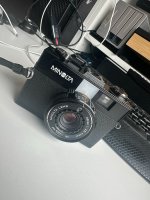
IMG_0478.jpgIMG_0479 copy.jpg
 
Little Minolta Himatic G2 Rangefinder.

I recognise this is probably (definitely) the worst of the Himatic range, but I've never had a rangefider before and it was cheap.

Bonus - it had a roll of film in.

It's Truprint something or other. Only saw it briefly when I opened the back :headbang:

So I'll shoot that and see what happens.

Also came with a Minolta 20 flash, but that doesn't appear to work. The contacts are 'green' though, so I might give them a clean and try again.

Looks brand new.
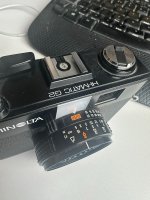
View attachment 481363View attachment 481364

I had one of those. Its basically a Minolta version of an Olympus Trip. It worked well, made nice pictures, and had the most satisfyingly tactile film advance of any camera I've ever used. :D
 
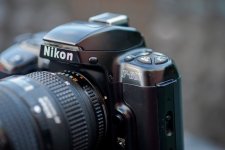
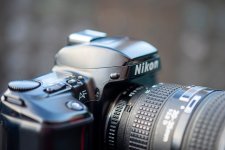
I waited with this until I could stick a battery in and make sure that it worked, a replacement for my F-801

19 quid plus 3 P+P

Very nice condition I think

The lens I already had.

 NIKON F-601-2.jpg


Looking forward to trying out the mechanical shutter release.


 NIKON F-601-3.jpg


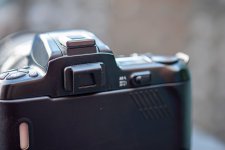
I dont know what the thing is covering the viewfinder, looks like a mini belt clip


 NIKON F-601.jpg
 
The thing over the viewfinder must be a mask which you use when the camera is used for long exposures on a tripod, it prevents light from the viewfinder getting back to the internal light meter. You can slide it onto your strap to carry it around.
 
The thing over the viewfinder must be a mask which you use when the camera is used for long exposures on a tripod, it prevents light from the viewfinder getting back to the internal light meter. You can slide it onto your strap to carry it around.

Exactly that.
 
I like the plastic cameras of that era. I have an F70 that I'd use if I had a nice lens for it. That was a good price to pay for a well spec'ed camera.
I have bought too many (is that possible?) plastic SLRs, quite a few Pentax MZ cams and lately a bunch of Dynax cams, all crazy cheap for their capabilities.
 
I like the plastic cameras of that era. I have an F70 that I'd use if I had a nice lens for it. That was a good price to pay for a well spec'ed camera.
I have bought too many (is that possible?) plastic SLRs, quite a few Pentax MZ cams and lately a bunch of Dynax cams, all crazy cheap for their capabilities.
The test roll is just going through the scanner Dave.
PS. I bought a roll of the chinese film you showed will you start a thread with a bit of instruction please.
 
The test roll is just going through the scanner Dave.
PS. I bought a roll of the chinese film you showed will you start a thread with a bit of instruction please.
I wondered if a film with a speed as low as 20-ish is any use at all. I have a roll in a Dynax5 and with my 50mm f1.7 lens on it, I can use it in bright conditions, so it could be a fun experiment. Not had a good go at it yet, just my customary shots of my garden fence in sun. You might finish a roll before I do!
There is no reason why I shouldn't shoot the whole roll in one day.... it's just that I end up carrying too many cameras.
 
I wondered if a film with a speed as low as 20-ish is any use at all. I have a roll in a Dynax5 and with my 50mm f1.7 lens on it, I can use it in bright conditions, so it could be a fun experiment. Not had a good go at it yet, just my customary shots of my garden fence in sun. You might finish a roll before I do!
There is no reason why I shouldn't shoot the whole roll in one day.... it's just that I end up carrying too many cameras.
Thats great news,
 
I did take a punt on a Minolta SRT100 with a 50mm MCX f/2.

I only really wanted the matte screen which I’m hoping to use to replace the one in my SRT and it was cheaper to buy a camera than the screen. Which was lucky as the camera had other issues that prevented it from working.

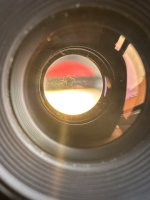
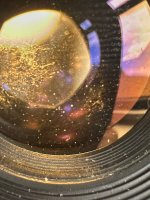
The lens had some heavy fungus so I thought I’d get a set of spanners and have a go at disassembling it and treating the lens.

Partially successful I’d say.

The rear elements are supposed to come apart and I think this last little bit is in there, but I can’t get them apart.

Fronts came up well.


IMG_0556.jpeg
IMG_0549.jpeg
 
Last edited:
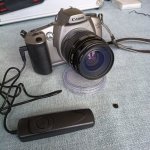
A new to me cheap EOS 3000N body

rsz_img_20260517_111158957.jpg

I've numerous consumer EOS bodies and kit lenses as I find they are v good value for money. This 3000 has been bought with a specific project in mind that requires the use of "cable release" and this model accepts one of Canon proprietary electronic releases. The tiny plug covering the cable socket could be very easy to loose...

Now I've just got to try and find my EF 50mm lens!
 
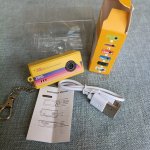
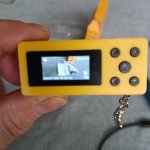
"110 film" camera

rsz_img_20260517_125518343.jpg

rsz_1img_20260517_130534328.jpg

Clone/rip off of the Reto/Kodak version.

PHO00006.JPG

PHO00013.JPG

PHO00004.JPG


Yes, as you'd expect for £5.03 delivered (an introductory offer via one of the large Chinese selling sites) the image quality is poor.

A little better in bright light but the elongated viewing screen doesn't help composition. As well as b&w there are a number of other "effects".

Despite all that it's great fun to use. The wife and kids think it's cute so I may buy them one.

PS I know this isn't a film camera and I won't be making a habit of posting about digital but as a one-off I think it's worthwhile.
 
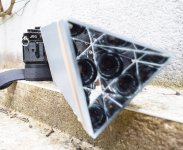
I finally got round to building a vortoscope to make vortographs (https://boshamgallery.com/blog/28-w...s-first-truly-abstract-photographs-were-made/).

Here it is mounted on my Canon A1. It is made with three mirrors in the manner of a kaleidoscope. It's fitted with a 58mm filter ring so with adapters I can use it with a variety of lenses. The picture is taken from the front of the device to show the kind of effect it produces.

The only photos I have at the moment are digital test shots. I'll post film shots in due course.

1779031266783.jpeg
 
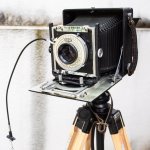
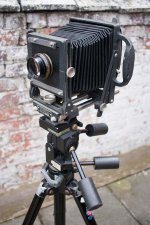
Also took delivery of this beauty, a Burke and James Press camera from the 1950s, although not the version with the rangefinder like a Graflex. It's a simple technical type camera, quite compact.

1779031518834.jpeg

The movements available are front tilt, rise and fall and lateral shift. The camera also has a focussing hood, a drop bed and, best of all, a rotating back. Unfortunately The back can't be rotated while the camera is mounted on any of my tripods. Also the bellows are really good.

The camera came with a working Ilex 6 1/2" lens in an Ilex shutter, a huge shutter by the way. The flash connection is proprietary. The shutter flash delay can be set manually, first time I've ever seen that feature.

Another nice thing is that the lens board is 4" square by 1/8" thick like my old Calumet, which Wayne now has, and my Brand camera so I can use lenses I already have without remounting them.

Now I have an eminently portable large format camera I will be able to get about with it, my other cameras are big and heavy so this will make a refreshing change.
 
Ilex 5 I assume? I have 2 lenses mounted in them.
 
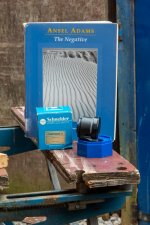
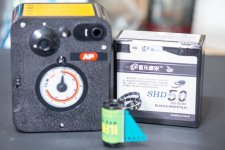
After Dave showed us this film for 30 odd quid, I decided to get a roll. and a bulk loader. I really need to incorporate development tests into my photography and this could be a suitable introduction.


SHD50.jpg

Some words of caution in case anyone else has a crack at it

1) The plastic container IS THE LIGHT TIGHT BOX there is no plastic bag inside.
2) there is a paper strip covering a couple of turns of the reel which IS STUCK DOWN with no release strip so make sure your finger nails are in good order and finger tips sensitive enough to find the end.

The AP (Kaiser) loader was quick and simple to load, a minute or two. I practiced finding the slot with an offcut of 35mm film. Seems foolproof.

I have loaded the 6 frames into a dynax, it will be interesting to see how many shots I actually get and if its light struck through opening the lid ever so slightly to see if the seal was broken.
 
Last edited:
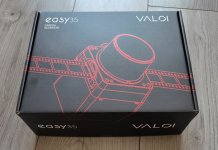
The scanning journey continues...

16672.jpg

The results are very good so far. It's also an incredibly fast workflow. Even without practice, I scanned a full roll of 36 exposures in under 10 minutes.

I did wonder how easy it would be to focus on the grain, but its very clear on my DSLR's rear LCD using manual focus and full zoom on the screen.
 
Last edited:
Which camera/lens combo are you using it with?
Nikon D810 and a Sigma 105mm f/2.8 OS HSM macro.

The D810's 36 megapixels is probably overkill for 35mm, so I'll resize the scans down to 24mp (which is still probably too much, but it's on a par with what the Reflecta gives me). The NEF files from the D810 are smaller than the RAW DNG files I get from a dedicated scanner, which is a bonus.
 
Last edited:
Also took delivery of this beauty, a Burke and James Press camera from the 1950s, although not the version with the rangefinder like a Graflex. It's a simple technical type camera, quite compact.

View attachment 482582

The movements available are front tilt, rise and fall and lateral shift. The camera also has a focussing hood, a drop bed and, best of all, a rotating back. Unfortunately The back can't be rotated while the camera is mounted on any of my tripods. Also the bellows are really good.

The camera came with a working Ilex 6 1/2" lens in an Ilex shutter, a huge shutter by the way. The flash connection is proprietary. The shutter flash delay can be set manually, first time I've ever seen that feature.

Another nice thing is that the lens board is 4" square by 1/8" thick like my old Calumet, which Wayne now has, and my Brand camera so I can use lenses I already have without remounting them.

Now I have an eminently portable large format camera I will be able to get about with it, my other cameras are big and heavy so this will make a refreshing change.

It's a very Germanic camera, there's something about it, I've seen that focus rail before with that distinctive curve. These cameras were sold around the same time B&J were selling various seized German optics under their Carl Meyer brand name.

The 4" square lens board was standard for pre and Anniversary Speed Graphics, MPP use the same for all their MicroTechnical cameras (except MkVIII). What is your "Brand" camera.

Ian
 
The Brand camera is a cast aluminium job which is rather odd as it isn't a press camera (or is it?) or a monorail but it does have a big cast handle, not leather strap, on the side. I'll post a picture when I get home. I'm photographing some Egyptomania ephemera at the moment in the museum archive so don't have access to a picture.
 
Yer 'tis, the Brand camera. In this instance fitted with a 210mm Tessar. I like the industrial finish, even more so than the Calumet CC400 I sold to @Barney, which is pretty basic and all the better for it. The Calumet also takes 4" square lens boards but they have to be chamfered a bit on the bottom inside edge. I found 3mm mdf worked well, easy to make, no special tools except an adjustable trepanning drill. That, a hand saw, a drill press, sandpaper and matt black spray paint and the job's done.

1780071297276.jpeg

Forget all your fancy wood and brass cameras, this is the way forward, cameras made out of recycled second world war bomber air frames.
 
Thanks, it's a camera I'd not come across Brand cameras before.

Correction! That is not the Zeiss lens but a Kodak process lens, I think.

Process lenses typically have a widest aperture of f9, I have a Bausch & Lomb 18" f10 Process Anastigmat, despite the aperture it's easy to focus.

It looks like a Kodak Anastigmat I have sat in a cabinet,
 
Yer 'tis, the Brand camera. In this instance fitted with a 210mm Tessar. I like the industrial finish, even more so than the Calumet CC400 I sold to @Barney, which is pretty basic and all the better for it. The Calumet also takes 4" square lens boards but they have to be chamfered a bit on the bottom inside edge. I found 3mm mdf worked well, easy to make, no special tools except an adjustable trepanning drill. That, a hand saw, a drill press, sandpaper and matt black spray paint and the job's done.

View attachment 483499

Forget all your fancy wood and brass cameras, this is the way forward, cameras made out of recycled second world war bomber air frames.

I chuckled the other day when I read Garrys suggestion on reading about the Scheimpflug principle, I thought to myself oooohh just think having geared movements with degree and angle markings everywhere. I quickly stopped myself and remembered my golf days with my Calaway big bertha (the first one) for years and years I stuck with it and as the latest and greatest driver came along me and my big bertha just kept booming along and winning the longest drive competitions.
I think these super heavy duty metal camera were for the pros who would be chucking them about left right and centre not worrying about a scratch on their Ebony masterpiece.
 
Nikon D810 and a Sigma 105mm f/2.8 OS HSM macro.

The D810's 36 megapixels is probably overkill for 35mm, so I'll resize the scans down to 24mp (which is still probably too much, but it's on a par with what the Reflecta gives me). The NEF files from the D810 are smaller than the RAW DNG files I get from a dedicated scanner, which is a bonus.


Have you scanned any slides yet? They usually have much finer grain than print films so might benefit from the extra pixels. Definitely worth an experiment since the scanning process is so much faster than "proper" scanning!
 
Have you scanned any slides yet? They usually have much finer grain than print films so might benefit from the extra pixels. Definitely worth an experiment since the scanning process is so much faster than "proper" scanning!

I did a couple quickly, but they were from an expired roll. I might dig out some Velvia 50 shots and have a go at those.
 
Back
Top