crop full frame 10 mp 12mp ??what?? help please

Messages
46
Edit My Images
Yes
my head hurts
ok let me explain im going to want to buy a proper camera but im lost

i cant spend ££££££££ on the ones iv seen being used on other forums

im looking to maybe make some kind of career out of it my interest is mainly wildlife and macro

so i really dont know what i need in the way of camera to do this

plus cost im going to have to look at the used market and realistically i maybe able to raise £400 to get the camera with hence the used market

so any advice would be great

thank you
 
For wildlife a crop camera will come in handy for the extra "reach" it gives you. Not sure how croppies fair with macro, not my thing currently.
 
To be frank, you can rule out full frame immediately with a £400 budget. A S/H Canon 1Ds body (cheapest FF available) without a lens will cost you in the region of £600.

So a cheap S/H DSLR with lens will leave you looking at something in the region of a Canon 20D/30D with a kit lens or a Nikon D40/D60 with a similar lens. Neither of these outfits will be particularly good as purchased at either wildlife or macro without spending further money.

My suggestion wouls be to look at a New (slightly older model) bridge camera, which you can pick up for around £200-275. This will have a long lens for wildlife, some macro capability, a large zoom range and will give you the opportunity to learn and progress before deciding if you really need to spend the money on a DSLR and the lenses you will need to cover the photography you like.

My suggestion is a Panasonic FZ38 which has had great reviews and has a really good specification.
 
thanks but whats the diff between the two crop and full
thank you

Size of the sensor is the main difference between crop and FF cameras, others are cost, FF requires larger lenses with a larger coverage.

The difference between a 10MP and 12MP crop sensor is just pixel density for a same sized sensor.

There are currently 3 crop ratios 1.3x (actually 1.25x) Canon 1D series bodies (well out of your budget) 1.5x Nikon standard crop factor and 1.6x Canon standard crop factor. All of these will have pixel densities of between 4MP and 18MP depending on model and age.

You also might want to look at the smaller 4/3rds DSLRs from Olympus and others, but my original suggestion persists, look for a decent bridge camera!
 
Agree with Ed but you could get a 2nd hand 400D or 450D for his budget, no idea of the Nikon models though???
 
Welcome to the forums first of all....:wave:

For example....

A Full Frame camera with a 100mm lens = 100mm
But if you put a 100mm lens on a 1.5x Crop Camera, then the lens is equivalent to 150mm.

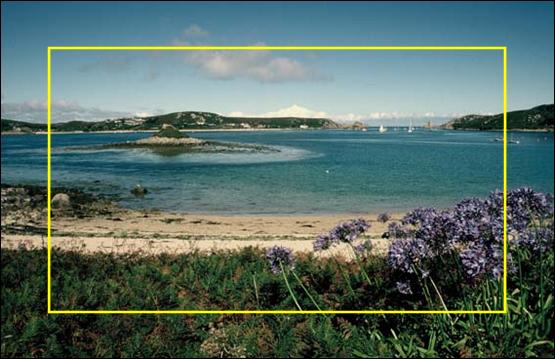
Here's an image to help.

Let's say this photo was taken on a Full Frame camera.
The yellow box, is what a 1.6x crop sensor camera would see

Crop%20Demo.jpg
 
a second hand sony a200 would set you back less than £200, that leaves another £200 for a lens. unfortunately you wont get a proper set up for £400 because even the higher end 70-300mm models can cost £400, and you'll want to do macro whihc requires a macro lens (duh) which the cheapest you can normally find is the tamron 90mm f2.8 macro but thats over £300.

i have been doing macro with my 55-200mm and while its not dedicated its still useful for product shots and hopefully this year i will be an owner of a tamron 90mm f2.8 macro.

oh forgot to mention the tamron 70-300mm can be had for £100 if you buy brand new at jessops which has a long zoom range and an OK macro facility.
 
Firstly, welcome to TP Cyberspider :thumbs:

There is a secondhand Canon 400D with kit lens here:

http://www.talkphotography.co.uk/forums/showthread.php?t=198517&page=2

It would be a good start based on your budget, although a brand new Nikon D3000 with kit lens is only £110 more.

If you bought the Canon, this would leave you £150 or so from your budget. The kit lens would be a start as far as landscapes and general pics go, but for wildlife and macro you could ideally use a bit more in the pot!

However, for starting off - £30 or so you could get a closeup lens adaptor that would help obtain some macro shots (Raynox). With the £120 change, you could quite easily buy a Sigma 70-300APO lens secondhand that would certainly give you a good start with the wildlife shots. I had one for my D90 and got some good results with it!

Obviously your budget does restrict you in what you can afford, but we all have to start somewhere and whilst the £££ will not buy you "pro" kit, there are some people who can get damn good results with the above (IMHO better than I can with my £2500 of kit :lol:)

I have bought and sold a few items on this forum and have found it very good - the classifieds are a great source of used kit.

Hope this helps :thumbs:
 
hmm thank you all for the replies and explaining full and crop

i did think about a canon 400 and 450d as i have seen some very good shots taken

however alot of people are recommending the Nikon d3000 for wildlife and landscape

i do like taking shots of landscapes and birds

and thank you very much EdBray for your recommendation of Panasonic FZ38
however i really want one i can buy lenses for i have a fuji finpix s5000

and i have 3 film cameras with some lenses and i really like the fact i can change the lens on the fuji i cant do that and focusing is a pain in the butt ( but that could be me )

i find it easy to focus my film cameras
 
To be honest, there isn't really any difference worth worrying about between all these cameras, it's the lenses that make it and they're the bits that cost the real money.
 
Weclome to TP :)

Because you have serious aspirations, and shooting wildlife on a commercial basis is about as serious as it gets, then I think you should get a DLSR. They are just better for learning, and better full stop.

If you could start with something like a used Canon 450D with kit lens, plus a Canon 55-250 and Raynox DCR-250 macro adapter (£40 macro close-up attachment) you will have something very capable at somewhere close to your budget. That will get you going and you'll learn a heck of a lot.

For serious macro, a ringflash is almost essential - Marumi make a basic one that works well for about £100.

Then get stuck in to some of the tutorials in the section below. There's some good stuff down there and any further questions will be willingly answered back up here :)

Edit: the reason you can focus manually okay with your film camera is because film is full frame which means the viewfinder is much bigger and brighter. Plus you probably have a lens with a low f/number which makes it brighter still, and the depth of field is correspondingly shallow meaning things snap in and out of focus more easily.

Double edit: yes, don't get too hung up between different brands. Nikon, Canon or Sony are all excellent and extensive systems. The main difference is that Sony are not so popular on the used market, but pound for pound there's nothing to choose between them.
 
i must admit i have been tempted by the canon 450d for some time
but i didnt know about Raynox DCR-250 that looks very interesting

i do have a canon film camera ESO 1000f it come with a sigma auto focus 70-210 1:4-5.6

i understand that i may be able to use it on a DSLR

thank you all once again for the info and help it is much appreciated
 
ok iv narrowed my choice down to two canon 450D and nikon D3000

just have to start raising the cash now
i have some things to put on ebay
i have two dell inspiron 9100 laptops for parts to put on there they should get a bit

also ill get the Raynox DCR-250 macro adapter looked at that on YouTube impressive
 
If you could raise an extra £50 you could get a twin lens Olympus E520 kit http://www.cameraworld.co.uk/ViewProdDetails.asp?prod_code=PON08E000063&Cat_Code=5&Subcat_Code=51 Might even find it cheaper elsewhere.

The x2 crop factor is a big advantage of Olympus when it comes to wildlife. That 40-150mm lens is the full frame equivalent of 80-300mm and when you get enough money you can add a 70-300mm which equates to a massive 140-600mm - by far the cheapest route to this type of magnification.

I used the older E510 with a 40-150mm lens to take this:- http://www.johnperrimentphotography.com/photo_2333802.html

True, the E520 is near the end of it's production run and won't be available new much longer but it's still a brilliant camera and an ideal one with which to start wildlife and macro on a budget. :)
oh this just got harder lol looks nice very nice thank you for the link and very nice shot
you took too
 
Back
Top