D800 vs. D800E- is the difference worth the extra?

Messages
512
Edit My Images
No
Hi, I'm currently weighing up an upgrade to a D800 or D800E either new or used. Can anyone out there speak with experience about whether paying the extra for the 'E' (I notice Nikon have stopped doing the cashback on the E too) is worth it?

If I go with the D800 I reckon I'll always harbour "what if" feelings for the more expensive 'E' and if I jump straight into bed with the D800E I'll be left with the "Is that it?!" feeling.

Currently using a D3 and D7000, shooting portraits/wedding/landscape/estate photography....... the latter is driving me down the 36.3mp route.
 
estate photography???
I could see fine art large prints of landscape... I can't speak to the -E, but if you were to take a DX crop from a D800 image it would look pretty identical to an image from your D7000.

There are MANY times I cannot get as good of an image out of the D800 as I can out of a D4/D3s/D3/D700... not at full resolution... and often not even after seriously downsizing the D800 image.

....I don't care what the reviews or fanboys say....

FWIW, I currently use a D4/D800. Used to have a D3s/D3 until I drowned them... Had a D7000 for ~ 1yr while I waited for the D4 release...
IMHO, the D800/E is a studio/fine art camera. It requires very sharp lenses (high MTF at wide apertures) and lower ISO's... otherwise you're just recording huge files to smash them into small prints; kind of pointless really.

IMHO, get a used D3s for what you're doing.... It might not be *quite* as good for the estate work, but it will be close, and it will be better for everything else.
 
dpreview has a direct image to image comparison of scenes photographed with both the D800 and the D800e. Maybe that could help you decide for yourself.

My conclusion was, the D800e indeed takes sharper pictures, but it is only visible at pixel level, and it seems that you can sharpen the images of the D800 a little more than those of the D800e (don't know why), and then they look pretty similarly sharp as those of the D800e.

When I bought the D800, the price difference was £400.- for me, not worth the difference. But with a difference of £100, I would have bought the D800e.

That said, I'm quite happy with the pics the D800 takes. But you have to know its limitations. No apertures larger than F8, low ISO (not above ISO200 for perfect results, not above ISO400 for excellent results), the need to either have very steady hands or use fast shutter times or a tripod, and indeed the requirement to have very sharp lenses for optimum results. OTOH, if you don't want to print large, average lenses will do as well.
 
Last edited:
Personally I bought the D800, as Achim says mainly down to price, with the cashback I think the gap was up at around £500!

I haven't found any real issues with the D800, I was a bit concerned having heard a lot of people go on about having to have excellent technique and that it was rubbish at higher iso but frankly I'm finding it to be better than the D600 was, seems fine at higher ISO (usually have it on Auto and Set to 3200 Max) and finding I'm getting excellent results.
Fair enough a lot of the time I'm using the Sigma 35mm f1.4 which is generally regarded as a stunning bit of glass but I'd highly reccomend the D800, I bought as a replacement for 2x faulty D600's and felt it was much better value at the time than the new D610.
 
Thanks for your input everyone, as I suspected and reading between the lines the E isn't worth the extra for what I'm doing currently as I wouldn't be utilising the extra it provides- I don't reckon some of the glass I'll attach to it will allow it be that bit better neither.
@sk66 The estate work is essentially property photography for an estate agents but some of the properties can be on the large side so it often calls for wider landscape shots. I know where you're coming from re: the D3s, but at the minute the D3 works well enough for the occasional wedding and I'd most likely be putting the D800 on an elevated pole to use remotely and so I'd consider the D3s not ideal for this because of the weight- when the time comes to retire the D3 I may consider the D3s.
 
Took me six months to decide...
rolleyes.gif


Got close SH offers, so price difference was not an issue. Finally "settled" for the non-E, and haven't had regrets.

Nasim don't agree though... http://photographylife.com/nikon-d800-d800e-for-wedding-photography
And thoughts on comparison: http://photographylife.com/nikon-d800-vs-d800e

If you think, you'll get second thoughts later on, go for the E-type!


Either way, the resolution is ridicilous!
biggrin3.gif
 
I went for the D800E, predominately based on the same feeling as you - I wanted to have the maximum possibility for resolved detail, and not have to wonder what-if. At the time the difference was around £300 and across the lifetime of ownership and with my ability to depreciate it as an asset almost irrelevant in terms of additional cost.

It does take more care to get the best out of it, and it does excel as a studio/tripod centred piece of kit. But you can get excellent hand-held images from it, and as well as interiors/exteriors and studio work I also use mine for stock images most of which are taken hand-held but with concentration on technique and a slightly higher shutter speed than I would with a 12-16MP body. I have also shot sport professionally with it as a second body - and as I time my shots rather than "spray and pray" find the 4-5 FPS adequate.

The one thing you do need to be aware of is that if you are using the 24mm PC-E (tilt/shift) lens then it won't rotate axis fully on the D800 or D800E - the prism housing blocks the rotation which is doesn't on the D3/D3s/D3x/D4 body. It isn't an issue for the 45mm and 85mm PC-E lenses - just the 24mm. Your standard horizontal shot with vertical shift works perfectly, as of course does a vertical shot with horizontal shift.

Worth noting that all of Nikons new 24MP bodies come with the AA filter removed as standard. I think the D800E was an experiment and was deemed successful and it is now the model for all high MP cameras - falling into line with the MF-D cameras like the Hasselblad H series.
 
When I got my D800E there was not such a large price gap between it and the D800. I had no idea if the D800E would produce sharper pics, but I would have hated getting a D800 then wishing I had got the E model. Bottom line is I am delighted with the camera and how much I can crop images (it has replaced my D700 + D300 combination).

I doubt if the current price difference is worth paying to the D800E.
 
Worth noting that all of Nikons new 24MP bodies come with the AA filter removed as standard. I think the D800E was an experiment and was deemed successful and it is now the model for all high MP cameras - falling into line with the MF-D cameras like the Hasselblad H series.

Doesn't the D610 still have an AA filter? The D600 certainly did.
 
When I got my D800E there was not such a large price gap between it and the D800. I had no idea if the D800E would produce sharper pics, but I would have hated getting a D800 then wishing I had got the E model. .


Same here, the difference was about €250 at the time [about 450 now with the drop in price on the non-E], and well, they only had the E in the store I got it - would have had to wait another week for the standard - and I have zero patience when I have cash in my hand! :D

Get the E - for Exclusivity ;) ... but really, for re-sale value. Plus that extra bit of sharpness. I haven't ever needed to adjust sharpness levels in lightroom since buying it.
 
Last edited:
That said, I'm quite happy with the pics the D800 takes. But you have to know its limitations. No apertures larger than F8, low ISO (not above ISO200 for perfect results, not above ISO400 for excellent results), the need to either have very steady hands or use fast shutter times or a tripod, and indeed the requirement to have very sharp lenses for optimum results. OTOH, if you don't want to print large, average lenses will do as well.

I thought we had gone past this sort of nonsense a long time ago with regards to this camera. Although no apertures larger than F8 is a new one on me. Rubbish.
 
Yeah, a lot of nonsense gets thrown about alright.

Not going above ISO 200-400?? you what??

The D800 is well capable of shooting clean at high ISO, or you're doing it wrong.
 
Everyone knows the D800 should not be used above ISO 400, come on guys, keep up..................:)
 
I thought we had gone past this sort of nonsense a long time ago with regards to this camera. Although no apertures larger than F8 is a new one on me. Rubbish.
I would guess he meant larger numbers/smaller apertures. At f/8 the D800 is already starting to get into diffraction and the max resolution you can record is ~ 30MP (16 @ f/11). That's assuming the lens you are using isn't the limiting factor and can generate 36MP of detail, which it probably can't...
 
Yeah, a lot of nonsense gets thrown about alright.

Not going above ISO 200-400?? you what??

The D800 is well capable of shooting clean at high ISO, or you're doing it wrong.

I won't use my D800 above ISO 1600. 800 is my preferred max. Beyond ISO 400 there are no real benefits to the D800 even at the same print size compared to my D4. At different print sizes (i.e. recording such huge files for an actual reason) the D4 will beat the D800 every time (and the D3/D700/D3s will be very close).
 
Worth noting that all of Nikons new 24MP bodies come with the AA filter removed as standard.
The reason they can get away with removing the AA filter is 1) Moire isn't always a problem and can often be avoided if you know how, and 2) Oversampling removes moire.

Oversampling being the smashing of huge amounts of data down into a smaller image... Oversampling fixes/improves a lot of things "somewhat," but why "fix" something that's not a problem?
 
Doesn't the D610 still have an AA filter? The D600 certainly did.

No you are correct.

Although the D610 *isn't really* a new model. It is basically a rebadged D600 to cease the oil spot reputation, with some peripheral changes to justify the "10" designation.
 
I won't use my D800 above ISO 1600. 800 is my preferred max. Beyond ISO 400 there are no real benefits to the D800 even at the same print size compared to my D4. At different print sizes (i.e. recording such huge files for an actual reason) the D4 will beat the D800 every time (and the D3/D700/D3s will be very close).


Beyond ISO 400 the advantage is you can shoot in lower/dimmer light, that is the only real reason for using higher ISO levels, and the D800 is more than capable. And there' not much benefit to the D4 in that case, shooting at higher ISO if you're printing.

Also - not everyone has a D4! Most here will only have one or the other. But the D800 is as good, if not better, in low light, than a D700.

People are so fussy. Just because it's an ideal studio or landscape camera, does not mean it's all you have to use it as.

I feel it's probably wasted on some.
 
Last edited:
Hi Cagey, don't be upset :) what I mentioned are - technically - indeed the optimal parameters for the D800, and indeed I try to stay within them. That doesn't mean you couldn't take excellent photos outside these parameters. Above F8 diffraction kicks in, above ISO 400 the D800 loses some of its special extra beauty in terms of colors and DR, and the thing with the steady hand is true as well.

That said, you can shoot great photos outside these parameters, certainly. But some of us get choked by knowing they are outside the optimum specs ;)
 
Beyond ISO 400 the advantage is you can shoot in lower/dimmer light, that is the only real reason for using higher ISO levels, and the D800 is more than capable. And there' not much benefit to the D4 in that case, shooting at higher ISO if you're printing.

Also - not everyone has a D4! Most here will only have one or the other. But the D800 is as good, if not better, in low light, than a D700.

People are so fussy. Just because it's an ideal studio or landscape camera, does not mean it's all you have to use it as.

I feel it's probably wasted on some.

There is a benefit to using the D4 over the D800 at higher ISO's and smaller apertures... I promise you I will get better images than from the D800.
But yes, not everyone has a D4, nor should they...hell, I wouldn't own one if the insurance hadn't bought it for me.

And I agree, the D800 is about as good as a D700 (D3) in low light for noise, but possibly not in overall IQ.

My main point is that the D800 is best for a couple specific things, if you're not doing those things then why record 45MB files? I also agree that that doesn't mean it can't be used for other things... I use mine for "other stuff" when I want something better than my compacts and lighter than my D4. But that kind of stuff is probably never going to be printed/displayed very large and recording the huge files is a bit of a waste...
 
Yeah, a lot of nonsense gets thrown about alright.

Not going above ISO 200-400?? you what??

The D800 is well capable of shooting clean at high ISO, or you're doing it wrong.
:agree:
 
What on earth am I reading??? Have a D700 and at some point this year would like to upgrade - the D800 is the natural path but a few concerns now.

My D700 takes great pics at 1600 ISO, and is good at 3200 and ok at 6400 - the D800 is no worse surely??
 
What on earth am I reading??? Have a D700 and at some point this year would like to upgrade - the D800 is the natural path but a few concerns now.

My D700 takes great pics at 1600 ISO, and is good at 3200 and ok at 6400 - the D800 is no worse surely??

Nope - the not use it above iso400 thing is to be frank, rubbish. Drop me your email if you're worried. I'll share real world Raws at a range of isos so you can check them out
 
Nope - the not use it above iso400 thing is to be frank, rubbish. Drop me your email if you're worried. I'll share real world Raws at a range of isos so you can check them out

Thanks, thought that was the case, couldn't believe it to be at D200 levels!!
 
What on earth am I reading??? Have a D700 and at some point this year would like to upgrade - the D800 is the natural path but a few concerns now.

My D700 takes great pics at 1600 ISO, and is good at 3200 and ok at 6400 - the D800 is no worse surely??

HERE:
The link shows 1:1 raw files for the D800 compared to the D7000/D700/D3s. Because they are 1:1 the images are different sizes (in both display and file size). You can improve the quality of the larger files by down-sampling, and you can degrade the quality of the smaller files by up-sampling. It's all a tradeoff. But if there is no requirement to up-sample the smaller files, then IMO that's the better choice.

Also, that's a well lit studio shot...they will all perform worse in actual low light environments. (~1 stop or so IMO)
 
Last edited:
FWIW, above ISO 400 the D800 drops hard in every aspect (ISO noise, DR, Color Depth, etc.). By ISO 800 it's ~ the same as the D3s and just slightly above the D700. It pretty much holds that match from there...and that's for a print of the same size (i.e. downsampling the D800 file more).

ISO 3200
D800: SNR 31.3db, DR 10.09ev, Tonal Range 7.36bit, Color Depth 18.9bit
D3s: SNR 31.1db, DR 10.5ev, Tonal Range 7.35bit, Color Depth 19.1bit
D700: SNR 29.5db, DR 9.44ev, Tonal Range 7.07bit, Color Depth 18.5bit

All from DXO; one might not like exactly how they test, but at least it is very standardized/empirical.
 
Those tests are crap IMO... not just those, but most like it.
You can use a very high ISO in good light w/o much noise.
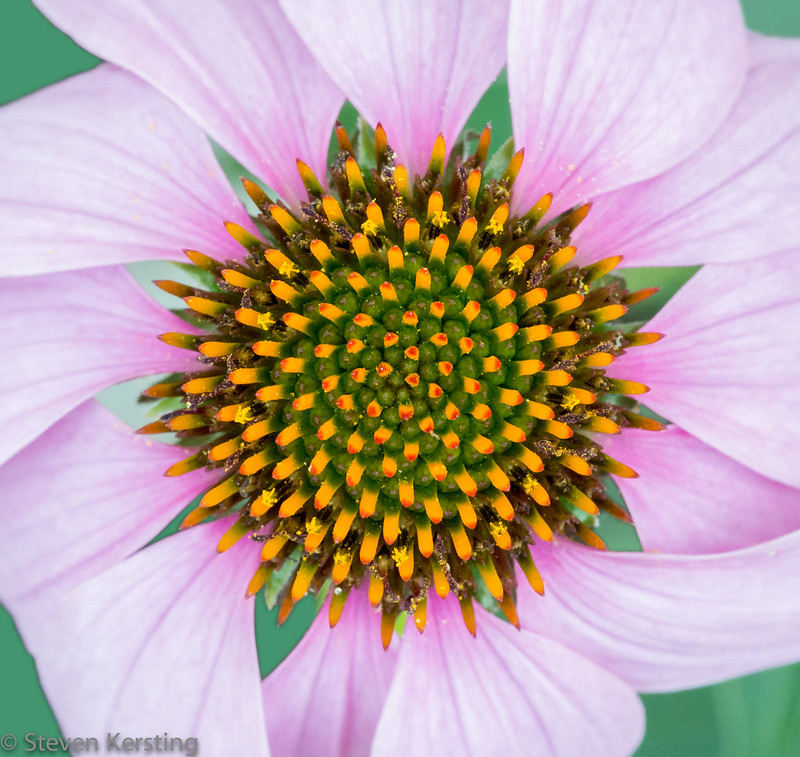
Here's a full res D4 image at ISO 12,800 (just cropped for composition); very little processing (basic LR stuff).But I dread using ISO 6400 w/ the D4 when there's no light.


Purple Coneflower
by skersting66, on Flickr
You can view it on Flick'r full size and check the exif if you like.
 
Last edited:
Of course the D800 can give you good photos at F16, and ISO 800, and slower shutter speeds. Probably even better than many other cameras. What I'm talking about is using the D800 to its fullest potential. Within the parameters I mentioned in my initial posting, you're using the D800 to its full potential, getting the best of the best in terms of IQ out of this camera, and this IQ will considerably exceed the IQ achieve by most other comparable cameras. Outside these parameters, the D800 is still a good camera, only its particular advantage over other cameras is reduced. But it will of course still take excellent pictures.

sk66 is not the only one seeing that the D4 retains color and DR better when the ISO gets higher (in low light, where you really need the higher ISO) than the D800. The measurement values in different reviews also show where the optimal range lies. But the D800 will of course still take photos in excellent quality at higher ISO, surpassing most other cameras. And it is true that to get the maximum sharpness on pixel level, you need (an excellent lens and) faster shutter speeds or a tripod. Your D800's images will still look as good as the image from other cameras or even better if you don't achieve the maximum detail sharpness the D800 is capable of, but in order to use the D800's potential to its fullest, indeed you have to pay a little extra attention to sharpness.

Similarly for diffraction - you will only see the effects of moderate diffraction when pixel peeping. Even F22 is possible. And if you want to use a specific DOF, you will of course use F11 or F16 and still get great pictures. After all, the artistic value of an image doesn't come from technical specs. But fact is, the maximum detail sharpness of the D800 is reduced as soon as you go beyond F8. It is not visible until a few F-stops higher (smaller apertures, higher F-numbers), but for those of us who just try to get the max possible technical IQ out of every image, those are parameters we should respect.

Personally, I have set my max ISO to 400 (silly, I know :) ) and if I need higher ISO, I increase the setting manually. I also noticed that I can get pretty much detail even if the image has been exposed a bit on the dark side (exposure to the left), but of course, I probably lose some detail in terms of DR and color this way, and I still don't know whether it would be better to increase ISO further instead.

Luckily, for the kind of pictures I usually take, the D800 can be used within the perfect parameters, getting me the max technical IQ, and I don't have to worry about it. So for me, the D800 is exactly the right camera. For the pictures I want to take, I can usually use it within its optimal parameter range. And when I can't, it's usually for images where the max technical IQ is not so important for me (family pics, my kids, evenings with friends).

And this is why I posted about those parameters initially - whoever aims for maximum technical IQ, needs to know about these limits and decide whether this camera is the right one for him. If you are more relaxed about obtaining the maxmium technically possible IQ this camera can provide, then the D800 is a great camera for you even far outside these specs.

I often wonder about these discussions whether a camera is better than another. I usually think that many of these discussions are not helpful, because in many cases, there is not a better or a less good camera. There's just one camera that's better for a particular purpose, and another camera that's better for another purpose.

If I were into video, btw, I'd use my wife's camcorder ;)
 
What lenses are people using to extract the best quality at these low ISO, tripod mounted D800 shots?
 
I still don't get why anyone compares the D800 to the D4 - sure let's compare the D800 to a D200! about the same priced difference :P

Phil, a few have said it now, and not just said but seemed to strongly state, that the D800 is only good to ISO 400-800, and that is so misleading it's not even funny.
 
No one said its only good to iso 400-800.

what has been said is the d800 is no better or only slightly better in many regards than the d3s/d700 at iso above this. The d800's DR and colour depth advantage is lost above these iso's and is actually worse than say the d3s/d4 at iso's above 1600.

There is no problem using the camera above this though. I've taken and posted many images in the d800 thread at 6400 and higher in very low light and it preformed great. Noise is there but its different compared to my d700 images. I also found i could add more noise reduction and still retain more detail due to the amount the camera captures. Then theres the fact that the AF is slightly better in low light as well.

You have to remember that one of the main feature's of the D800 is its great DR, colour depth and abitily to raise shadows with no noise or detail loss, but this is only at its full potential at lower iso's.
Even though i shoot alot at higher iso i wouldn't go back to a d700 thats for sure, i would love to add a d3s/d4 though.
 
What on earth am I reading??? Have a D700 and at some point this year would like to upgrade - the D800 is the natural path but a few concerns now.

My D700 takes great pics at 1600 ISO, and is good at 3200 and ok at 6400 - the D800 is no worse surely??
Don't worry I went from D700 to D800 and I am very pleased with the results, the OP asked for comparisons between D800 & D800E but unfortunately the thread has degenerated into just another platform for people
to knock these excellent cameras.
 
Back
Top