Display on Lens Focus Ring - What is it used for?

Messages
1,047
Name
Mick
Edit My Images
Yes
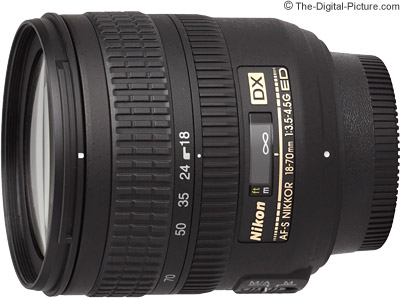
A bit embarrassing owning my D3100 for 9 months and i've never thought what this indicator is that changes when you rotate the manual focus ring.


Nikon-18-70mm-f-3.5-4.5G-AF-S-DX-Lens.jpg


What is this indicator on the focus ring?
And how should I use it?
Is it only for when manually focussing?

Seems to be something to do with distances?

To this point, i've just used A, S or M and auto-focussed on what i've wanted through the display.

How can this display help me?

Probably something simple i've just not grasped yet. :thinking:

Many Thanks
 
It tells you the distance of the subject that you are focusing on. Usefull for hyperfocal distance calculations when doing landscapes, or manually focusing when you know the approx distance of the subject.
Otherwise not really neccesary to look at
 
The infinity symbol is the point beyond which everything is in focus, whether that's the end of the road or the moon.

Lenses run just beyond infinity because the AF system needs to see either side of sharpest point in order to know where the sharpest position is. The exact infinity point can also move fractionally if the lens gets very hot, due to expansion.

So if you put the lens into manual, rotate the ring to the infinity mark then the whole shot will be in focus? Surely the chosen aperture affects this too? :thinking:
 
So if you put the lens into manual, rotate the ring to the infinity mark then the whole shot will be in focus? Surely the chosen aperture affects this too? :thinking:

If you want the whole shot "in focus" you need to use the hyperfocal scale markings.

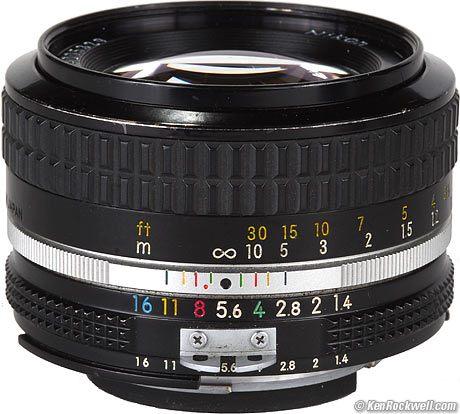
Sadly these markings are very poor on a lot of newer lenses, even pro quality lenses.

An example of the "dumbing down" trend in photography.
 
So if you put the lens into manual, rotate the ring to the infinity mark then the whole shot will be in focus? Surely the chosen aperture affects this too? :thinking:

No, everything will be in optimum focus at the infinity point, and beyond. The exact infinity distance varies with focal length. With a wide-angle it will be around the end of your garden, and with a super-telephoto it will be further than the length of a football pitch.

In terms of sharpness, you need to use the focusing distance in conjunction with depth of field. Lots of stuff about that here, including an easy DoF calculator http://www.dofmaster.com/dofjs.html

Yep, you get a proper distance scale and not some dinky plastic window to squint through.

Mind you, Leica lenses still seem nicely designed, but not cheap!

Prime lenses still have DoF scales, though they only refer to full frame so are not accurate with crop format cameras.

You can't have DoF scales on a zoom as there's not room to include a different scale for every focal length, and you would need two for full frame and crop.
 
Yep, you get a proper distance scale and not some dinky plastic window to squint through.

Mind you, Leica lenses still seem nicely designed, but not cheap!


That's where Zeiss lenses for Canon and Nikon come in. Not cheap either, but I love my 21mm - almost worth the price for the ease of hyperfocal focusing alone!
 
That's where Zeiss lenses for Canon and Nikon come in. Not cheap either, but I love my 21mm - almost worth the price for the ease of hyperfocal focusing alone!

What's wrong with the scale on Canikon primes? :thinking:
 
You can't have DoF scales on a zoom as there's not room to include a different scale for every focal length, and you would need two for full frame and crop.

Not necessarily, you can have depth of field scales ofn zooms although most are limited to the smaller apertures. All you have to do is have a continuous line that moves outwards as the focal length decreases. Although this only works with push-pull lenses sadly.

DOFzoom.jpg
 
Not necessarily, you can have depth of field scales ofn zooms although most are limited to the smaller apertures. All you have to do is have a continuous line that moves outwards as the focal length decreases. Although this only works with push-pull lenses sadly.

DOFzoom.jpg

There was a few of those made for film cameras, notably the Vivitar Series 1 and some others, but they never made it through to digital where ring-zoom controls prevail. And the DoF scale only refers to full frame 35mm.

Apart from that, they're next to useless. If you're shooting a portrait - say 100mm at f/5.6 from 6ft - how much DoF have you actually got? That scale is no help at all. (Edit: it's only 4.23in on FF)

If DoF is critical, as it often is, then you need real accuracy. On the DoFmaster link posted above, you can download tables, or make a cool custom rotary calculator (similar to a lens DoF scale, but a hundred times more accurate), or download a mobile phone app. All far better options IMHO.

The way I often do it is to take a snap and then zoom in on the LCD to see what I've actually got. If you have a decent quality LCD, that's a very accurate method.
 
Last edited:
So if you put the lens into manual, rotate the ring to the infinity mark then the whole shot will be in focus? Surely the chosen aperture affects this too? :thinking:

Yes... sort of... a bit like hyperfocal... but easier...

With hyperfocal focusing you set your camera to focus at a specific distance and set an appropriate aperture to ensure that everything is in acceptable focus. Nothing except what is at the distance the focus is set to, and a bit before and a bit after, is actually in focus but it's all in enough focus to trick you into thinking that it's in focus at what someone who decided the numbers you've used thinks is a normal print size and viewing distance.

To do this you need to memorise hyperfocal tables or take them with you but there is a simpler way of doing things...

As an alternative to hyperfocal focusing you can set your lens to focus at infinity and set an appropriate aperture based upon the zoom length of the lens and the size of anything you want to capture in acceptable focus / detail...

Zoom length divided by aperture = detail in mm.

For example... 50mm lens at f10 will clearly resolve a 5mm object from near to far. This is a much simpler system than hyperfocal focusing as you don't have to memorise hyperfocal tables or take them with you. All you need to know is the zoom length of your lens and then you can take a guess at the detail you want capture and from that set the aperture. Simple (ish.)

Here's a write up that tells it a little clearer than I can...

http://www.northlight-images.co.uk/article_pages/hyperfocal_distance.html

http://www.trenholm.org/hmmerk/DOFR.html

"Now it's important here to understand that the "size of the lens" is the diameter of the lens diaphragm at it stopped-down or working position. If we are shooting at f/8 with a 50 mm lens, that diameter is 50 divided by 8 millimeters: 6.25 mm, or about one-quarter of an inch. For a 300 mm lens at f/5.6, the diameter would be 300 divided by 5.6, or 53.6 mm-about two inches.

What this rule does, is give the photographer direct control of the problem. The photographer can decide what must be resolved, and what need not. Or, he can use the rule to ensure something will be intentionally blurred out and unrecognizable. As the spot size increases relative to the size of the object being photographed, the image of that object grows in size and fades in contrast."

I've been using this simple system for years and if you try this you'll see that it works.

 
Last edited:
No, everything will be in optimum focus at the infinity point, and beyond. The exact infinity distance varies with focal length. With a wide-angle it will be around the end of your garden, and with a super-telephoto it will be further than the length of a football pitch...

I'd say that the "infinity distance" remains technically "at infinity" regardless of focal length BUT the DOF is much narrower with longer focal length so that focussing becomes more critical.
 
With a longer lens distant things will appear larger in the frame than with a wider lens so any focus (in or out of) will be more visible.

With a wider lens distant things will probably be smaller in the frame and will therefore probably look sharper (small things tend to look sharper to the eye,) possibly regardless of if they're actually in focus or not.
 
I'd say that the "infinity distance" remains technically "at infinity" regardless of focal length BUT the DOF is much narrower with longer focal length so that focussing becomes more critical.

How far away is infinity then? There is no such measure.

In photographic terms, you can measure 'effective infinity' - and it changes (a lot) with focal length.
 
Yes... sort of... a bit like hyperfocal... but easier...

<snip>

There are several much easier ways. As I have posted often enough in the past.
 
Much easier than focal length divided by f10? I doubt it :lol:

Hyperfocal works to a degree but it's also somewhat ridiculous really when you think about it... focus accuracy to 1/100th inch... I don't think so.:lol:
 
How far away is infinity then? There is no such measure.

In photographic terms, you can measure 'effective infinity' - and it changes (a lot) with focal length.

Not quite the case. Infinity can get a little bit complicated when you do the sums, but in optical terms it is actually quite simple. It means that all light entering the lens is travelling in a parallel direction.

An example is the head up display in an aircraft. It uses what is called infinity collimation. This means that the pilot sees the outside world (which can be considered near enough infinity for these purposes) and the HUD information in focus together, rather than having to focus on one then the other.
 
Back
Top