Does horizontal distance matter

Messages
1,940
Name
Dini
Edit My Images
Yes
When reading about DOF, i always find that most articles talk about DOF covering what is infront of the subject and what is behind the subject (Depth).

Do the same rules apply to what is next to the subject?

For example, if f4 will give me 3 metres of sharpness in-front and behind the subject, will it also give me 3 metres of sharpness to the left and to the right of the subject?

To put it in another way, what is the shape of DOF - if that makes sense : ):thinking:
 
Last edited:
However I probably should add that you can get corner softness with many lenses which can trick you into think that it's OOF.
 
I don't know how to describe the shape other than flat, the field is not curved, which will mean things on the edge on the picture that are in focus are a further distance away from the camera than things in focus in the centre of the shot.

If the Dof shape was curved everything would be the same distance from the camera.
 
ziggy©;4554888 said:
What does a flat shape mean? Does it mean that everything horizontally will always be in focus (apart from corner softness as you mentioned)?

Yes. If your DOF is suggested as 1m-2m area of sharpness, then everything that is 1m to 2m away from the lens will be sharp, regardless of how far away it is from the suject sideways.

There are in depth discussions and so on that say DOF is not perfectly flat, but for the purposes of keeping it simple, it's safe enough to assume that it's flat or at least flat enough to matter :thumbs:
 
When you focus on a subject, everything that is on the same plane as the subject will also be in focus.

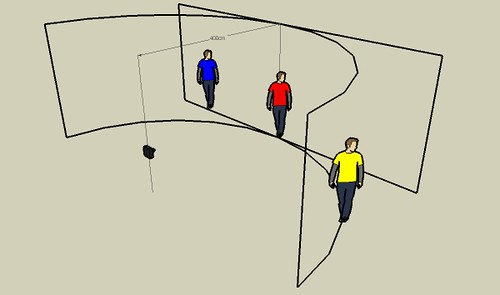
Easier to explain with a picture. Red dotted lines indicate the focal plane in the camera, and the plane that runs parallel to this where you focus. Everything along the dotted line where you focus is in focus... all the blurry dots will be out of focus

focus.jpg
 
Depth of field plane is usualy flat for most camera's, Its only some specialist type of camera's where the depth of field can be altered at a tilt.

But generaly Depth of field extends twice as far behind the point of focus than it does in front.
 
I disagree (with Richardthesanes diagram).

I would describe the sharp area (i.e. what's in focus) as a bubble around the end of the lens with the lens being the central point...

Because, if the above (richards diagram) were true, it means that something that is on the same dotted line which is perpendicular to the direction the camera is pointing will always be in focus, which common sense tells me it can't be because (if you drew a triangle with the camera being one point, the subject being the second point, and something else on the same plane as the subject but a couple of metres away from it) the hypotenuse (distance from camera to the 'something else' is a greater distance from the camera.

so, If the camera has the range of 1.2metres-1.4metres in focus, everything closer or further will be out of focus, and therefore the 0.2 metres which is in focus can only be a continuous curve.

I hope that makes sense! I'm sure someone will be along shortly to put it into better words :)
 
Last edited:
I disagree (with Richardthesanes diagram).

I would describe the sharp area (i.e. what's in focus) as a bubble around the end of the lens with the lens being the central point...

Because, if the above (richards diagram) were true, it means that something that is on the same dotted line which is perpendicular to the direction the camera is pointing will always be in focus, which common sense tells me it can't be because the hypotenuse is a greater distance from the camera.

so, If the camera has the range of 1.2metres-1.4metres in focus, everything closer or further will be out of focus, and therefore the 0.2 metres which is in focus can only be a continuous curve.

I hope that makes sense! I'm sure someone will be along shortly to put it into better words :)

Richard's diagram is correct, like I've already said the DOF is produced as a flat field NOT a curve.
 
how can it be?
As if you take a shot face on of a brick wall with aperture wide open, the edges of the image will be oof
 
I disagree (with Richardthesanes diagram).

I would describe the sharp area (i.e. what's in focus) as a bubble around the end of the lens with the lens being the central point...

Because, if the above (richards diagram) were true, it means that something that is on the same dotted line which is perpendicular to the direction the camera is pointing will always be in focus, which common sense tells me it can't be because (if you drew a triangle with the camera being one point, the subject being the second point, and something else on the same plane as the subject but a couple of metres away from it) the hypotenuse (distance from camera to the 'something else' is a greater distance from the camera.

so, If the camera has the range of 1.2metres-1.4metres in focus, everything closer or further will be out of focus, and therefore the 0.2 metres which is in focus can only be a continuous curve.

I hope that makes sense! I'm sure someone will be along shortly to put it into better words :)

The way I think of it is that although the hypotenuse distance is further from the camera the light from that point has to travel further inside the camera to reach the sensor.
Magic means that everything works out OK and the focus plane is a plane with the DOF being parallel to it.
If you had a curved sensor then the focus plane would also be curved.
Probably not very theoretical but it helps me to think of it like that :)
 
HopefulM said:
how can it be?
As if you take a shot face on of a brick wall with aperture wide open, the edges of the image will be oof

If you shot a flat wall perpendicularly with a good lens wide open it would all be sharp, if you do it with a poorer lens the edges might be soft giving the appearance of a curved depth of field.

Most lenses are flat field designs, and you can't escape that fact.
 
I disagree (with Richardthesanes diagram).

I would describe the sharp area (i.e. what's in focus) as a bubble around the end of the lens with the lens being the central point...

Because, if the above (richards diagram) were true, it means that something that is on the same dotted line which is perpendicular to the direction the camera is pointing will always be in focus, which common sense tells me it can't be because (if you drew a triangle with the camera being one point, the subject being the second point, and something else on the same plane as the subject but a couple of metres away from it) the hypotenuse (distance from camera to the 'something else' is a greater distance from the camera.

so, If the camera has the range of 1.2metres-1.4metres in focus, everything closer or further will be out of focus, and therefore the 0.2 metres which is in focus can only be a continuous curve.

I hope that makes sense! I'm sure someone will be along shortly to put it into better words :)

You are thinking only of the distance from the lens to the subject.

However you need also to consider the distance from nodal point within the lens to the sensor inside the camera. The nodal point, simply described, is the point within a lens that all light passing through the lens converges on.

Light travelling from directly in front of the camera passes into the lens through the nodal point and directly to the middle of the sensor. Light travelling from the top right of the scene will travel further inside the lens to the nodal point, but in turn also has to travel further to the bottom left corner of the sensor.
 
Think of the plane of focus as a 12 foot semicircle around your lens, assuming you are focused at 12ft of course, DOF will bring more into acceptable focus ddepending on f stop, that will increase the semi circular band of acceptable focus. This assume of course that the lens isn't rubbish in the corners :D
 
The focal plane is a plane, a flat plane parallel to the flat plane of the sensor/film surface.


Blue and Red are different distances from the camera but are in the same focal plane.

Red and Yellow are the same distance from the camera but are in different focal planes.
 
The focal plane is a plane, a flat plane parallel to the flat plane of the sensor/film surface.


Blue and Red are different distances from the camera but are in the same focal plane.

Red and Yellow are the same distance from the camera but are in different focal planes.

In the above example, if i focus on RED (using a large aperture), blue will also be in focus but yellow will not. Yellow will only be in focus if it also is on the focal plane. right?
 
Last edited:
No blue wont be in focus as it is further away from the camera.
 
ziggy©;4555285 said:
In the above example, if i focus on RED (using a large aperture), blue will also be in focus but yellow will not. Yellow will only be in focus if it also is on the focal plane. right?

Red and Blue will be in focus, Yellow will only be in focus if the depth of field is sufficient to encompass him as well.
 
Last edited:
Red and Blue will be in focus, Yellow will only be in focus if the depth of field is sufficient to encompass him as well.

Alistair, I can't get my head round this at all! :lol:

yellow is the same distance from the camera, blue is further... so why would blue still be in focus and yellow not? :thinking:
 
Alistair, I can't get my head round this at all! :lol:

yellow is the same distance from the camera, blue is further... so why would blue still be in focus and yellow not? :thinking:

I think because yellow is not on the focal plane. (The rectangular shape shown in the diagram -not the curved shape).

Actually i think the issue is that some people think the focal plane is the rectangular shape and some say it is the curved shape. :lol:
 
Last edited:
The distance to the camera is not relevant..

The sensor (or film) is a flat plane, the focal plane is also flat (not curved). The two are parallel.

You can test this on the dining table or in the garden. On the dining table a big bit of paper, some string, a pencil, a ruler and a variety of different objects.
 
Oh my god I can't believe the over complication here. It doesn't matter if blue in the diagram above is 100 meters away (assuming they still fit in the actual shot of course) so long as he is LEVEL with red, he would always be in focus. Example...
You get out a telephoto lens at one end of a football pitch and you mount it on a tripod exactly in the center of the goal on the goal line. You lock focus on Wayne Rooney's eyes standing at the exact opposite end of the pitch in the center of that goal on the goal line looking back at you. Assume Mr Rooney has two team mates each standing on the same goal line but they are standing one on each corner flag (but still on the line) looking back at the camera. Assume that your telephoto lens had a wide enough field of view to actually get them all in the same shot, then they would ALL be in focus, as they are standing on the focal plane (the goal line).

If ANY of the guys move along that line nearer to the goal post/s, but stay on it, they are still in focus. If they move BACKWARDS or FORWARDS off the line they are out of the focal plane and will start to become out of focus.

Does this make sense?
 
Last edited:
This has been confused by a couple of inaccurate answers. The focal plane is flat, it isn't curved, as Alastair has shown in the diagram
 
Alistair, I can't get my head round this at all! :lol:

yellow is the same distance from the camera, blue is further... so why would blue still be in focus and yellow not? :thinking:

As has been said don't just think about the light from Yellow,Blue and Red to the camera, think about the light inside the camera as well.
I hate to introduce yet another colour but think of Green who is behind Red and is therefore further away and will be out of focus.
Green will be out of focus because the light from him/her reaches the lens and needs more distance to reach focus than the light from Red does therefore the light hits the sensor before it is focused.
Now consider Blue who is also further away than Red. The light from Blue reaches the lens and also needs more distance to reach focus than Red does but the edge of sensor is further away than its middle (where Red is focused) so the light from Blue has enough distance to become focused on the sensor.
Yellow is the same distance as Red but the light from Yellow has further to travel inside the camera than the light from Red does because the edge of the sensor is further away, so the light from Yellow reaches a focus before the sensor and spreads out again before it hits the sensor.
 
Last edited:
Lens manufacturers strive to achieve a flat focal plane. If you take a picture of a wall square on, you want it all in focus. At a wide aperture, softness in the corners starts to become an issue in most lenses. The better the lens, the less of an issue it is. That's what all standard lenses aim to achieve. Softness in the corners is a function of how difficult it is to achieve.
 
Oh my god I can't believe the over complication here. It doesn't matter if blue in the diagram above is 100 meters away (assuming they still fit in the actual shot of course) so long as he is LEVEL with red, he would always be in focus. Example...
You get out a telephoto lens at one end of a football pitch and you mount it on a tripod exactly in the center of the goal on the goal line. You lock focus on Wayne Rooney's eyes standing at the exact opposite end of the pitch in the center of that goal on the goal line looking back at you. Assume Mr Rooney has two team mates each standing on the same goal line but they are standing one on each corner flag (but still on the line) looking back at the camera. Assume that your telephoto lens had a wide enough field of view to actually get them all in the same shot, then they would ALL be in focus, as they are standing on the focal plane (the goal line).

If ANY of the guys move along that line nearer to the goal post/s, but stay on it, they are still in focus. If they move BACKWARDS or FORWARDS off the line they are out of the focal plane and will start to become out of focus.

Does this make sense?

is this something to do with the offside rule?!? ;) :lol:
 
OK, rough diagram here. Again.

nodal.png


Firstly, this all makes more sense when you remember a lens is focusing rays of light reflected off a subject.

The red line is the path of light taken from object that is in focus directly in front of the camera, passing through the nodal point in the lens.

The green lines are the paths taken by light passing through the nodal point from objects at the edge of the frame - but on the same focal plane as the subject in focus. The length of the red line from the nodal point to the subject is shorter than the green lines from the nodal point to the subject... so light from the objects has travelled further.

Now look behind the nodal point. Notice again how the red line is shorter then the green lines? The light from the subjects at the edge also has to travel further inside the camera. But proportionally the difference is the same as the extra distance the light travels on the other side of the nodal point.

So the rays of light from the subject that is further from the camera but still on the same focal plane are correctly focussed on the sensor.

In reality it is not exactly this simple, but that is the best way I can explain it.
 
I was playing about with a friends macro lens a few weeks ago and took this image, which I think shows the plane of focus going from one side to (almost) the other.

focalplane.jpg
 
But proportionally the difference is the same as the extra distance the light travels on the other side of the nodal point.
I think that clears it up for me :thumbs:

If someone was further/closer to the nodal point, the distance would be disproportionate to the rear distance .... I seeeeee :)
 
OK, rough diagram here. Again.

nodal.png


Firstly, this all makes more sense when you remember a lens is focusing rays of light reflected off a subject.

The red line is the path of light taken from object that is in focus directly in front of the camera, passing through the nodal point in the lens.

The green lines are the paths taken by light passing through the nodal point from objects at the edge of the frame - but on the same focal plane as the subject in focus. The length of the red line from the nodal point to the subject is shorter than the green lines from the nodal point to the subject... so light from the objects has travelled further.

Now look behind the nodal point. Notice again how the red line is shorter then the green lines? The light from the subjects at the edge also has to travel further inside the camera. But proportionally the difference is the same as the extra distance the light travels on the other side of the nodal point.

So the rays of light from the subject that is further from the camera but still on the same focal plane are correctly focussed on the sensor.

In reality it is not exactly this simple, but that is the best way I can explain it.

thank you, that makes sense! :)
 
Just to confuse the matter further since the distance from the centre of the film or sensor is different than the edges IN THEORY a curved film or sensor would be the ideal shape to get a scene sharp all over but the (almost) impossibility of making curved films or sensors means that lens manufacturers have to go to a great deal of trouble to correct the lenses to get as sharp a picture as possible across a flat plane.

.

I'm guessing the curved plane would have to vary depending on the focal length of the lens and the distance to the subject?!!
 
Oh my god I can't believe the over complication here. It doesn't matter if blue in the diagram above is 100 meters away (assuming they still fit in the actual shot of course) so long as he is LEVEL with red, he would always be in focus. Example...
You get out a telephoto lens at one end of a football pitch and you mount it on a tripod exactly in the center of the goal on the goal line. You lock focus on Wayne Rooney's eyes standing at the exact opposite end of the pitch in the center of that goal on the goal line looking back at you. Assume Mr Rooney has two team mates each standing on the same goal line but they are standing one on each corner flag (but still on the line) looking back at the camera. Assume that your telephoto lens had a wide enough field of view to actually get them all in the same shot, then they would ALL be in focus, as they are standing on the focal plane (the goal line).

If ANY of the guys move along that line nearer to the goal post/s, but stay on it, they are still in focus. If they move BACKWARDS or FORWARDS off the line they are out of the focal plane and will start to become out of focus.

Does this make sense?

Yes it does. Thanks :thumbs:
 
Take a look on your camera, probably on the top somewhere, and you should see a little engraving of a line with a circle, will look something like this:

2070993-FP.JPG


The line will be shown horizontally, left to right, on the camera. This mark shows the focal plane.

When thinking about DOF, forget the distance from the camera, this is irrelevant. Think in terms of distance from the focal plane.

For the purposes of this, imagine that the focal plane is an infinite length, so this is a line extending out either side of your camera horizontally, following the line of this engraving.

Anything that is parallel to the focal plane will be in focus, regardless of it's distance from the camera.

Therefore, anything parallel to the cameras sensor, (that is the focal plane, or this infinite stretching line from your camera) will be in focus.
 
Last edited:
But generaly Depth of field extends twice as far behind the point of focus than it does in front.

OK, the main point seems to have been settled (the focal plane is a plane (d'oh) not a semicircle - or at least that's what the lens designers aim for) but everybody has let this one slip past.

This keeps getting repeated and it's wrong. There is only one distance between camera and object that gives the 2:1 ratio of far:near for Dof. One specific distance - at any other distance the ratio isn't 2:1. For landscape shooters it's normally going to be (something very big):1, for macro shooters it's normally around 1:1.

Try plugging numbers into the calculator here.

Macro example:
7D; 100mm; f16; 100cm. - DoF ratio = 1:1​

Landscape example:
7D; 16mm; f8; 20m. - DoF ratio = infinity:1​
 
Back
Top