Exposure - Setting your exposure to -2/3 for most shots

Messages
7,969
Name
Sara
Edit My Images
Yes
I am following on TP the thread about the 'Understanding Exposure' Book. I also just got a copy and am reading it, so the thread has been useful. Also didn,t want to hijack it. Anyway ............... towards the end of that thread, one of the posters say that for most shots they set a -2/3 exposure.

Interested if this is a common thing to do and why would you do it? I uderstand that it can help with blown out skies, but so can filters and a correct exposure:shrug::cuckoo:

Does it mean that all your pics come out dark? Does it mean loads of processing?
 
Depends on the scene and the camera really.
Most of the time my D80 is great indors with 0 compensation, sometimes outdoors I need -0.7, and took one yesterday at -1.7 because I liked how it looked (my pylon out of my 365).
It's about knowing your own camera.
 
... one of the posters say that for most shots they set a -2/3 exposure.

Interested if this is a common thing to do and why would you do it?
I bet that person is using their camera's evaluative metering function as opposed to (say) spot metering. And i bet they're using a Canon 400D.

Evaluative metering tries to work out which bits of the picture are important and which should be exposed correctly. I think I read somewhere that Canon's engineers had "taught" the algorithms what matters in each situation by analysing the brightness patterns of 15,000 different photos. It does a pretty amazing job when you think about it. But even so, there are two important qualifications:
(1) the camera might not "understand" the scene properly;
(2) the exposure settings programmed into it might not be to your taste.

It is commonly believed that Canon deliberately set the 400D to under-expose by about 2/3rds of a stop, to prevent inexperienced users (of which there are many) blowing out highlights. You can always recover a picture that's slightly under-exposed, but you can't recover blown highlights.
 
Interested if this is a common thing to do and why would you do it? I uderstand that it can help with blown out skies, but so can filters and a correct exposure:shrug::cuckoo:

I can't see any reason why you would want to do this as a general rule unless your exposure meter is out.

It might help if you're using an "average" reading to meter for landscapes which contain a lot of sky, but as you say, there are filters (ND grads) to correct for this situation.

The only situations where you would routinely add in exposure compensation (+ or -) are where you have got a dark subject which you want to stay dark, or a light subject which you want to stay light. In both these situations the meter will give you a correct reading for an averagely light/dark subject.

One thing we used to do with film was to point the meter at an averagely light/dark subject, lock the meter reading and re-compose. :)
 
But isn't this where real photographic knowledge comes in. If you are not taking a snapshot, when evaluative metering is ideal, and assuming you are not bracketing for HDR, then shouldn't you as photographers meter for the part of the scene/model that you want to reproduce corrrectly and then adjust the exposure to ensure that that is captured correctly.

As for the 400D being deliberately set to underexpose, try taking a picture of an 18% grey card and see where the exposure falls on the histogram, easy really!
 
I shoot using Canon and it's a technique I employ, although it does not apply to every shot it is useful for making sure I get the full range of tones in an image without blowing the highlights.

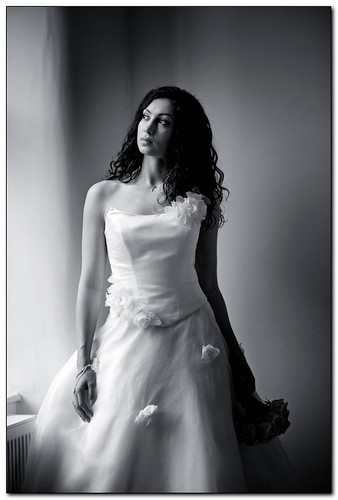
This one was shot with between -2/3 and -1 dialled in for the whole series. It makes sure that the highlights in this one which is a white dress on a white background and lit directionally with window light don't get blown. This is straight out of camera and the exposure has not been brought back up in PP.

3059121061_9ba16bf59b.jpg
 
Underexposing was something that used to be done frequently with certain types of E6 film to try and ensure better colour saturation as there was no post processing available.

If you are permanently underexposing with digital, why? Surely post processing, shooting in RAW, histogram checks and using the best type of metering for the scene you are shooting should negate the need for this?
 
I actually prefer the slightly underexposed look ,but thats my personal taste ,in my very little experience ,a slightly underexposed landscape tends to bring out the colours more ,but thats probably more down to my colour blindness :)
 
I tend to underexpose if im struggling to get an appropriate shutter speed and don't have a monopod/tripod handy.

For example, the other week at Martin Mere - light was fading fast and I hadn't brought a monopod, still wanted to get a few shots in but to get any sort of reasonable shutter speed I had to dial in -2/3 exposure to get the shot, as I was shooting raw it was easy to get things to how they should look in PP.

Obviously you'd have to be careful doing this, underexpose too much and you've got nothing to work with afterwards - or you start to get banding or dramatically increased noise.
 
Underexposing was something that used to be done frequently with certain types of E6 film to try and ensure better colour saturation as there was no post processing available.

This was my understanding also - I know when I used to shoot on fuji slide film it was pretty much mandatory to get the punchy colours.
 
I've just taken some images with my 5D MkII and I have found that the meter is set to underexpose by 0.7 stop.

Took a shot of my grey card and this came up below halfway on the histogram, similarly when I took a shot of my white door in which I wanted to keep some detail it came out a light grey. Increasing the exposure by 0.7 stop improved the images no end.

Images posted have had absolutely no PP at all, straight jpgs out of the camera! All taken on 100mm Macro at about 2 mtr distance. (didn't want the mfd to increase the exposure)

Image 1, Grey card, directly as metered. (too dark)

IMG_1086.jpg


IMG_1986.jpg


Image 2, White Door, directly as metered (too dark)

IMG_1087.jpg


IMG_1987.jpg


Image 3, Grey Card, +1 exposure, (bit bright)

IMG_1089.jpg


IMG_1989.jpg


Image 4, White Door, +1 exposure, (bit bright but still retains detail)

IMG_1088.jpg


IMG_1988.jpg
 
Image 5, Grey Card, +0.7 Exposure, Correctly exposed.

IMG_1091.jpg


IMG_1991.jpg


Image 6, White Door, +0.7 Exposure, Correctly exposed.

IMG_1090.jpg


IMG_1990.jpg
 
With regard to StewartR's point, why would someone further reduce the exposure for a camera that underexposes?
 
Ed, Does that mean that in order to get correctly exposed images you will be setting your exposure to +0.7?

Is this the first time you have done this test and are you surprised by the results?
 
The camera will try to make a white door grey, it will also try to make a black door grey, that's the point. You will need +ve compensation for a white scene like a swan in a snow covered field and -ve compensation for a black cat in a coalmine.
 
Ed, Does that mean that in order to get correctly exposed images you will be setting your exposure to +0.7?

Is this the first time you have done this test and are you surprised by the results?

Yes to both questions, but to answer question 1, Yes, I will be adding +0.7 to my exposure. I usually take a spot reading of something I want to reproduce correctly and adjust the exposure to acheive that. May be something light that I want to keep detail in or something dark that I do not want to lose in shadow. I do not always meter from a mid grey, and I am usually using manual, but do use the histogram to help.

Point 2, I have only had the camera for 11 days so still getting to grips with it, yes it is the first time I have done a full set of exposure tests and no, I am not really surprised at the results, I suspected that the camera meter had an inherrant underexposure built in, but just adjusted for each shot. In future I now know that there is an underexposure factor to take into account when exposing in auto.
 
The camera will try to make a white door grey, it will also try to make a black door grey, that's the point. You will need +ve compensation for a white scene like a swan in a snow covered field and -ve compensation for a black cat in a coalmine.

That is correct in principle and if you are metering from a white door or a black door, the camera doesn't know what you are pointing it at, but that has nothing to do with the fact that my 5D2 camera meter underexposes by 0.7 stops by default. All the shots I took were in manual exposure with the original spot meter reading taken from an 18% grey card. In this instance the camera underexposed the image, end of story!
 
It is commonly believed that Canon deliberately set the 400D to under-expose by about 2/3rds of a stop, to prevent inexperienced users (of which there are many) blowing out highlights.
That's interesting. Wonder if its true!

That would make alot of sence as in most cases the 400D is the common "newbie" camera is someone gets buys there first DLSR. Anyone know if it is the same with the nikon D40/D40X ?
 
That would make alot of sence as in most cases the 400D is the common "newbie" camera is someone gets buys there first DLSR.

So what's their reason for my 5D MkII doing the same then?
 
Both, there will always be production tolerances so the same model will vary slightly. However these tolerances will be very tight so you will be talking a very small fraction of a stop, you'd do well to spot a difference unless one of them has a fault or damage.
 
Apologies to EdBray - on my large monitor the pairs of pictures side by side looked oversize but they were not :$

:coat:
 
I don't think its about inexperienced or experienced users, its about how the sensor best collects information, and that varies from type to type ...from all I can tell the meters in all digital cameras, underexpose in bright light and overexpose in low light, it varies with type but the idea is the same, to produce the best possible image from that sensor, blow highlights verses data in larger quantities. (better data)

There’s also information from the manufactures that in-fact the in-built meters are set for 12% grey (reflected) but as most of us use 18% grey in bright conditions then that works out okay and is also about 0.7 of a stop.

Just to confuse me... :thinking:

That is the opposite to what I have found doing my tests, if you look at the images of the camera you will see that the exposures were from between 1/40 @ f4 ISO1600 to 1/20 @ f4 ISO1600, hardly bright light and the meter was underexposing by 0.7 stops.

I have also just been right through the Canon 5D MkII manual and there is no mention of the meter being set at 12% grey as opposed to the standard 18% grey.

If what you say is fact and Canon have deliberately changed the calibration standard for their metering systems to something away from what the photographic world rely on as the industry standard for metering (18% grey)Perhaps it would be prudent if Canon or any other manufacturer who was planning to deviate from that then let their costomers know.

I am curious enough about this to contact Canon and await their answer as to why my rather expensive camera underexposes by 0.7 stops.
 
I've just taken some images with my 5D MkII and I have found that the meter is set to underexpose by 0.7 stop.


Now take a photo of a black door, and discover that you have to put negative exposure compensation in. All you're discovering here are the limitations of reflective metering, not some flaw in Canon cameras.
 
Now take a photo of a black door, and discover that you have to put negative exposure compensation in. All you're discovering here are the limitations of reflective metering, not some flaw in Canon cameras.

How does that work then?

You are saying that if I spot meter from a Grey Card, then set the exposure IN MANUAL and take a picture of a black door it will not come out black?

Please enlighten me why?
 
I think where talking the same direction with the stops EdBray, :thinking: as I say I'm confused about it.

Note: I don't intend to mislead anyone ...its based on an article I read a while ago, bookmarked on my old machine so I don't have it anymore


If you search for 'digital light meters 12% grey'

You can find a few leads, Here says some of the reasons in the second post.

Edit. Perhaps not a good example that one..
 
Now take a photo of a black door, and discover that you have to put negative exposure compensation in. All you're discovering here are the limitations of reflective metering, not some flaw in Canon cameras.

Spot metered using the cameras meter from the grey card, set the exposure in manual +0.7 stops and took the shot of the card and the shoe (don't have a black door). Card correctly exposed, shoe correctly exposed, +0.7 stops exposure given to compensate for the cameras underexposure.

IMG_1101.jpg


Just noticed the inside of my shoe is almost 18% grey.
 
I think where talking the same direction with the stops EdBray, :thinking: as I say I'm confused about it.

Note: I don't intend to mislead anyone ...its based on an article I read a while ago, bookmarked on my old machine so I don't have it anymore


If you search for 'digital light meters 12% grey'

You can find a few leads, Here says some of the reasons in the second post.

Edit. Perhaps not a good example that one..

LOL, you are not wrong there, if I was looking to find the a thread with the most rubbish talked about exposure readings I would have to look long and hard before I found a worst example than that.

I've just checked the 5D2s meter against my Lunasix F meter (which is very accurate) and it is down about 1/2 a stop, my 30D is down about a 1/3 stop.
 
Lol. tryig not to waffle to much here myself... ;)

So if you used a 12% grey card the 5D would be nearer to showing the correct exposure ... is that what it could suggest?

I reiterate I'm confused, But I think its to do with reflected light, more in daylight I think, the difference between 12% and 18% being about 2/3rds of a stop which in some way that I don't understand, is allowable because of the way digital sensors gather info and therefore the 18% grey card technique is still an acceptable standard to use on all meters.
 
Back
Top