How to use a Tilt and Shift lens for table top photography ?

Messages
1,336
Edit My Images
Yes
I am considering buying and using a Tilt and Shift lens for table top photography rather than their typical landscape / architectural usage, but am struggling to properly understand the technicalities behind using a T & S lens for this specific purpose.

– although I have read it read several times the Scheimpflug principle and Hinge Rule still leaves me slightly cold, especially as some of the measurements required like the Scheimpflug Intersection may be under the ground you are standing on…….:cuckoo:

I have tried searching for examples of how to use a T & S lens for table top product photography, but have not been very successful. I would be photographing products up to 12 inches in length, so believe that the T-SE 45mm lens would be the most suitable focal length, although it seems not to be very popular? I will be using the lens in combination with my Canon 7D or would an alternative T & S lens be more suitable for table top product photography?

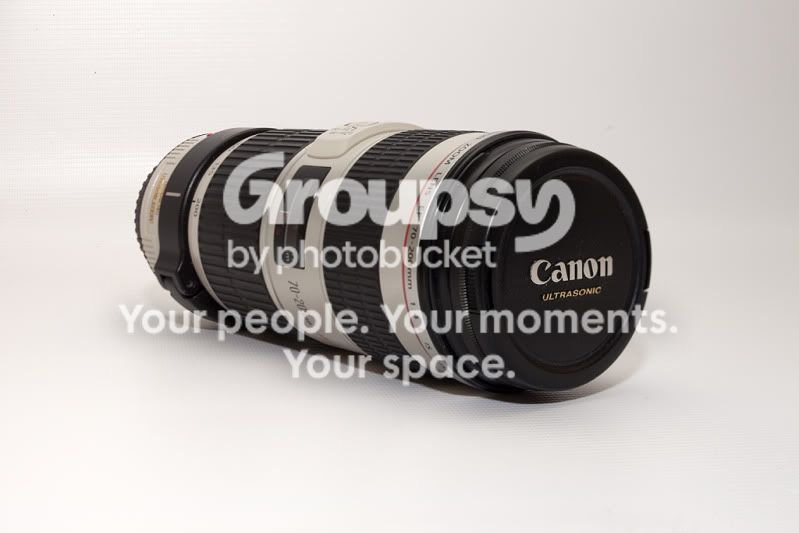
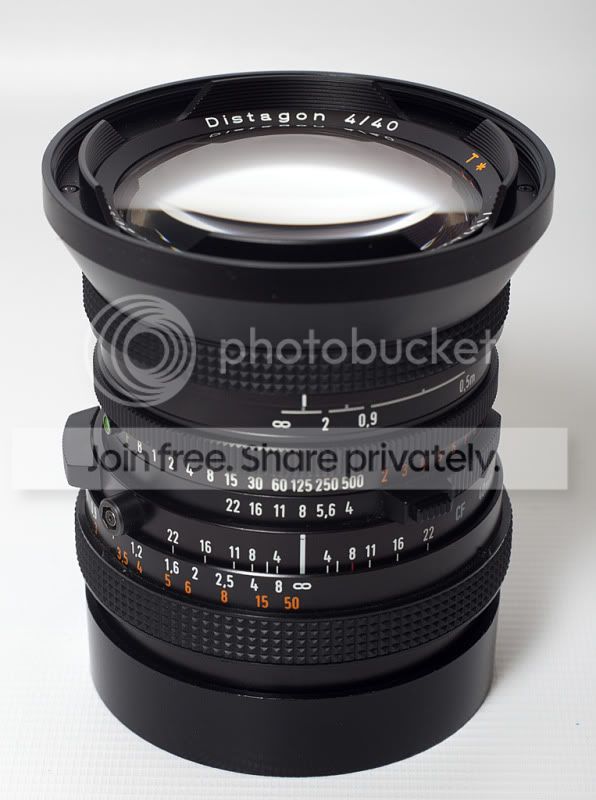
For example if I wish to take a photo of a lens such as this example below which is roughly angled at 45 degrees, to get most of the lens in focus, I would, using a normal lens being about 0.5 metres (focal length ~70mm) away from the subject and the camera about 15-20cm above the subject, use circa F20 to maximize DOF to get most of the lens detail sharp.

crIMG_4622.jpg


It appears that with the T & S I should first “tilt downwards” to get the T & S lens plane to correspond with the subject plane of focus relevant to the height my camera is higher than the subject and then “shift rightwards” to account for the angle of the subject (i.e. the lens), but is it possible to calculate the degree of shift and tilt needed? And whether the TS-E 45mm would be suitable for the task?

Is that the correct principle to get the ‘equivalent’ of maximum DOF [plane of focus]?

Grateful for any advice or links to tutorials on using a T & S lens for table top product photography.

Regards
 
My suggestion would be to buy a Mirex adapter Canon/Mamiya (circa £380) and a selection of Mamiya 645 lenses (quick check on ebay buy it now):

Mamiya 35mm £300
Mamiya 45mm £150
Mamiya 80mm £135
Mamiya 150mm £80


So for under the cost of a new Canon t/s lens you can get an adapter with 45, 80 and 150mm lenses to fit it.

I will take a shot with my Mirex adapter on my 5DMk2 and 50mm Hasselblad fit Distagon lens to show you that what you are trying to do can be done quite easily.
 

There are some tables here http://www.luminous-landscape.com/tutorials/focusing-ts.shtml - they might be of some use.

I think I had seen these tutorials before on my travels and the tables are easy to use, but unless I have misunderstood are more suited to landscape/ architectural scenarios. As when doing table top photography the "J" or perpendicular height would typically be quite shallow.

Thanks for the links.
 
Right, I have taken some quick and dirty images to show what you can do quite easily on a tabletop with a tilt/shift lens.

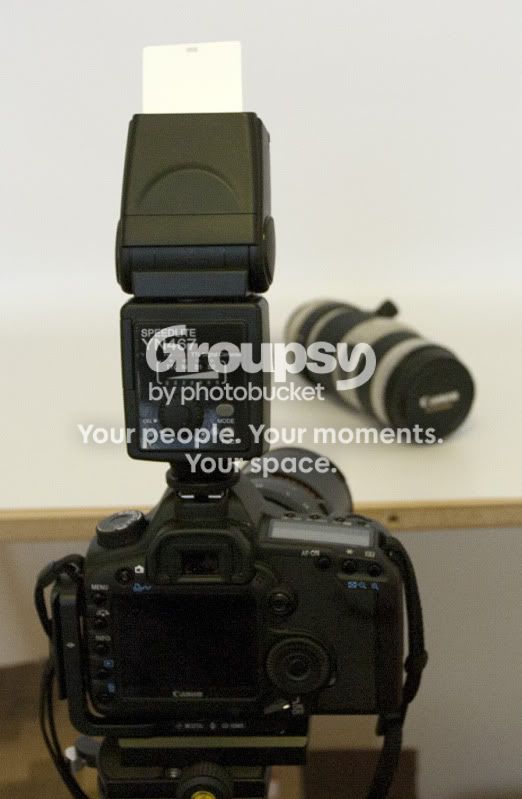
This is the setup. Full swing (sideways tilt) to right. Canon 5DMk2 with 50mm Carl Zeiss CF T* (Hasselblad) on Mirex Hasselblad to Canon Tilt/Shift adapter. Yongnou Flash set to Manual to give consistent results, aperture changes allowed for by changing ISO to compensate.

Subject is Canon 70-200L f4 IS on white vinal on tabletop, camera to subject distance about 12".

tssetup.jpg


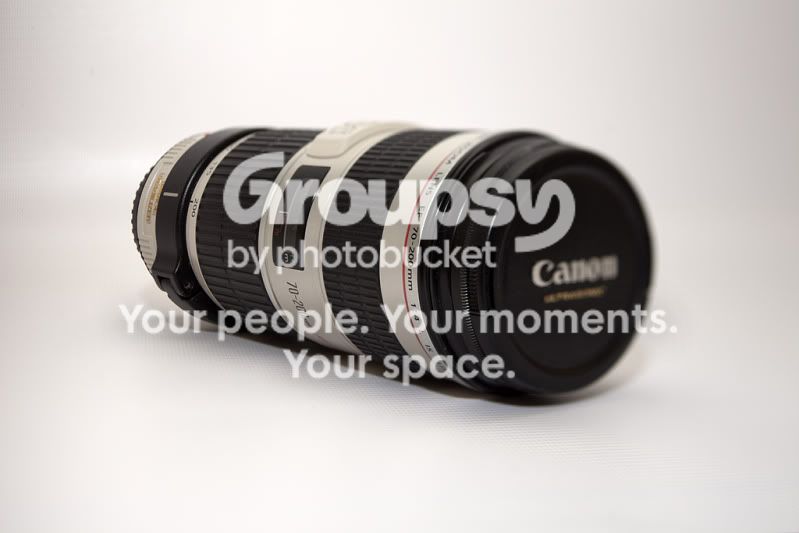
First image taken wide open at f4, ISO50. The plane of focus is along the left edge of the lens.

tsf4.jpg


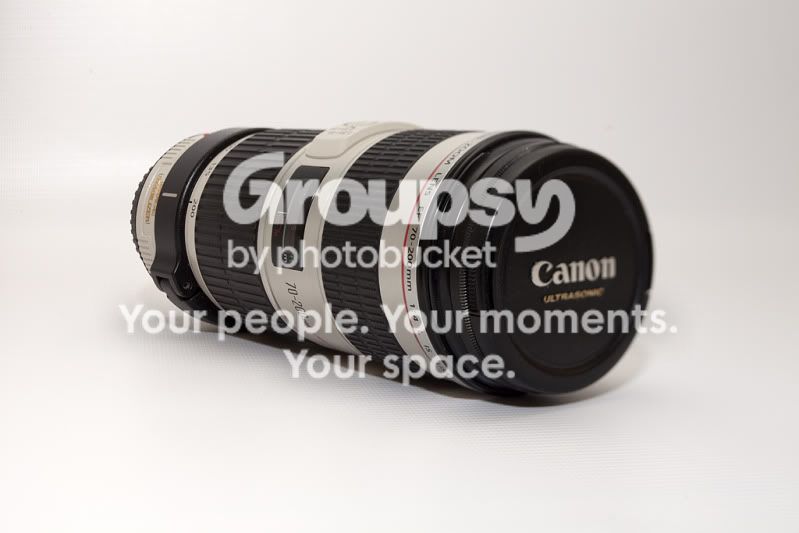
Second image taken at f8, ISO 200. The plane of focus again along the left edge of the lens. Notice more of the Canon logo is sharp on the lens cap.

tsf8.jpg


Third image taken at f16, ISO 800. The plane of focus again along the left edge of the lens. Even more of the Canon logo is sharp on the lens cap. (This is quite wasteful of DOF though as the DOF in front of the plane of focus is being lost).

tsf16.jpg


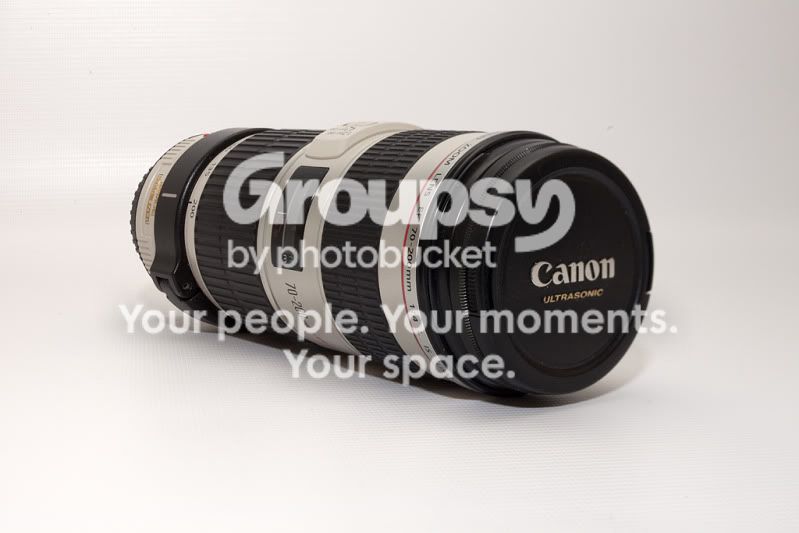
This last image is nearer to the finished item. The plane of focus is through the front edge of the C of the Canon logo and is thus allowing the DOF at f11 to cover the whole of the lens (actually could be a bit better but it was just to show what can be acheived quite easily).

tsf11.jpg


If you are going to attempt this type of photography my suggestion would be that you need a camera with live view (makes life much easier) and a full frame sensor would be an advantage as it allows you to use more lenses, as with a crop factor to contend with you will be limited as to what cheaper options are available, that said, both the 17L TSE & 24L TSE Mk2 are phenominal lenses and will work fantastically on a crop camera.

If buying a Mirex adapter for a 1.6x crop camera I would probably limit myself to the Mamiya 35mm (AOV of 56mm), 55mm (AOV of 90mm) & 80mm (AOV of 130mm).
 
I don't know whether this thread will help at all. I was struggling to take a picture in my light tent using my T&S lens. Lots of helpful advice on there, but gave up in the end. I'm such a girl!!!

Hello Sarah,

Thanks for the link, I had not spotted that thread and have been trying to grasp the helpful comments contained therein - certainly for me the technical illustrations are confusing as they all typically refer to a Film or MF camera where the film focal plane can be adjusted in all directions (focusing by moving the the bellows) - but as I have not grown up with film in that depth, it is difficult to translate that to a digital environment where we are using a fixed focal length T & S lens......

It does appear that using either the 24mm or even the 45mm T & S may not be totally suitable for the type of small products we want to shoot as the amount of tilt we need may be greater than the lens can achieve - I may have to go and just buy a lens to experiment with as that may be the easiest option to see the various effects that can be achieved...... it is difficult to envisage how it all works without an actual lens!

I was erring towards the 45mm lens as I thought that also be used for landscape / architectural shots as well, but the 90mm T & S lens might be the one to go for for table top / product / macro shots, although its then more restrictive on what else it can be used for.

Or I could carry on using my normal lens and just up the F-stop to get maximum DOF?

Don't give up, the lens you have certainly seems ideal for landscape/ architectural situations and can also be used for some product shots as has been demonstrated.

-Eb Bray used an Extender on his 24mm lens for his chilli shot, but I wonder if using a 500D close-up lens would be a better combination?

Regards

Roy
 
Roy,

I'm confused, what is it you actually want to shoot?

Apart from my having specifically chosen something to match the subject in your initial post, you now seem to be suggesting that what you want to shoot cannot be done with a normal tilt/shift lens. I beg to differ.

Since you have completely ignored any of my posts but have posted around them it would seem that my suggestions are of no consequence to you. Therefore I shall not waste my time on this any more.
 
Hello Edward,

Thank you for producing the example shots above and seeing the set up has helped with my understanding of how to set up the T & S lens.

I will be using the lens on my 7D and so will be able to use Live view to see the effects. Your Mirex adapter / lens configuration certainly is very capable of achieving what I would like to shoot, which typically would be model cars, small products and similar objects typically less than 12" in size.

Thank you.
 
Roy,

I'm confused, what is it you actually want to shoot?

Apart from my having specifically chosen something to match the subject in your initial post, you now seem to be suggesting that what you want to shoot cannot be done with a normal tilt/shift lens. I beg to differ.

Since you have completely ignored any of my posts but have posted around them it would seem that my suggestions are of no consequence to you. Therefore I shall not waste my time on this any more.

Edward,

I was attempting to reply to the posts as they occurred and not ignoring you. I have already posted a thank you note for the photos you produced above.

This is a totally new area to me and as I said I was having difficulty in grasping the technicalities and I was going through the thread following the links and trying to understand all that was being presented to me, for which I am very grateful.

I had never heard of the Mirex adapter you referred to and tried to do some research before replying which took me some time.

Looking at the photos you produced, with the lens on Full swing (sideways tilt) the first 3 shots were at F4, F8 and then F16 - I though perhaps [naively] that I would be able to achieve a shot with everything in focus with the lens wide open, by changing the tilt and shift settings ?

But the last shot was taken at F11 and appears overall to have more 'DOF', Did you change the shift / tilt settings to achieve this please?

Regards

Roy

ps You gave a link above to your "original thread"

- but the link took me to a thread where you purchased some Star Wars Lego and I could not see any reference to Tilt and shift lenses.
- Have you the correct link please?
 
Edward,

I was attempting to reply to the posts as they occurred and not ignoring you. I have already posted a thank you note for the photos you produced above.

Not strictly correct as you replied to Ozei before replying to Sara although they posted in the reverse order

This is a totally new area to me and as I said I was having difficulty in grasping the technicalities and I was going through the thread following the links and trying to understand all that was being presented to me, for which I am very grateful.

I had never heard of the Mirex adapter you referred to and tried to do some research before replying which took me some time.

Looking at the photos you produced, with the lens on Full swing (sideways tilt) the first 3 shots were at F4, F8 and then F16 - I though perhaps [naively] that I would be able to achieve a shot with everything in focus with the lens wide open, by changing the tilt and shift settings ?

That will depend on how close you are to your subject as the depth of field is dependant on magnification regardless of the plane of focus.

But the last shot was taken at F11 and appears overall to have more 'DOF', Did you change the shift / tilt settings to achieve this please?

No, no change to the shift/tilt just a change to the plane of focus. As I tried to explain, if you set your plane of focus along the outside of the lens, you are in effect wasting Depth of Field as any DOF outside of that will not have any effect on the lens as it would fall outside the area of the lens, but if you move your plane of focus 'inside the lens' (I focussed on the edge of the C of Canon) then the depth of field will then cover both the side of the lens and also the top/front giving the impession of greater depth of field even though the aperture used was smaller at f11. This was done deliberately to show that it is not all about how much depth of field you have but how to focus properly to make best use of what you have available.

Regards

Roy

ps You gave a link above to your "original thread"

- but the link took me to a thread where you purchased some Star Wars Lego and I could not see any reference to Tilt and shift lenses.
- Have you the correct link please?

Now corrected
 
Hello Edward,

I enjoyed reading your Battery Depth of Field thread, that is how I thought the T & S lens would work, i.e. a large 'apparent DOF' with the lens fully wide open - as all the battery shots were taken with the 24mm T & S lens at F/3.5.

If you had used the 24mm T & S lens on the Canon 70-200L f4 IS you used as a subject above, using the last example where you focused on the 'C' of Canon on the lens cap, would it also have been totally in focus?

I think I will have to bite the bullet and get myself one of these lenses to see how it all works in practice, hopefully it will be easier to use in practice rather than trying to work out the theory. Then if I get to grips with that I can investigate your Mirex adapter and lens combinations further as that does sound appealing and more versatile than one Canon T & S lens.

Thanks again.
 
What you do not seem to be grasping is that at the maximum aperture there will only be a certain amount of Depth of Field at a focused distance. It will not matter where you put the Plane of Focus, dependant on the aperture the amount of DOF will be the same.

Depending on the item being photographed and where you put the plane of focus and knowing that DOF extends in a 3D cone (point closest to the camera) from around the plane of focus and that the size of the cone is dependant on the size of the aperture then it is possible to extend that cone around the item to make it appear that all is in focus.
 
My suggestion would be to buy a Mirex adapter Canon/Mamiya (circa £380) and a selection of Mamiya 645 lenses (quick check on ebay buy it now):

Mamiya 35mm £300
Mamiya 45mm £150
Mamiya 80mm £135
Mamiya 150mm £80


So for under the cost of a new Canon t/s lens you can get an adapter with 45, 80 and 150mm lenses to fit it.

I will take a shot with my Mirex adapter on my 5DMk2 and 50mm Hasselblad fit Distagon lens to show you that what you are trying to do can be done quite easily.


Hmm. Interesting. Especially as I already own a Mamiya M645J and a wide lens for it is already on my shopping list.
 
For 'tabletop' or studio product photography as is being discussed here is a TS lens not just a very expensive way of getting things in focus?

Could full focus coverage of the subject not be achieved using a smaller aperture and a longer exposure?

It doesn't seem like theses thing will be running off anytime soon so longer exposures surely not a problem?
 
For 'tabletop' or studio product photography as is being discussed here is a TS lens not just a very expensive way of getting things in focus?

Depends on what you want to do and what you are willing to accept I suppose. You could also ask why people buy Canon 5DMk2s when a 5DMk1 will give perfectly acceptable results. Why do some people buy L lenses when they could get away with a cheaper equivalent?

Could full focus coverage of the subject not be achieved using a smaller aperture and a longer exposure?

Not always, it would depend. You would also be limited by the minimum aperture, the size of the subject and close you wish to shoot. You could shoot from further away and crop if you don't mind compromising on quality. Also after f11 diffraction starts to play a part in degrading the image with the degradation increasing proportionately the smaller the aperture.


It doesn't seem like these things will be running off anytime soon so longer exposures surely not a problem?

Not so much now that we are not using film with its associated reciprocity failure, still a shorter exposure is usually better.

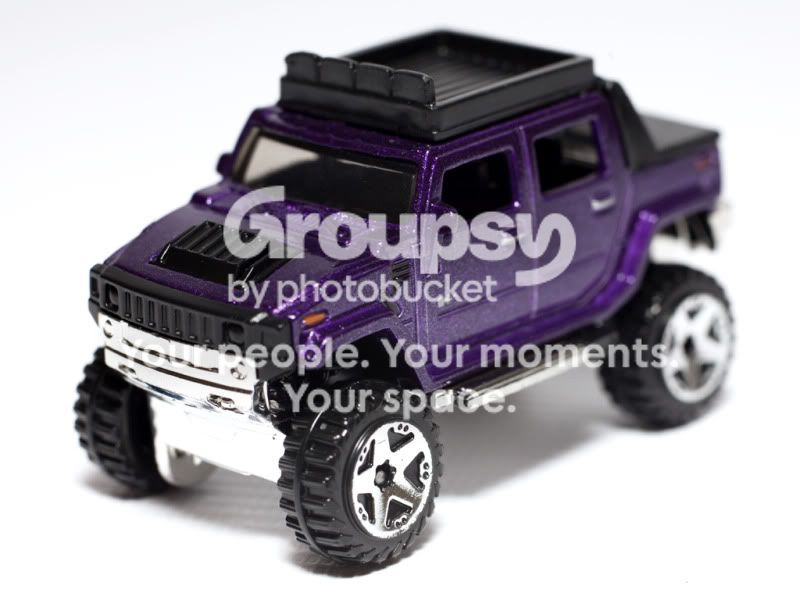
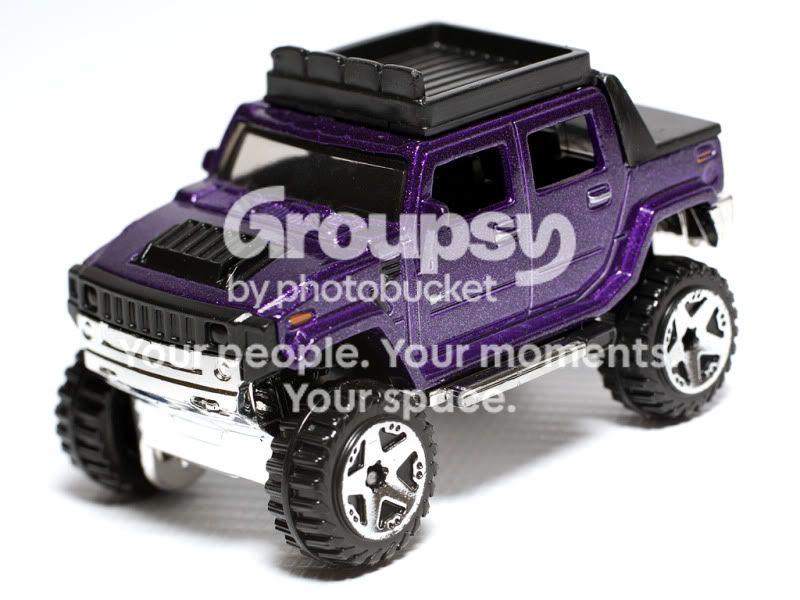
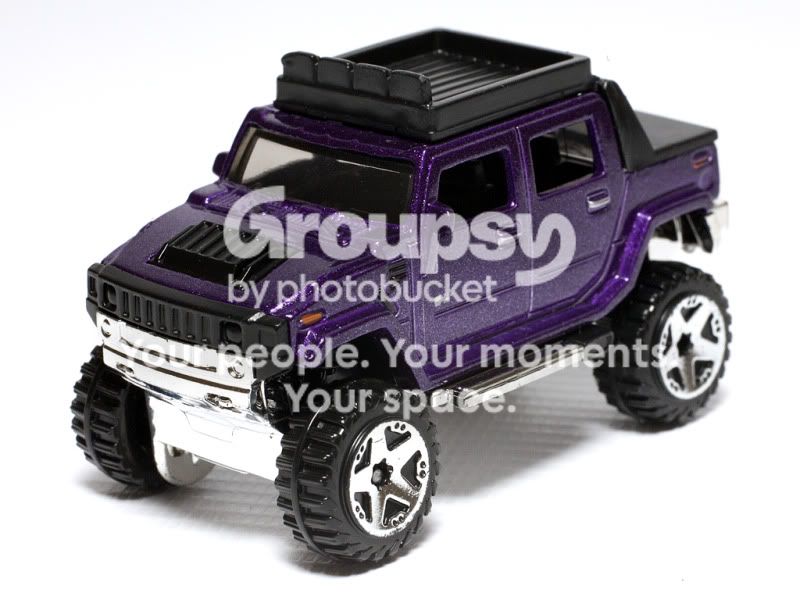
Here are a number of images of a 3" Toy Car. They were all taken from the same position on the same lens an 80mm C T* Carl Zeiss Planar on the Mirex adapter on my Canon 5DMk2. I focussed on the rear edge of the nearside wing to allow for DOF in front of and behind the focus point

f4 straight shot

f4straight.jpg


f8 straight shot


f8straight.jpg


f8 lens tilted (swung)

f8swing.jpg


f22 straight shot

f22straight.jpg


F22 lens tilted (swung)

f22swing.jpg
 
hey ed, i've been considering the mirex adapter for quite sometime now but i'm concerned about the sift mechanism. i also own a 50mm f/4 Distagon CF T* lens but the image circle on the rear of the lens seems so small, wont this show up on photos when i have the adapter sifted? if it doesn't, and if its not too much trouble, would it be possible for you to post some examples photos with and with out sift?

i want to be able to do some architectural photography and control perspective but can't afford any of Canon's TS lenses since im a poor college student! i was really hoping this adapter (in combination with my Hasselblad lenses) could help solve my problems so i would really appreciate your help!!
 
hey ed, i've been considering the mirex adapter for quite sometime now but i'm concerned about the sift mechanism. i also own a 50mm f/4 Distagon CF T* lens but the image circle on the rear of the lens seems so small, wont this show up on photos when i have the adapter sifted? if it doesn't, and if its not too much trouble, would it be possible for you to post some examples photos with and with out sift?

i want to be able to do some architectural photography and control perspective but can't afford any of Canon's TS lenses since im a poor college student! i was really hoping this adapter (in combination with my Hasselblad lenses) could help solve my problems so i would really appreciate your help!!

Does the h not work on your keyboard?

There are some images in this thread showing the use of shift and tilt on both the 50mm Distagon and the 80mm Planar.


Hope that helps.
 
http://www.mirex-adapter.de/tilt_shift_adapter.htm

Just drop them an email (in English is fine) and they will get back to you.

If I was buying again I would get a T Mount or M42 mount version as the option would be open to change camera systems without forgoing my tilt/shift options.

Thanks Ed. I've had a snoop round the site but can't figure out which Mirex (if any) would fit a Nikon. :thinking:

Also, how well does the Mirex/Mamiya combination(s) compare with equivalent tilt/shift lenses from Canon or Nikon?
 
Just some comments to the OP really.

I'm not sure you have presented a compelling reason why you need a T&S lens. They are needed on large format cameras because they inherantly have such shallow DoF you need all the help you can get. Why can't you just shoot at a high f/number? If that's not enough, then move back so that the image is smaller, which increases DoF. Compacts have tons of DoF, whether you want it or not!

If you then run into image quality problems, then that is important in large prints but if you are only outputting small, or to web or something, that's unlikely to be an issue. T&S lenses are really to give you more sharpness, where you need it, without having to use high f/numbers where diffraction becomes a problem. They are also used creatively quite a lot now, with reverse Scheimpflug, so give very shallow/selective DoF but that doesn't seem to apply here.

I think you are making Scheimpflug more complicated that it is. Very simple, quick and easy. I think you need to understand the '3D cone of sharpness' Ed mentions first - that is the variable and moveable zone of DoF that is at the heart of how these things work.

Just reading between the lines, I think maybe the 90mm T&S may be the better choice, if you are not to be too close and possibly running out of background behind due to the wider field of view. Possibly the 45 with an extender might be an option, and athough Canon doesn't recommend it, it seems to work well for some people.

Either way, you can hire one quite cheaply from a number of places, like www.LensesForHire.co.uk that advertise on here.
 
Thanks Ed. I've had a snoop round the site but can't figure out which Mirex (if any) would fit a Nikon. :thinking:

Also, how well does the Mirex/Mamiya combination(s) compare with equivalent tilt/shift lenses from Canon or Nikon?

Send Mirex an email, they can answer any questions you have. I can only speak for the Canon varient.

As for how they compare with equivalent lenses from Canon/Nikon well, apart from the wider angles available 17mm & 24mm from Canon and 24mm from Nikon there would be little or no difference when using the Mirex, except for the stop down metering you would have to employ but on certain Nikons you can set the lens to work anyway.

There is one major advantage to the Mirex/Mamiya varient though you can have the option to get hold of a 55mm T/S Mamiya lens and combine the two to give a wide variety of movements.
 
Thanks Ed. I've had a snoop round the site but can't figure out which Mirex (if any) would fit a Nikon. :thinking:

Also, how well does the Mirex/Mamiya combination(s) compare with equivalent tilt/shift lenses from Canon or Nikon?

Send Mirex an email, they can answer any questions you have. I can only speak for the Canon varient.

As for how they compare with equivalent lenses from Canon/Nikon well, apart from the wider angles available 17mm & 24mm from Canon and 24mm from Nikon there would be little or no difference when using the Mirex, except for the stop down metering you would have to employ but on certain Nikons you can set the lens to work anyway.

There is one major advantage to the Mirex/Mamiya varient though you can have the option to get hold of a 50mm Shift Mamiya lens and combine the two to give a wide variety of movements.
 
Just some comments to the OP really.

I'm not sure you have presented a compelling reason why you need a T&S lens. They are needed on large format cameras because they inherantly have such shallow DoF you need all the help you can get. Why can't you just shoot at a high f/number? If that's not enough, then move back so that the image is smaller, which increases DoF. Compacts have tons of DoF, whether you want it or not!

If you then run into image quality problems, then that is important in large prints but if you are only outputting small, or to web or something, that's unlikely to be an issue. T&S lenses are really to give you more sharpness, where you need it, without having to use high f/numbers where diffraction becomes a problem. They are also used creatively quite a lot now, with reverse Scheimpflug, so give very shallow/selective DoF but that doesn't seem to apply here.

I think you are making Scheimpflug more complicated that it is. Very simple, quick and easy. I think you need to understand the '3D cone of sharpness' Ed mentions first - that is the variable and moveable zone of DoF that is at the heart of how these things work.

Just reading between the lines, I think maybe the 90mm T&S may be the better choice, if you are not to be too close and possibly running out of background behind due to the wider field of view. Possibly the 45 with an extender might be an option, and athough Canon doesn't recommend it, it seems to work well for some people.

Either way, you can hire one quite cheaply from a number of places, like www.LensesForHire.co.uk that advertise on here.

As I said initially I was considering a T & S lens for table top product photography and the reason is that using a combination of a 7D plus the 24-105mm lens to get most of the subject overall in focus I was having to increase the F/number to circa 20 and I saw to 'my eyes' that the shots were slightly less sharp than shooting at F/8 - the shots were perfectly acceptably sharp for screen shots or for uploading to the web, but I do want to be able to print out the results in large print hence my interest in a T & S lens.

I had thought about using a decent compact camera, but have not as yet gone down that route, I will explore that option too.

I know everyone says the Scheimpflug principle is simple in operation, but all the reading I have seen, appears too complicated for me...... perhaps its because I have only been into photography fairly recently and have not got the basic theoretical grounding from a film background or I am a slow learner? All the reading I spotted on the Scheimpflug rules were based around film/MF cameras and had complicated looking theorem and diagrams which left me slightly cold.

I have seen how the wedge shaped or 3D cone of sharpness extends and gets greater the further away from a subject, but as I will be shooting at close focus distances, therefore my 3D cone/wedge will be narrow, perhaps for me mentally visualizing how tilting a lens will correspond to changes in the depth of field so close to my subject is difficult without actually using a T & S lens.

Perhaps the easiest scenario is those which demand more tilt than the lens supports. I can then just use maximal tilt in the chosen direction, then choose the focus distance which achieves the best available depth of field placement.

I had been re-reading the initial link that Sarah posted where she was having difficulty in shooting a chilli and you made a comment that 'Scheimpflug needs maybe 15 degrees of tilt, and I think you've only got 8 degrees on the lens?' I saw from this that there are limitations of using a T & S lens with a subject at very close range - Sara was using the 24mm version and I thought this would point me towards the 45mm or more likely the 90mm so I would have a longer subject distance and potential for a reduction in the angle of tilt required by decreasing the height above the subject.

Thanks for your advice and yes lens rental is another option.

regards

Roy
 
As I said initially I was considering a T & S lens for table top product photography and the reason is that using a combination of a 7D plus the 24-105mm lens to get most of the subject overall in focus I was having to increase the F/number to circa 20 and I saw to 'my eyes' that the shots were slightly less sharp than shooting at F/8 - the shots were perfectly acceptably sharp for screen shots or for uploading to the web, but I do want to be able to print out the results in large print hence my interest in a T & S lens.

I had thought about using a decent compact camera, but have not as yet gone down that route, I will explore that option too.

I know everyone says the Scheimpflug principle is simple in operation, but all the reading I have seen, appears too complicated for me...... perhaps its because I have only been into photography fairly recently and have not got the basic theoretical grounding from a film background or I am a slow learner? All the reading I spotted on the Scheimpflug rules were based around film/MF cameras and had complicated looking theorem and diagrams which left me slightly cold.

I have seen how the wedge shaped or 3D cone of sharpness extends and gets greater the further away from a subject, but as I will be shooting at close focus distances, therefore my 3D cone/wedge will be narrow, perhaps for me mentally visualizing how tilting a lens will correspond to changes in the depth of field so close to my subject is difficult without actually using a T & S lens.

Perhaps the easiest scenario is those which demand more tilt than the lens supports. I can then just use maximal tilt in the chosen direction, then choose the focus distance which achieves the best available depth of field placement.

I had been re-reading the initial link that Sarah posted where she was having difficulty in shooting a chilli and you made a comment that 'Scheimpflug needs maybe 15 degrees of tilt, and I think you've only got 8 degrees on the lens?' I saw from this that there are limitations of using a T & S lens with a subject at very close range - Sara was using the 24mm version and I thought this would point me towards the 45mm or more likely the 90mm so I would have a longer subject distance and potential for a reduction in the angle of tilt required by decreasing the height above the subject.

Thanks for your advice and yes lens rental is another option.

regards

Roy

I still think you are making too much of Scheimpflug. It is simply taking the image plane (which is fixed in a DSLR) and the plane of the subject that you want sharp, then disecting it.

For example, imagine a flat landscape with the camera upright. The image plane is vertical and the subject plane is horizontal, and if you draw imaginary lines extending them both, the two planes meet directly at the spot beneath the camera at ground level. So simply tilt until the the lens plane points to the spot and that has maximised your potential DoF.

If you have a longer lens, then you need more angle as it's pivot point will be correspondingly further forward. The more you tilt, you soon run out of image circle and there's only so far you can go with these things.

Also, a T&S lens does not increase DoF, it just allows you to move the plane of sharpness to where it will be most useful which is of course not the same thing. For example, I can imagine the case with a model that you'll be able to get it sharp down the sides but it will be blurred across the front - as with Ed's example on the lens cap.

I don't think a compact is the answer if you want nice big prints. You might get the DoF, but you won't get the image quality. One idea though might be focus stacking, popular with extreme macro. I've never done it myself but I've seen very effective results with fantastic quality and I guess that in theory you can get as much DoF as you want that way. Basically take a series of images at different focusing points and merge them in post processing.

Could be the answer?
 
Good example I shot yesterday.

The image itself was taken on a Canon 5DMk2 using an 80mm Planar at f8 with 16mm Extension tube on the Mirex Tilt/Shift adapter using full tilt to give a sharp plane of focus diagonally from the bottom front of the lens to the rear top. Lit with an on camera flash bounced into a small Lastolite Ezybalance (white side). This almost completely filled the frame giving the maximum amount of Pixels available if required (obviously not really required in this case).


40mmDistagon.jpg
 
Back
Top