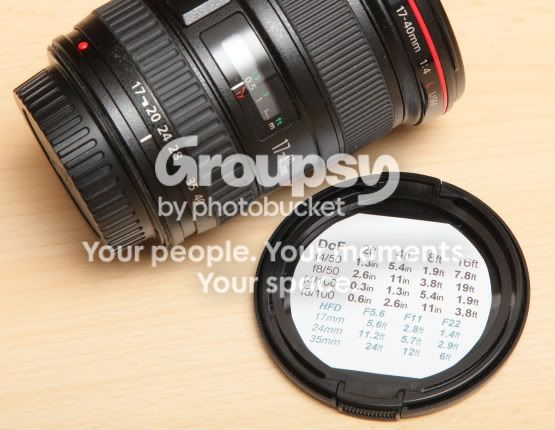
Hyperfocal distance focusing is actually very simple. This is all I need, written inside the lens cap of my 17-40L lens (data from
www.dofmaster.com ).
HFD..........f5.6.......f11......f22
17mm......5.6ft.....2.8ft....1.4ft
24mm.....11.2ft.....5.7ft....2.9ft
35mm......24ft.......12ft......6ft
That's all I need - a handful of numbers (note that they relate to full frame, crop format is different). The reality of hyperfocal distance focusing is that it only really applies to wide angles and landscape photography. And because the real world use of depth of field is not nearly so exact as the numbers might lead you to believe, it is easily possible to estimate the inbetween settings.
As mentioned above, the other thing to know about HFD focusing is that the
near point of the hyperfocal
range is always exactly
half the HFD, ie HFD 10ft, everything sharp from 5ft to infinity.
This is how I do it in practise - landscape with distant mountains and a nice rock formation in the foreground. Frame it up at 24mm, and I visually estimate that the nearest rock I want sharp is 6ft away. I therefore know that the hyperfocal distance I need is double that at 12ft, and I will usually use AF (centre point, focus-recompose) to focus on something which I estimate is twice as far away as that nearest point. This is very easy to do, and completely avoids the need to refer to any distance scales on the lens, which are often not much help. Then if I look inside my lenscap, I see that 12ft corresponds pretty closely to f/5.6. Job done

Just one more thing. HFD focusing can be quite controversial, and one objection is that by definition what it does is put infinity right at the extreme edge of acceptable sharpness. If those distant snow capped mountain are maybe the most important thing in the shot, then you need to make sure they are very sharp rather than just sharp enough. There are various ways of addressing that, but one of the simplest is just to use a higher f/number than the one suggested, in the case above, set f/8 instead of f/5.6.