Hyperfocal Help

Messages
6
Name
Stuart
Edit My Images
Yes
I really want to take a lot of landscape shots and it's important that my photos are as sharp as they can be so I've been trying to get my head around hyperfocal distances.

I'm shooting with the Nikon 18-55 kit lens which doesn't have any of the markings or scales that I'm seeing on the lenses in the examples given so what setting should I be using?

Also, how do I focus on the correct distance with autofocus? Do I need to use manual focus?

Thanks.
 
There is a formula for calculating the hyperfocal focusing distance which you can find on Google. A lot of people use High f numbers for landscapes at the expense of shutter speed. If you don't want to calculate each time then an accepted practise is to (manual) focus one third into the scene and this will give you the maximum Dof. When the camera is focused at this point everything in the picture should be sharp from halfway between it and the camera, right out to infinity. An example with a 28mm focal length @f8 focused to 5.25 meters ISO 200 will give 1/50 shutter speed. I got a table for Canon cameras from pbase.com/eos5d

Paul
 
an accepted practise is to (manual) focus one third into the scene
Paul

I use this approach, but I've used spot focus on a point one third into the scene - is there any need for it to be manual? I don't see how that can make a difference - but am often proved wrong, so do fill me in if it's the case again!
 
I use this approach, but I've used spot focus on a point one third into the scene - is there any need for it to be manual? I don't see how that can make a difference - but am often proved wrong, so do fill me in if it's the case again!

Putting it on manual allows you to recompose, if you leave it on AF it will re focus if you recompose.

I`m no expert landscape photographer, but I think that is right.
 
No need to focus manually, which can be difficult when something is far away, and especially on a cropped sensor camera, just use the auto focus at the point you want, and then switch to manual focus.
 
No need to focus manually, which can be difficult when something is far away, and especially on a cropped sensor camera, just use the auto focus at the point you want, and then switch to manual focus.

Would it not be easier to us back button focus to get the correct focal point.
When the camera is moved and the shutter button pressed the camera will not refocus.
 
Would it not be easier to us back button focus to get the correct focal point.
When the camera is moved and the shutter button pressed the camera will not refocus.

Yep, that's another way to get focus without using the shutter button. :thumbs: :)

I prefer switching to manual focus once I've focused on a point because then I know that the only thing which is going to change focus is moving the focus ring or switching the AF back on a re-focusing, and not accidentally touching the AF lock button again or the shutter button. What ever works and you're comfortable with though.

If you switch the AF off though, don't forget to switch it back on. ;) :lol:
 
The dofmaster link in post #6 is excellent - it's all there.

You cannot really use the rough 'one-third in' rule of thumb for landscape. The ratio is more like 1:10 or even more at long distance, rather than 1:3 - also one third of infinity is hard to estimate ;) And at very close range (macro) there is almost exactly 50/50% depth of field either side of the focused point. 'One third in' is not a bad trick to use if you know both the near and far focus limits, when shooting a group perhaps. If you try and use it for landscape, you will usually miss out on a lot of near sharpness.

One handy tip to remember for hyperfocal distance setting is that the HFD is always exactly double the closest point of the hyperfocal range. For example, if the HFD is 3m, then everything will be sharp from 1.5m to infinity.

You can use either AF or manual for HFD setting. Sometimes AF is easier if the focusing scale doesn't have many markings, or maybe even no markings at all. If the HFD is 3m, just estimate 3m and AF on something at that distance.
 
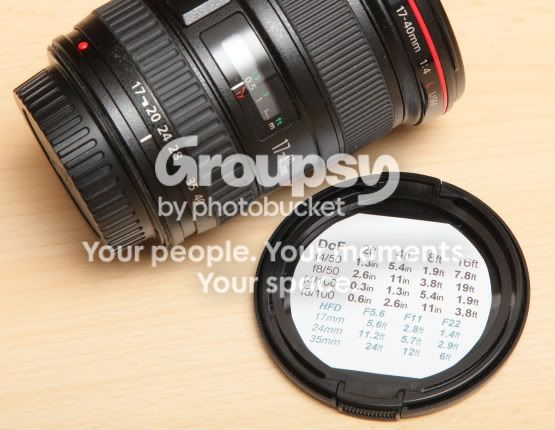
Hyperfocal distance focusing is actually very simple. This is all I need, written inside the lens cap of my 17-40L lens (data from www.dofmaster.com ).

HFD..........f5.6.......f11......f22
17mm......5.6ft.....2.8ft....1.4ft
24mm.....11.2ft.....5.7ft....2.9ft
35mm......24ft.......12ft......6ft

That's all I need - a handful of numbers (note that they relate to full frame, crop format is different). The reality of hyperfocal distance focusing is that it only really applies to wide angles and landscape photography. And because the real world use of depth of field is not nearly so exact as the numbers might lead you to believe, it is easily possible to estimate the inbetween settings.

As mentioned above, the other thing to know about HFD focusing is that the near point of the hyperfocal range is always exactly half the HFD, ie HFD 10ft, everything sharp from 5ft to infinity.

This is how I do it in practise - landscape with distant mountains and a nice rock formation in the foreground. Frame it up at 24mm, and I visually estimate that the nearest rock I want sharp is 6ft away. I therefore know that the hyperfocal distance I need is double that at 12ft, and I will usually use AF (centre point, focus-recompose) to focus on something which I estimate is twice as far away as that nearest point. This is very easy to do, and completely avoids the need to refer to any distance scales on the lens, which are often not much help. Then if I look inside my lenscap, I see that 12ft corresponds pretty closely to f/5.6. Job done :)

Just one more thing. HFD focusing can be quite controversial, and one objection is that by definition what it does is put infinity right at the extreme edge of acceptable sharpness. If those distant snow capped mountain are maybe the most important thing in the shot, then you need to make sure they are very sharp rather than just sharp enough. There are various ways of addressing that, but one of the simplest is just to use a higher f/number than the one suggested, in the case above, set f/8 instead of f/5.6.

 
Cracking post Hoppy UK Great idea re the lens cap. I'll use that on my 10-20mm

Paul
 
Good practical advice there from Hoppy - it might just be the best advice on hyperfocal distance you ever get. :thumbs:

I don't understand all the confusion about focusing and then recomposing using AF?

As long as you're using one shot AF (not servo) once the focus confirmation led lights up the focus is locked! As long as you maintain that half pressed position on the shutter button you can point the camera where you like to recompose, and the point of focus wont alter.
 
Thank you so much guys. Very generous comments, much appreciated :)

Here is the inside of the lens cap in question, same as the one on my 24-105L, which has also got a few regular depth of field reminders on there. I hope the numbers are readable, because when you notice that there is a lot of halving and doubling and squaring going on, it's easy to work out what the DoF is for 25mm and 200mm with a bit of mental arithmetic.

IMG_4014-1.jpg


That maybe needs a bit more thought. I've got an idea to do something based on field of view and magnification rather than distance, which should then allow it to be used for any focal length. Work in progress ;)
 
Thanks Hoppy, I've read this subject time and time and time again and never grasped it properly or I forget. This thread is the first time a light has come on :clap:

I will make a little chart up for the next time I go practicing :)
 
Back
Top