Macro advice

Messages
2,346
Name
Peter
Edit My Images
No
Only recently started my hand at macro work and struggling with a few points.
Firstly I am using a Canon 100 2.8 IS, and I find the AF does not appear to work well at shorter distances, even after adjusting the AF distance. Is this to be expected due to the shallow DOF?
On this lens, is there an optimum working distance for macro shots. I know the minimum shooting distance is 0.3m, but I seem to be achieving better results being a bit further back and then cropping if required. Is this normal, or is it my poor technique? Am I correct in thinking the DOF increaseS the further back you are from the subject, hence the better success rate. I have tried many tests, with different f numbers, shooting speed, tripod etc, and still can’t say I have found the best combination. A friend advised me AF is a waste of time for macro, and the success rate at shots can be very low?
 
Peter, I do not shoot Canon, but I can tell you AF can be a pain in the butt, use MF, I am starting to set the size I want and then rocking in and out to run the focus plane up and down the subject until I get it where I want and then take the shot. The other big difference I found was external light. I also am not using a tripod for my macro work.

The only other thing I can say is practice, practice practice, and have fun.
 
Hi Pete and welcome to the frustrating and rewarding world of macro!

My advice would be to switch off the AF, I have had so little sucess with it that I cannot remember the last time I used it with my 100mm f2.8. My other macro lens the mp-e 65mm does not even have it. Focussing is best achieved by setting the lens to the desired distance and then moving the camera and lens to achieve focus.
I don't use a tripod but instead use flash to freeze movement. This also allows the lens to be stopped down to f16 to maximise DOF.
What you need to remember and practise is the laying of the plane of focus over the subject. The focal point is not a point but a plane (imagine a sheet of paper) practise laying this plane onto the subject and you'll be well on the way.

I used a 50D and a 100mm f2.8 to capture the crab spider here:
http://www.talkphotography.co.uk/forums/showthread.php?t=314810
Lighting was achieved with an mt-24ex in ettl mode. f16 1/200 iso400.

HTH
 
Peter, I do not shoot Canon, but I can tell you AF can be a pain in the butt, use MF, I am starting to set the size I want and then rocking in and out to run the focus plane up and down the subject until I get it where I want and then take the shot. The other big difference I found was external light. I also am not using a tripod for my macro work.

The only other thing I can say is practice, practice practice, and have fun.

Thanks for the reply. I think I will give up with AF and stick with manual.

Hi Pete and welcome to the frustrating and rewarding world of macro!

My advice would be to switch off the AF, I have had so little sucess with it that I cannot remember the last time I used it with my 100mm f2.8. My other macro lens the mp-e 65mm does not even have it. Focussing is best achieved by setting the lens to the desired distance and then moving the camera and lens to achieve focus.
I don't use a tripod but instead use flash to freeze movement. This also allows the lens to be stopped down to f16 to maximise DOF.
What you need to remember and practise is the laying of the plane of focus over the subject. The focal point is not a point but a plane (imagine a sheet of paper) practise laying this plane onto the subject and you'll be well on the way.

I used a 50D and a 100mm f2.8 to capture the crab spider here:
http://www.talkphotography.co.uk/forums/showthread.php?t=314810
Lighting was achieved with an mt-24ex in ettl mode. f16 1/200 iso400.

HTH

Thanks for the reply. Great detail of the Crab Spider. The macro flash certainly seems to have some great advantages.
 
I use AF most of the time on my 100 f/2.8 macro and rarely have any problems with focussing at minimum distance. For insect work I normally use a ring flash and f/18 or higher.

Both the photos below were taken using AF.


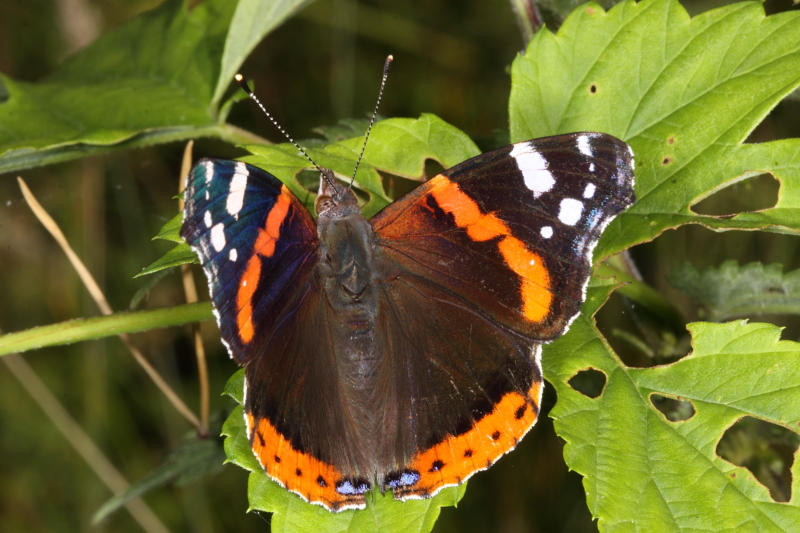
Red Admiral by Mike Jackson1, on Flickr


Dinnertime by Mike Jackson1, on Flickr
 
Try using mf to find the subject then let the cam af on it. Works for me
 
Many thanks for the advice and examples.
Spent most of today, trying various settings, and I now wonder what peoples view are on IS. I had kept it on most of the time, until I did some test shots, and on a small percentage I found with the IS off, the results were shaper, when handheld. Why would that be?
Although I appreciate a high f number is better for depth, so far I am seem to find f2, although shallow, seems much sharper?

A couple of examples so far, although I feel I have a long way to go yet!

1/125 F22

MacroFly4.jpg


1/4000 f2

MacroBee.jpg
 
Back
Top