- Messages
- 4,963
- Name
- Graham
- Edit My Images
- No
Just released in public beta (No NDA) is C1's AI noise reduction. Initial tests look very good and below is one of my initial tests at 12800 iso.
On the left is DXO Prime 3 (latest version PL9.7 or PR6), in the middle is C1 default non-ai (default) noise reduction and on the right is C1s AI noise reduction. All at 100% view
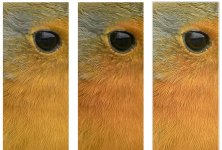
As noise reduction results are not only specific to software but also to individual files, it's difficult to draw any conclusions. I've also done a bit of editing on the two noise-reduced files, trying to match their appearance. Which is the other issue with comparisons because the more time you spend tweaking the results, the smaller the differences between them.
I reckon DXO is still looks as if it's pulling out more detail, but it also has a "flatter" less "3d" look than the C1 result. It's the same conclusion I came to when comparing Adobe AI Denoise and DXO, and in so far I think I prefer the C1 results.
I haven't tried any really high ISOs yet, and it was with higher ISOs that, overall, the detail enhancements provided by DXO outweighed the more natural look of Adobe AI Denoise. However, at the moment, the C1 implementation is looking pretty good.
It works on the base RAW layer, and disables the original denoising tools. But you can still add a layer and use the old tools to further adjust luminance noise removal, and detail enhancement, selectively.
You only get one slider, which adjusts the strength of the noise reduction, and allows you to balance enhancing detail vs reducing noise.
I haven't timed it, but I reckon the AI noise reduction takes about the same time as DXO. The AI noise reduction information is stored in an XMP file, which increases file storage by between half and the same amount as the original file, Which as I remember, is about the same as the increase in storage needed by Adobe DenoiseAI since they stopped using a DNG interim file.
The new DXO compressed DNG format, which shows no loss in quality, produces DNGs that can be as much as half the size of the original RAW.
It's been a long wait, but at the moment it's looking good for C1.
On the left is DXO Prime 3 (latest version PL9.7 or PR6), in the middle is C1 default non-ai (default) noise reduction and on the right is C1s AI noise reduction. All at 100% view
As noise reduction results are not only specific to software but also to individual files, it's difficult to draw any conclusions. I've also done a bit of editing on the two noise-reduced files, trying to match their appearance. Which is the other issue with comparisons because the more time you spend tweaking the results, the smaller the differences between them.
I reckon DXO is still looks as if it's pulling out more detail, but it also has a "flatter" less "3d" look than the C1 result. It's the same conclusion I came to when comparing Adobe AI Denoise and DXO, and in so far I think I prefer the C1 results.
I haven't tried any really high ISOs yet, and it was with higher ISOs that, overall, the detail enhancements provided by DXO outweighed the more natural look of Adobe AI Denoise. However, at the moment, the C1 implementation is looking pretty good.
It works on the base RAW layer, and disables the original denoising tools. But you can still add a layer and use the old tools to further adjust luminance noise removal, and detail enhancement, selectively.
You only get one slider, which adjusts the strength of the noise reduction, and allows you to balance enhancing detail vs reducing noise.
I haven't timed it, but I reckon the AI noise reduction takes about the same time as DXO. The AI noise reduction information is stored in an XMP file, which increases file storage by between half and the same amount as the original file, Which as I remember, is about the same as the increase in storage needed by Adobe DenoiseAI since they stopped using a DNG interim file.
The new DXO compressed DNG format, which shows no loss in quality, produces DNGs that can be as much as half the size of the original RAW.
It's been a long wait, but at the moment it's looking good for C1.