Non DSLR

Not wrong at all it's just an opinion like everything else, and an opinion cant be right or wrong.

My view is that personally it doesn't matter what you do as long as you get the result you wanted - I personally edit my pictures for if they didn't come quite right on the camera. I usually aim to get them as realistic as possible, and since I'm not David Bailey this means I sometimes have to sharpen a touch or up the brightness a bit, etc. This is child's play on RAWs, whereas if you try brightening a JPEG anything more than a stop or two it just turns all 'milky'.

One thing I want to try and get into is HDR, as this is one way of beating the fact that a camera will struggle when part of the image is bright, and the other part very dark - you either have to choose between one bit of it over exposed, or one bit under. HDR gets around this by merging multiple images of different exposures together, to try and get the best of both worlds. Non editors, like yourself, can get around this by using filters to darken the bright areas.

There's nothing wrong about the way you feel at all.
 
maybe it's like you say...when you try adjusting a JPEG, it just turns milky.
I do love the effects people come up with...like vibrant blue skies and golden sandy beaches...i just wish they weren't manipulated! As I learn more, maybe I will change my mind!
 
4292661419_6640c83dba.jpg
4292685481_9fd912d46e.jpg


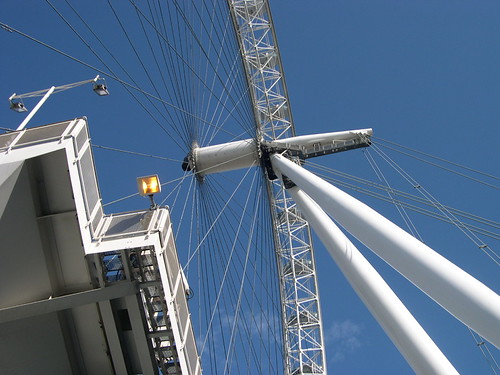
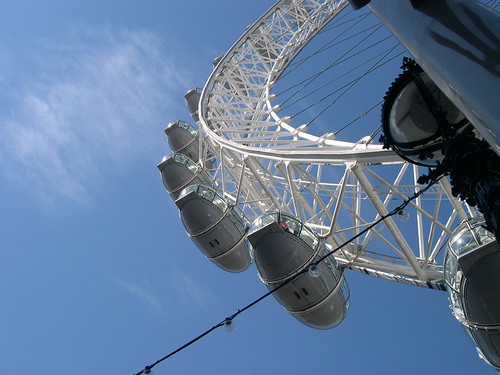
I have a couple of Dslr cameras but I dug out my first digital camera a couple of weeks ago.I intended to sell it.But when I looked at the photos I took in London in 2006 I decided to keep it.The camera is a four mega pixel Nikon 4300 coolpix.I hadn,t realised how good a photo it can take.So I wouldn,t worry Doddy about which camera you have.Take some pics and let us see them.
Pics above taken at London Eye 2006.
 
maybe it's like you say...when you try adjusting a JPEG, it just turns milky.
I do love the effects people come up with...like vibrant blue skies and golden sandy beaches...i just wish they weren't manipulated! As I learn more, maybe I will change my mind!

Not sure I understand. If you're talking about vibrant blue skies and golden sandy beaches that are not realistic, but all the same look absolutely gorgeous, then the image must be manipulated in some way - by means of post processing or by application of filters.

I have a friend who swears by filters, and he sticks some incredible contraptions on the front of his glass - yet he won't touch his images with an editor as he claims it's unnatural. Either way, you're just using different methods to obtain the same result.
 
maybe it's like you say...when you try adjusting a JPEG, it just turns milky.
I do love the effects people come up with...like vibrant blue skies and golden sandy beaches...i just wish they weren't manipulated! As I learn more, maybe I will change my mind!

It's hard to object to any post processing treatment. Even your Fuji has quite a lot of in-camera 'Photoshop' going on just to produce a JPEG image, or it would look terrible. The question is, where do you draw the line?

Your Fuji S1500 has a very wide zoom range, with equivalent focal length of 33-396mm, but I bet you don't use the long end much. That compares to about 28-90mm in equivalent terms to the kind of range you would get with a regular kit lens on a DSLR.

Most people find that the kit lens covers most popular subjects maybe three- quarters of the time - it certainly does for me even though I've got a few other lenses.

The main reason I've got those other lenses, and they are quite expensive, is because I like them and I want them. I hardly ever need them - I could probably work around them if I had to. But the kit is a big part of photography for a lot of people, including me, almost equipment for equipment's sake. I'm just a bit more honest about it :)
 
Very true!!
I am very happy with the equipment i do have, and will learn to use it as best i can!
If i can eventually sell the manual stuff i do have, then i might be able to venture into the DSLR's!!!

Am I wrong to not agree with "playing" with pictures on programs like photoshop?? I just feel that by adjusting levels etc on programs, it does not give a true representation of the picture taken.
Is this something I am going to have to expect, and am I wrong to not totally agree with it??

You're opening up a whole new cans of worms with that topic, something that gets discussed here frequently!

The way I see it, you can never reproduce what you see anyway, manipulation is as integral as any other setting of the camera.

Light trails/traffic trails. You cannot see these with the human eye. (Unless you're stoned or drunk!).
Smooth water falls from long exposures. You cannot see these with the human eye.
Selective focus shorts / Narrow DoF. You cannot see these with the human eye (unless you're short sighted... ;) )

I could go on! It is impossible to make anything look like it's natural as a camera and lens simply do not work like the eye does. So by this logic, processing on the computer is simply an extension of any other setting on your camera...
 
At least it's a Fuji. I'd be mocking a bridge camera from any other manufacturer ;)

If you feel excluded from conversations relating to tech/DSLRs then don't. Measurebating doesn't make good photos anyway.

IIRC the Fuji has a manual mode with variable aperture and shutterspeed, you can focus manually, what more do you need? Couple that with Fuji's excellent dynamic range (Which beats any SLR other than the Fuji S5...), superb out of camera colours and the fact it doesn't weigh 3kg. NO problems.

In fact, you'll probably learn a ton if you DO chip in on the "DSLR" conversations and then try and relate what they're on about to your own equipment. That abstraction from the "Standard" DSLR realm to your S1500 will probably teach you more than simply "copying and pasting" other people's advice anyway.
 
Not sure it has manual focus...i thought it was automatic...how would i find the manual focus??

I am struggling to understand focal length 33-396mm. Can someone please explain it in english!! I know it's something to do with zoom...but i want to totally understand and not just take a bunch of numbers for granted...sorry if this is a dense question!!!

I never would have thought using filters was just another way of manipulating an image...but i guess really, it is!
Maybe i need/should play with my Photoshop a bit more, and see what it can do...i have had a play but haven't really achieved anything with it so far.

So these pics that you see....they have all been manipulated then? I guess they do look artificial, but the blue skies and beautiful beaches look fab....all been played with??!!

I am loving the pics of the "Eye"...this is what i like...the contrast of the white against the blue....
 
Most pictures done by pros have been manipulated in some way, may it's been sharpened, colour/brightness adjusted a bit, or cropped. I sharpen a good 50% of my images, and crop others that need crap taking off the edges, or crop to fit into rule of 3rds.
 
Another quick question...sorry!!

On pics, people state what the focal length was when taking the pic...how do you know if you have zoomed???
 
All that lovely information is contained in the EXIF data. Unless I misunderstood you :thinking:
 
Not sure it has manual focus...i thought it was automatic...how would i find the manual focus??

I don't think there is one (if there is I'd be grateful to hear about it). Some of Fuji's more expensive bridges have manual focus.
 
Not sure it has manual focus...i thought it was automatic...how would i find the manual focus??

I am struggling to understand focal length 33-396mm. Can someone please explain it in english!! I know it's something to do with zoom...but i want to totally understand and not just take a bunch of numbers for granted...sorry if this is a dense question!!!

I never would have thought using filters was just another way of manipulating an image...but i guess really, it is!
Maybe i need/should play with my Photoshop a bit more, and see what it can do...i have had a play but haven't really achieved anything with it so far.

So these pics that you see....they have all been manipulated then? I guess they do look artificial, but the blue skies and beautiful beaches look fab....all been played with??!!

I am loving the pics of the "Eye"...this is what i like...the contrast of the white against the blue....

The focal length defines the magnification of the lens. But it only becomes meaningful when matched with a sensor size - only then can you decide how much of the scene you will get in the picture. In other words, a lens of a given focal length will produce an image of a certain size, and the bigger the sensor the more of that image will be recorded - the view of the scene will be wider, and vice versa. So, when you put the lens focal length and the sensor together, that then translates into the angle of view.

However, in the days of film almost everyone used 35mm film (that's the width of the film, nothing to do with focal length) which produces an image 24x36mm - known as full-frame. This was such a universal format that everyone became very familar with it and knew what you got in the picture with certain focal lengths.

So when digital came along, with its different and variously smaller sensor sizes, it seemed like a good idea to relate the new lenses back to a full-frame standard of reference, in a way that people could easily grasp. That's where the 'crop factor' comes from and phrases like '33-396mm equivalent' when applied to compacts.

What this means with your Fuji is that at the wide angle end, if you stand side by side with somebody using a full-frame camera, they would have to set their lens to 33mm to get the same picture that you are seeing. And at the other end, they would need a huge 396mm lens to exactly match the Fuji on max zoom.

So far so good I hope, but I'm afraid there's another bit of confusion to add to that when talking about popular DSLRs. They don't use a full-frame sensor, theirs are smaller, to the tune of 1.6x Canon and 1.5x Nikon/Sony. That is the crop factor which must be applied to the full-frame equivalents to pull the comparison back into line. Taking a Canon for example, if you want to match the zoom on your Fuji, you would need to divide 33-396 by 1.6x to give you a 21-247mm lens with the equivalent angle of view.

In summary, all these lenses would give the same range of angles of view on their respective cameras.

Fuji S1500, 5.9-70.8mm
Canon 1.6x crop, 21-247mm
Full-frame, 33-396mm
 
non dslr just means you dont change lenses
its still single lens but not reflex
its the sensor and lens which i think make the real difference to most
but if you do a good shot...its you that takes it
 
Thankyou for taking the time to explain it! Can't say I totally understand it, but i will try and digest it all again later when it is quiet here!!!

:bang::bang: trying to get me to understand!!!
 
Cheers Doddy :) If you like reading, you'll love this - Understanding Photography, written for folks like you I think http://www.talkphotography.co.uk/forums/showthread.php?t=99841

non dslr just means you dont change lenses
its still single lens but not reflex
its the sensor and lens which i think make the real difference to most
but if you do a good shot...its you that takes it

That's not quite true - there are plenty of cameras with interchangeable lenses that are not DSLRs - Leica, new Olympus F-P1, Pano GF1.

The unique bit about a DSLR is the 'R' bit, which refers to the Reflex mirror and prism viewing system.
 
Cheers Doddy :) If you like reading, you'll love this - Understanding Photography, written for folks like you I think http://www.talkphotography.co.uk/forums/showthread.php?t=99841


That's not quite true - there are plenty of cameras with interchangeable lenses that are not DSLRs - Leica, new Olympus F-P1, Pano GF1.

The unique bit about a DSLR is the 'R' bit, which refers to the Reflex mirror and prism viewing system.

I'm glad you made the correction....!
 
Back
Top