Sorry, mathematics?
Shoot at the optimum aperture, meter with the filter off. Do the following sum:
New Shutter Speed = Old Shutter Speed * 2^n
Where n is the number of stops your filter adds. Really you can just count it off on your fingers.
Say you initially meter a 1/60th of a second exposure and you have a 3 stop ND filter:
Easy!
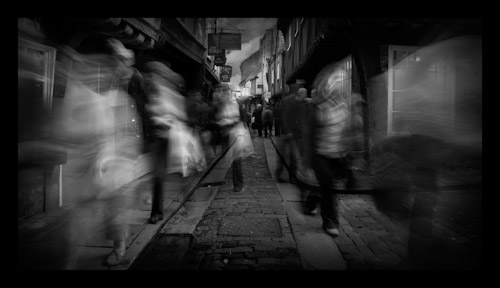
Depending on traffic and what exactly you want, you're probably going to want exposure times at around 1/2 a second to 1 second. Any longer and people will vanish rather than blur.
Guesstimating with sunny 16.
f/16
ISO 200
1/125th (slightly overcast)
You'll want to shoot at f/8, because f/16 will diffract.
f/8
ISO 200
1/60th
You want a 1/2th second shutter speed. (Admittedly, it gets hard here, but it's just A level maths, and you could calculate it using trial and error.)
New Shutter Speed = Old Shutter Speed * 2^n
1/2 = 1/60 * 2^n
30 = 2^n
2^n = 30
ln(2^n) = ln(30)
nln(2) = ln(30)
n = ln(30)/ln(2)
n = 4.9
5 stop ND will do!
Now, it's faster to do it with your fingers for simple equations, but it's worth having the formula in your toolkit:
ND Filter Stops = (ln((new shutter speed)/(old shutter speed)))/(ln(2))
Copy and paste this into google:
(ln((1/2)/(1/60)))/(ln(2))
And change the speed values for the ones you want. Google is a calculator too and will give you your answer!




 but in the recent experience that I've had with using my 10-stop ND filter, if you're shooting in bright daylight, there'll be enough light getting into the camera for it to work out the metering for you without too much trouble. It's only once you get into slightly lower light conditions (such as badly overcast, dusk, indoors etc.) that mathematics really come into play :|.
 . But, as I said, in strong light it's just a case of point and shoot
 !