Seeking advice

KayJay

Give us a Tena
Messages
5,783
Edit My Images
Yes
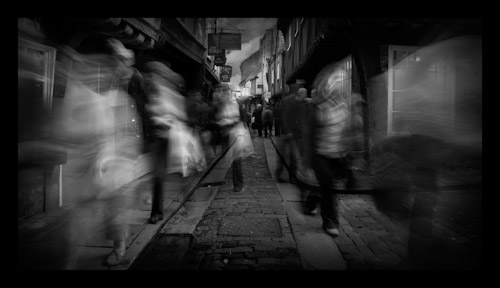
I need some advice. I want to do some long exposures of around 2 to 3 seconds in day light but am not sure how to do it. Do I need a filter on the lens or can I do it by under exposing the shot?

Essentially want to take pictures of a still object but have people moving nearby.

Any help would be greatly appreciated.

KJ

Use the smallest aperture, slightly OVER EXPOSE and add some filters...you can take some of the overexposed detail back from a bracketed second shot...

Or get a ND 10 stop, and go wild with daytime exposures :)

Gary.
 
Yep filters will be required.
Shorter exposures will under expose he shot, not long ones.
Dialling in -ve exposure will give you a shorter exposure, you could try stopping down as far as your lens will go, but it's unlikely to have the desired effect in daylight.
 
3 prongs of exposure: ISO, Aperture and Shutter speed.

Decrease the ISO, increase the required light
Decrease the aperture (increase the f number), increase the required light.

Basically, stick it at the minimum aperture it will go to (probably f/22) and put it on the lowest ISO (probably ISO100).

Also to get a longer shutter speed, if you were to under expose then it kind of wouldn't work like that - this means the shutter isn't open long enough, reducing movement in the frame. You'd need to overexpose.

Alternatively get an ND filter, it will reduce the amount of light reaching the sensor, therefore requiring you to expose for longer.
 
Well, that's it really.
You're going to need a few ND filters and experiment from there.
 
I know very little but I was thinking the same as Flash In The Pan.
My thoughts were:-
Flash your subject and then use the shutter (anything over 1/50th) and drag the camera to make movement, drag away from your flash though or it will look odd
 
I've not got a clue where to start with ND filters. Time for some fast learnin'!
 
I've not got a clue where to start with ND filters. Time for some fast learnin'!

:shrug: Not much to learn really, for what you say you're planning to do with them. Just screw one on, snap off a few shots and adjust the exposure compensation if you don't get what you want first time :).

Of course, that's the slobbish way of doing it ;) but in the recent experience that I've had with using my 10-stop ND filter, if you're shooting in bright daylight, there'll be enough light getting into the camera for it to work out the metering for you without too much trouble. It's only once you get into slightly lower light conditions (such as badly overcast, dusk, indoors etc.) that mathematics really come into play :|.

A lot of cameras will only evaluate exposures up to about 30 seconds or so (I believe :thinking:), so it gets messy when you try and work out the exposure with the filter on and the camera just comes up with "bulb", or "too dark" type warnings :(. But, as I said, in strong light it's just a case of point and shoot :thumbs:!

Not quite...focus can be problematic with the 10 stop on :) Autofocus does not work...and you can't see through the viewfinder to manually focus.

Gary.
 
Sorry, mathematics?

Shoot at the optimum aperture, meter with the filter off. Do the following sum:

New Shutter Speed = Old Shutter Speed * 2^n

Where n is the number of stops your filter adds. Really you can just count it off on your fingers.

Say you initially meter a 1/60th of a second exposure and you have a 3 stop ND filter:
Code:
1/60        1/30        1/15        1/8
        1          2            3

Easy!

Depending on traffic and what exactly you want, you're probably going to want exposure times at around 1/2 a second to 1 second. Any longer and people will vanish rather than blur.

Guesstimating with sunny 16.

f/16
ISO 100
1/60th (slightly overcast)

You'll want to shoot at f/8, because f/16 will diffract.

f/8
ISO 100
1/250th

You want a 1/2th second shutter speed. (Admittedly, it gets hard here, but it's just A level maths, and you could calculate it using trial and error.)

New Shutter Speed = Old Shutter Speed * 2^n
1/2 = 1/250 * 2^n
125 = 2^n
2^n = 125
ln(2^n) = ln(125)
nln(2) = ln(125)
n = ln(125)/ln(2)
n = 7

7 stops needed!

Now, it's faster to do it with your fingers for simple equations, but it's worth having the formula in your toolkit:
ND Filter Stops = (ln((new shutter speed)/(old shutter speed)))/(ln(2))

Copy and paste this into google:
(ln((1/2)/(1/250)))/(ln(2))
And change the speed values for the ones you want. Google is a calculator too and will give you your answer!

 
You could do something like this, by using flash and playing with your zoom lens....

_jm155311.jpg
 
Yay! Zoom blur!

A very under utilised effect IMHO. All the photography books are full of it but you rarely see it on here...
 
Sorry, mathematics?

Shoot at the optimum aperture, meter with the filter off. Do the following sum:

New Shutter Speed = Old Shutter Speed * 2^n

Where n is the number of stops your filter adds. Really you can just count it off on your fingers.

Say you initially meter a 1/60th of a second exposure and you have a 3 stop ND filter:
Code:
1/60        1/30        1/15        1/8
        1          2            3

Easy!

Depending on traffic and what exactly you want, you're probably going to want exposure times at around 1/2 a second to 1 second. Any longer and people will vanish rather than blur.

Guesstimating with sunny 16.

f/16
ISO 200
1/125th (slightly overcast)

You'll want to shoot at f/8, because f/16 will diffract.

f/8
ISO 200
1/60th

You want a 1/2th second shutter speed. (Admittedly, it gets hard here, but it's just A level maths, and you could calculate it using trial and error.)

New Shutter Speed = Old Shutter Speed * 2^n
1/2 = 1/60 * 2^n
30 = 2^n
2^n = 30
ln(2^n) = ln(30)
nln(2) = ln(30)
n = ln(30)/ln(2)
n = 4.9

5 stop ND will do!

Now, it's faster to do it with your fingers for simple equations, but it's worth having the formula in your toolkit:
ND Filter Stops = (ln((new shutter speed)/(old shutter speed)))/(ln(2))

Copy and paste this into google:
(ln((1/2)/(1/60)))/(ln(2))
And change the speed values for the ones you want. Google is a calculator too and will give you your answer!


Bed time reading for me! Thanks for the help :)
 
FITP - I hope the originator knows you are using his shot without a credit!

Fine to put it up here, but it should have had a credit to JOE McNALLY underneath/beside it, or you should have said he took it in your text. Should be OK now though because I have done it for you...I'll tell him to keep the dogs on their leads!

I find the whole thread incredible...ami the only one to have picked up on the fact that the OP has got a paid job coming up....yet he doesn't know how to take pictures.

Buyers of photography nowadays leave me stunned......how the hell can you commission someone to do a job they don't know how to do?

I am off to the dentist tomorrow - it'll be OK, he will have a book beside him and he has borrowed some pliers from the gas man!

They saw my past work. They contacted me. They're one of the biggest branding agencies in the country. There are elements in this particular job that are new to me so I'm learning the necessary skills and asking for some advice. If we all listened to people like you human progress would come to a halt extremely quickly.

Anything else you want addressed?
 
PS Good luck at the dentist.

PPS Thanks to everyone that has contributed to this thread so far. It'll not only benefit me but others who are too afraid to ask the same question because of the pretentiousness of some people.
 
FITP - I hope the originator knows you are using his shot without a credit!

Fine to put it up here, but it should have had a credit to JOE McNALLY underneath/beside it, or you should have said he took it in your text. Should be OK now though because I have done it for you...I'll tell him to keep the dogs on their leads!

My bad, :bonk: tbf, it's pretty obvious from the code where it came from, but you're right, credit where credit's due and all that :D

Kayjay, you could probably have found all the info you needed (and more) by doing a quick Google, I can't imagine it would look terribly good if your client stumbled upon this thread iand discovers you're charging for something you don't know how to do :shrug:
 
Well it's too late now. Like I said though, it's only a small part of the brief, everything else I'm clear on, just not the use of ND filters. I appreciate your help.
 
FITP - I hope the originator knows you are using his shot without a credit!

Fine to put it up here, but it should have had a credit to JOE McNALLY underneath/beside it, or you should have said he took it in your text. Should be OK now though because I have done it for you...I'll tell him to keep the dogs on their leads!

I find the whole thread incredible...ami the only one to have picked up on the fact that the OP has got a paid job coming up....yet he doesn't know how to take pictures.

Buyers of photography nowadays leave me stunned......how the hell can you commission someone to do a job they don't know how to do?

I am off to the dentist tomorrow - it'll be OK, he will have a book beside him and he has borrowed some pliers from the gas man!

You're not the only one who picked up on it, but you are the only one who cares about it. From what I've seen of KayJay's work, he's a fantastic photographer, and conscientious enough to learn about what he needs to do for a shoot he's getting paid for.

That analogy you used is stupid. It would be like a client requiring a procedure that the dentist has never done before, and so before the time comes, the dentist learns how to do the procedure.

As long as KayJay doesn't cock up, and does what he's been paid to do, then I don't see what the problem is!
 
Poison - you're right. My analogy was abit different, and your context of the dentist is one that hadn't occurred to me. I would hope though, that he might at least have had some idea of the new treatment.

In the photography case though, ND filters are as old as your hat....nothing new there, a basic technique which is hardly breaking new ground.

You want long exposures, you need to reduce the light. How difficult is that? I don't care how prestigious the client is, the question is still basic.

Wind the sensitivity to its minimum. Close the curtains on the windows....whatever it takes to reduce the light so as to increase the exposure time. ND filters are just clear curtains for your lens! I would have thought anyone would have known that from absolute beginnings...maybe this is one of the signs of the film photographers dropping away and the only ever used digi photographers coming through.
Anyone: worth looking back through old photography books for some of these basic techniques...which have been forgotten, or passed over by the sound of it. Nothing new under the sun.

Some cameras, by the way, have ND filters built in...how they work I have no idea, but I have seen them in the manual or menu or somewhere....could just be a sensitivity dodge on the chip?
 
FITP - what code? Can't see a code on my confuser......just the picture.
 
Poison - you're right. My analogy was abit different, and your context of the dentist is one that hadn't occurred to me. I would hope though, that he might at least have had some idea of the new treatment.

In the photography case though, ND filters are as old as your hat....nothing new there, a basic technique which is hardly breaking new ground.

You want long exposures, you need to reduce the light. How difficult is that? I don't care how prestigious the client is, the question is still basic.

Wind the sensitivity to its minimum. Close the curtains on the windows....whatever it takes to reduce the light so as to increase the exposure time. ND filters are just clear curtains for your lens! I would have thought anyone would have known that from absolute beginnings...maybe this is one of the signs of the film photographers dropping away and the only ever used digi photographers coming through.
Anyone: worth looking back through old photography books for some of these basic techniques...which have been forgotten, or passed over by the sound of it. Nothing new under the sun.

Some cameras, by the way, have ND filters built in...how they work I have no idea, but I have seen them in the manual or menu or somewhere....could just be a sensitivity dodge on the chip?

While the basic premise of ND filters is simple - they reduce light intake - I always found them to be daunting, all this 0.3x or nd4 nonsense, they need a universal way of knowing which is which!

As far as built in nd filters, perhaps just a digital version of pulling the image back?
 
Poison - you're right. My analogy was abit different, and your context of the dentist is one that hadn't occurred to me. I would hope though, that he might at least have had some idea of the new treatment.

In the photography case though, ND filters are as old as your hat....nothing new there, a basic technique which is hardly breaking new ground.

You want long exposures, you need to reduce the light. How difficult is that? I don't care how prestigious the client is, the question is still basic.

Wind the sensitivity to its minimum. Close the curtains on the windows....whatever it takes to reduce the light so as to increase the exposure time. ND filters are just clear curtains for your lens! I would have thought anyone would have known that from absolute beginnings...maybe this is one of the signs of the film photographers dropping away and the only ever used digi photographers coming through.
Anyone: worth looking back through old photography books for some of these basic techniques...which have been forgotten, or passed over by the sound of it. Nothing new under the sun.

Some cameras, by the way, have ND filters built in...how they work I have no idea, but I have seen them in the manual or menu or somewhere....could just be a sensitivity dodge on the chip?

I was 6 years old when you turned professional. Just a thought. I know a lot about reducing light, I've just never used ND filters to do it before. Seriously. What is your problem? The fact that I'm a digital photographer or the fact that you see me as a threat to your profession? Get over it.

I also couldn't care less if the question was basic. You obviously feel aggrieved in some way but that's your problem. Don't make it mine.
 
I need some advice. I want to do some long exposures of around 2 to 3 seconds in day light but am not sure how to do it. Do I need a filter on the lens or can I do it by under exposing the shot?

Essentially want to take pictures of a still object but have people moving nearby.

Any help would be greatly appreciated.

KJ

You do not want to underexpose the shot, just devise a way of reducing the light level so that it comes within range of a 2-3 sec shutter speed. If you want a 2-3 secs exposure in normal daylight, you will need a Neutral Density filter. Hoya does a three stops one, B+W do six stops, and also 10 stops (expensive). I would get a 6 stops ND filter as a general all-rounder to make people blur and disappear, blur water falls etc.

Say your normal daylight exposure is 1/500 sec at f/8 ISO 400. Prolly not a million miles out. Put a 6-stops ND on there and that becomes 1/8sec, f/8, ISO400. You need another three stops, so knock 2 stops off the ISO, and one stop on the f/number and you're there. 1sec at f/11 at ISO100, or 2secs at f/16 at ISO100.

If you want a little more flexibility on the f/number, pop a polariser on there, which should be worth another 1.5 - 2 stops, or can you get your ISO down to 50? Maybe you could start with a 10 stops ND, but I think they are too heavy for most days when there isn't bright sun. Go to f/22 if you have to, but will will lose a bit of sharpness to diffraction, maybe quite a lot if you have a short focal legnth lens.

Set focus and normal exposure, then switch to manual and make the new exposure adjustments you want, as calculated above. Fit the filter/s and shoot a test pic - it's quite likely to be a bit out, especially if you've put a polarizer on there, too. Check the LCD and histogram, you'll quite likely need a bit of exposure compensation. The away you go.

Be careful to cover the viewfinder during exposure as light can get in there and sneak between the gaps around the piggy back mirror, sometimes putting coloured streaks on the image.

I hope I have't missed anything. Good luck :)
 
Independent today - story of an Aussie Doc saving a kids life by operating with a Black and Decker while taking advice over the phone..... Guess its good to ask now and again :-)
 
Back
Top