the eclipse

Messages
2,162
Name
dave
Edit My Images
Yes
as im sure most people are aware we have a solar eclipse coming on wednesday, should be low on the horizon in a westerly direction when its at its peak...ive got an idea in my head of one of anthony gormleys statues in the forground and the eclipse in the back, photopils will help me line up the shot ...but is the any hints at shooting the sun part...apart from dont look down the viewfinder and shoot in manual...ive shot sunsets before but not an eclipse so feel it will be slightly different..to be fair its ove a period of time so i can have a wee play around with the settings so im not too worried
 
It will be a bit bright, unless there’s a layer of cloud. Even though it is only 8% or so of the sun, that 8% will be full strength.
 
I've bought a Sonner solar filter, but I think that it's more for shooting straight at the sun with a long lens so I'm not sure I'll need it.

I've shot sunsets and sunrises before, so I'm just planning on using a similar method to that. I've been trying to think where a good location to shoot from would be around here, and I think I'm just going to go down by the river where I'll have an unobstructed view of the horizon.
 
Just a thought, but if you could find a bridge or arch facing the right way it might make a good frame for the subject.

Edit: and make sure the lens and sensor are clean!
 
Last edited:
Maximum eclipse is well before sunset, so it's not going to be that low. If you're thinking a landscape shot with the sun in the frame it could be too bright to tell it's eclipsed
For anything close up you need a proper solar filter. Here in SW England the eclipse is over about 25 mins before sunset
 
Maximum eclipse is well before sunset, so it's not going to be that low. If you're thinking a landscape shot with the sun in the frame it could be too bright to tell it's eclipsed
For anything close up you need a proper solar filter. Here in SW England the eclipse is over about 25 mins before sunset
Ideally you'll need an even low cloud cover. Otherwise it's going to be hard to get it to work.
 
I've bought a Sonner solar filter, but I think that it's more for shooting straight at the sun with a long lens so I'm not sure I'll need it.
The focal length doesn't much matter. A fast short lens (e.g. f/1.x wide open) is more likely to damage the camera than a slower longer lens is (more light concentrated into a smaller spot).
 
Is all this camera damage talk a bit over the top?

I'm pretty sure we've all taken landscape photos before with the sun in the frame, shining onto the sensor. And with regard to any aperture or ISO settings, surely it's the total amount of light hitting the sensor..... And if you are perfectly exposing for the sun, surely the foreground is going to be pretty under exposed.
 
I think a website said that the Sun would be at about 16 degrees. So that is about 60mm if you want some foreground and space above it.

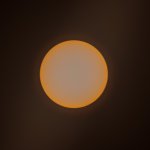
I've got a solar filter and on my 300mm lens I can't see anything in the foreground. Everything bar the Sun is too dark. It is doing reasonable exposure of the Sun at 1/400s, f/5.6 and iso 500. I can just about pick up sunspots

I could always do a double exposure and add the Sun in later, but that feels like cheating.
 
Sun Aug 10 2026.jpg

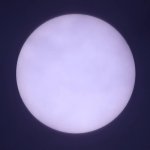
800 ISO. 1/800s f/8 1200mm. Solar filter. Very slight cloud.
 
Is all this camera damage talk a bit over the top?

I'm pretty sure we've all taken landscape photos before with the sun in the frame, shining onto the sensor. And with regard to any aperture or ISO settings, surely it's the total amount of light hitting the sensor..... And if you are perfectly exposing for the sun, surely the foreground is going to be pretty under exposed.
This is my thinking. I'm planning on trying to get some sunset(ish) shots with a crescent sun, rather than a shot of the sun. I'll try the solar filter first to be on the safe side though.
 
Is all this camera damage talk a bit over the top?

I'm pretty sure we've all taken landscape photos before with the sun in the frame, shining onto the sensor.
Not really... the difference is that the sun is not focused. I.e. the total light gathered is not concentrated and it is not an image "of the sun". These days shutters, sensor shields, and aperture blades are commonly made of some sort of composite/plastic which is more likely to be damaged than the sensor is. But even sensor damage is not unheard of. And, of course, the biggest risk is to the eye (direct viewing/ reflex camera).

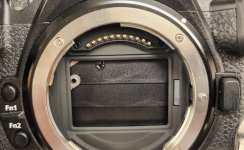
The Sony A1 has a warning in the manual about it when using the shutter as a sensor shield.
1786386104216.png

Nikon does not have a warning about it's sensor shield, but the function is not enabled by default. Damage is not that uncommon when it is enabled.

Z8 sensor shield
Untitled-1.jpg

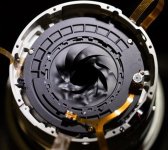
Melted aperture blades on Canon 600/4
Untitled-1.jpg
 
I could always do a double exposure and add the Sun in later, but that feels like cheating.
In camera double exposure, or composite in post?
You should be able to get a silhouette against the sun. A double exposure is not likely to work as the "double" only shows up in dark regions.
 
I have a Canon R7 and various canon lens from 60 mm to 150-600mm - any advice? I do not have any specialist equipment
 
Bit of a while back I got this through some clouds. At first I thought there was dirt on sensor or lens, but think it was someone on her who put me onto the fact they're sun spots.

River Wear Nov24 53 by Dawns Prey, on Flickr

I'm feeling fast shutter speed, like uber fast for the eclipse but I dunno.
 
I think
In camera double exposure, or composite in post?
You should be able to get a silhouette against the sun. A double exposure is not likely to work as the "double" only shows up in dark regions.
I was thinking in-camera. In a Nikon the bright bits of both images get combined at whatever ratio you want t make a new raw file.. The dark bits will still look like the sky but I can fix that in post.
 
So if you drop the expo compensation by a lot, you're not actually doing anything to protect the sensor?
Depends on the kind of camera... if it's a mirrorless,no. If it is a reflex camera it would help protect the sensor, but not necessarily other parts... I think a lot of the damage occurs due to "waiting" (pointed at the sun but not actively taking a picture, or multiple exposures). I know when I did the solar eclipse of 2024 my camera was pointed at the sun for quite a while.
 
Hi. I have done this before with film cameras but I am now using a Sony A300 and have a 100-3oomm zoom. I tried taking a picture last year using a poloriser but that was bleached. Can any professionals here tell me what cokin filters I could use in combination if needed please?

I currently have P694 and P160
 
Last edited:
Hi. I have done this before with film cameras but I am now using a Sony A300 and have a 100-3oomm zoom. I tried taking a picture last year using a poloriser but that was bleached. Can any professionals here tell me what cokin filters I could use in combination if needed please?

I currently have P694 and P160
I hope you didnt damage your sensor. To do this safely you need a specialist solar ND 5.0 (aka ND100,000) filter to block 16 stops of light with UV and IR protection too. You can stack ND's to get to the same level of light blocking, but there is still some risk to your sensor if you dont include UV and IR protection.
 
where could I buy one of these on line? Amazon? I am in the UK. I take it also that Cokin are not the best to use. Don't have a K&F holder or filters.
 
Last edited:
I think you've left it late, seems that eclipse/solar glasses and filters are out of stock.

I was debating whether adding a Big stopper to a Super Stopper (Lee 10x and 16x) would be appropriate, checked on t'net and it basically said what Tim said....
 
Yes a bit late. I should have put a date in my diry. I looked at a you-tube video and I realised last year I did not set it to ISO100 and should have had a shutter spead of 1/500th. I stupidly let the camera decide. Amazon only sell ND2s Maybe next year? Whould I be better moving to K&F Concept, Hoya, B+W?

Next one is August 2, 2027 (Total) for Europe.
 
Last edited:
You might find a piece of glass for a welding mask at a specialist supplier and that might be enough to get a shot of the eclipse (but I wouldn't use it to view the eclipse directly...)
 
In 2015 , I used welding glass and stacked my ND filters. Not a great image, but memory of the event shot.
If memory serves me correct I had the front of the lens covered all the time apart from the split second to get an image

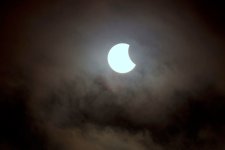
solarE.jpg
 
Last edited:
You might find a piece of glass for a welding mask at a specialist supplier and that might be enough to get a shot of the eclipse (but I wouldn't use it to view the eclipse directly...)
Lidl is selling cheap gas welding masks at the moment for a few pounds. I don't know if they are any good for photography (or just looking at the Sun).

The glass bit isn't very big and won't fit over most lenses.
 
How bright is the Sun? If you take a commonly photographed object that is about the same size of the Sun in the sky and compared it's illumination levels on Earth you get 18 stops of light difference. (That is the Moon- 15 ev in the sky and makes -3 EV on a landscape). So the Sun which makes 15 ev on a landscape is 33 ev as a subject in the sky. If you want to get it down to normal light levels you need 18ev of filtering

ND filters don't block infrared so I'd be dubious about stacking them. The Sun puts out a lot of infrared.

The solar filter sheet I bought is about 22 stops.
 
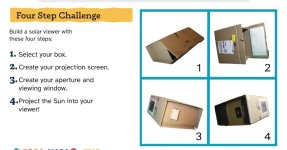
I’m building a box viewer using an old cardboard box, some white writing paper and some kitchen foil with a pin hole in the centre. I will photograph the eclipse using either my canon Ixus 30 or my iPhone.IMG_3883.jpeg
 
Jut had an idea. I have a tamron zoom 70-300mm. I was wondering can I get a x2 multiplier for this? I used extension rings years ago when I had a screw in lens type and a x2 and x3.
 
I'm not risking any of my cameras to try and capture it, if it's visible I'll just watch and enjoy it :)
I took a close-up one last time; was that 2015? Time is flying.... This time, maybe a regular landscape pic.
 
I have bought some solar film, and stuck it to some old cokin filter rings - makes a great cheap filter. Went out to practice the other night. Couldn't find anything local to put in front of the sun though. Need a bit more practice to get it sharp - I will take a cloth to put over my head so I can actually see the live view screen properly (reflection of my face was too bright!)

DSC01802.jpg
 
Back
Top