The Stop Down Button

Plain Nev

Vincent Furnier
Messages
2,749
Name
Neville
Edit My Images
Yes
I'm always bemused when a film camera has a stop down button. I mean what earthly use are they? I've never been able to discover a practical use for it. Yes, it stops down the shutter and makes your viewfinder darker. But what is the point of that?
 
To assess depth of field.
 
I used to think that the slightly darkened areas were the bits that would be out of focus and that seemed to work with many subjects, the focus point being the center of maximum sharpness. I then did a few tests on walls etc where everything would be in focus and the image through the viewfinder still had a feint darkening as the button is depressed, so that blew that theory out of the water. The only possible conclusion I could come to in my tests was that the "Stop down" button was so accurate that it was showing lens sharpness fall off to the edges.

Probably just erroneous gobbledegook.
 
Yes, but how precisely?

It shows you the scene as it will be passed to the negative.

If you're a Sony mirrorless camera user you will already be familiar with seeing the exact depth of field, albeit more easily thanks to the EVF, for the selected aperture. This does the same thing while allowing you the best chance to focus, although the ground glass of a typical SLR tends to be so dark and gritty it may be a struggle.

Yes, it stops down the shutter and makes your viewfinder darker.

It does nothing to the shutter, but rather closes the lens aperture the to taking aperture you have selected. I appreciate this may have been what you meant.
 
If you're using a "normal" 35mm SLR, I suggest that the stop down button is all but useless. The screen is too small. If you can swap the prism for a waist level finder with magnifier, you're in with a chance. Odds improve if you can fit a different focusing screen. And there's a significant jump if you can fit a specialised magnifying finder - one with a powerful lens.

Medium format users have it easier, because the screen is larger. And large format users, where depth of field is razor thin, routinely assess depth of field stopped down and with a loupe on the ground glass.

So, it depends really on the camera and format whether there's much value in it.
 
It shows you the scene as it will be passed to the negative.

It does nothing to the shutter, but rather closes the lens aperture the to taking aperture you have selected. I appreciate this may have been what you meant.
Yes, I did indeed mean aperture. I was not in full possession of my faculties. :p I take your point. Obviously the level of detail is governed by your aperture, etc. I just can't see it. I think Stephen has the answer.
If you're using a "normal" 35mm SLR, I suggest that the stop down button is all but useless. The screen is too small. If you can swap the prism for a waist level finder with magnifier, you're in with a chance. Odds improve if you can fit a different focusing screen. And there's a significant jump if you can fit a specialised magnifying finder - one with a powerful lens.

Medium format users have it easier, because the screen is larger. And large format users, where depth of field is razor thin, routinely assess depth of field stopped down and with a loupe on the ground glass.

So, it depends really on the camera and format whether there's much value in it.
Yes, that would make sense. I can see that it would be much improved on a larger screen.
 
There is also a rather interesting trade off in the focusing screen. Simplifying a bit, the brighter the screen, the more difficult it is to assess what's in focus. In the limiting case of a screen designed for microscope use, everything is in focus; the photographer uses the cross hairs for focusing. And I'm not going into details on that one! A finer ground glass will aid focusing, but be dimmer.

My first view camera had a plain ground glass. It was dim, but easy to focus with a loupe. My second had a Fresnel screen. Much, much brighter, but the rings under a loupe made focusing a real pain.

Ever since the OM1, screen brightness assumed priority. And with autofocus, all pretence of making screens and focusing aids for manual focus went out the window.
 
Interesting discussion. My first SLR was a Pentax P30 that had a stop-down lever, and to a degree I found it useful, with obvious limitations. My second SLR was a Minolta 7000, and the bright focussing screen was a revelation, not because of the slow and slightly unreliable AF, but because it was the first screen I'd seen that made manual focusing easy and quick. It was bright and images were clear & crisp, detail in and out of focus was easy to see and I really enjoyed that camera (still have it now).


In the limiting case of a screen designed for microscope use, everything is in focus

I'm slightly puzzled by this, as a regular microscope user and micrographer. Getting sharp & detailed images that are precisely focused is challenging, often because depth of field effects alter density through the subject, but it's quite clear when things aren't sharp.
 
With some old cameras when pressing the stop down button it also activates the exposure meter to give a reading when the lens is stopped down (or wide open).
e.g Pentax spotmatic
 
It shows you the scene as it will be passed to the negative.

If you're a Sony mirrorless camera user you will already be familiar with seeing the exact depth of field, albeit more easily thanks to the EVF, for the selected aperture. This does the same thing while allowing you the best chance to focus, although the ground glass of a typical SLR tends to be so dark and gritty it may be a struggle.


It does nothing to the shutter, but rather closes the lens aperture the to taking aperture you have selected. I appreciate this may have been what you meant.
This.
Go back to the early SLR cameras - or just be glad that you don't have to - and we didn't have the technology to view and focus the scene with the lens wide open and for the camera to then stop down automatically when we took the shot. We had to view and focus wide open, some of the more expensive lenses could be set to the "taking" aperture and we would then operate a small lever that would close the aperture down to whatever it was set to (manually) just before taking the shot.

Others just had click stops instead, so we would view/focus at full aperture then manually stop down, counting the number of clicks needed to get down to (say) f/11. My own first SLR camera didn't even have that, no clicks, so view/focus wide open, then set the required f/ manually, then look through the viewfinder again and try to find the subject:(

Very difficult in bright conditions, and even more so when the camera had a waist-level viewfinder and we wanted to shoot in portrait mode, with the image upside-down . . .
This was the massive advantage of twin lens reflex cameras, with the viewing lens always wide open and the taking lens set to the required aperture.
 
With some old cameras when pressing the stop down button it also activates the exposure meter to give a reading when the lens is stopped down (or wide open).
e.g Pentax spotmatic

Cameras like the Spotmatic F have full aperture metering, but you still need the stop down function to meter with non coupled lenses.

Ian
 
Go back to the early SLR cameras - or just be glad that you don't have to - and we didn't have the technology to view and focus the scene with the lens wide open and for the camera to then stop down automatically when we took the shot. We had to view and focus wide open, some of the more expensive lenses could be set to the "taking" aperture and we would then operate a small lever that would close the aperture down to whatever it was set to (manually) just before taking the shot.

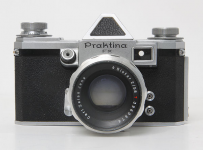
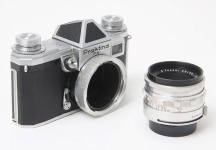
Some SLRs had an additional direct viewfinder, early Alpa, and all Praktina cameras. Useful with manual pre-set lenses stopped down.

1775034336357.png

These were the first SLRs to have semi-automatic stop down, initially pressure on the shutter release and the lens stops down, as you continue on to exposure. After the mirror remains up and the aperture stopped down, winding on drops the mirror, and re-sets the shutter, and a lever on the lens resets the aperture to full aperture. Pentax copied this system for some early lenses.

1775035434857.png

Still very useable cameras today, the Praktina was a professional camera system, with a 17m film back, two motor drive options, lenses from many manufacturers. Better built than Exactas, but ultimately too expensive, and they couldn't compete with the 1959 Nikon F.

Ian
 
Yes, I'd completely forgotten about the Praktina, and back then (around 1960) there were loads of manufacturers who had quite quirky designs. The reality is that none of them really had much chance here in the UK, before the internet, simply because retailers simply couldn't stock them all and so the public didn't really know about them - advertising at the time basically consisted of retailers taking up several pages in the photography magazines, listing their stock and prices.

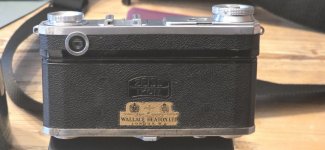
At about that time I worked at Wallace Heatons, New Bond Street, the biggest by far I believe, but even we had limited stock. We had just one showcase, stuck almost out of sight, with Japanese cameras, and I especially remember the Asahi Pentax, great cameras for the money, and very up to date, but a combination of snobbery and anti-Japanese sentiment (which is still extremely strong in China) stopped them from being popular. I mentioned earlier that the TLR cameras had the massive advantage of not needing to be stopped down manually to take the shot, this of course also applied to all rangefinder cameras, which is probably why Rollie and Leica dominated the market at that time.

There were alway the oddities, there were the Vito cameras, which were excellent value for money and well-built, competing with the Ilford film tearing machine (The Sportsman) there was then excellent Mamiya TLR cameras with interchangeable lenses, there were the awful Reid and Wray Leica copies, some Ukranian Leica copies, and the dreadful Irish Corfield 66, then there was the Werra camera, where we wound on the film by twisting the lens mount, which was noisy and unreliable, there was the Robot, which had a mechanical motor drive, The Edixa, with a cloth FP shutter that was guaranteed to fail, and the Exacta series, which looked like Frankenstein and which was just as badly made:)

Aout the only advantage of working for Wallace Heaton was that, if we paid a few pence for insurance, we could take home and borrow any stock.

 
My first serious camera was a Pentacon FM, the third iteration of the Contax S, the world's first pentaprism equipped 35mm SLR.

I couldn't afford a lens with an "automatic" diaphragm, so I had the Meritar 50mm/f2.9, which had a stop down ring. You set the target aperture with one ring, focussed on the subject, then spun the second ring until it stopped, which confused my understanding of "lens stops" for some time!

What it did do was to provide me with a good understanding about depth of field, because although not brilliant by any means, my teenage eyes could clearly see how more of the image came into focus as I closed down the aperture.
 
As well as the stop down lever some cameras have a mirror up.

TP=pentax.jpg

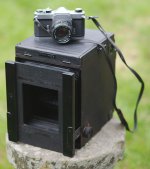
This little TP reflex, is on my "to restore" list. It t's a Half plate camera, On the other side first pressure on the shutter release lifts the mirror, unfortunately a lens for it has to be manually sopped down, not even a pre-set.

Aout the only advantage of working for Wallace Heaton was that, if we paid a few pence for insurance, we could take home and borrow any stock.


I went into Wallace Heaton, once, probably around 1970, it was an amazing shop. I have the 1971-2 Blue Book, bought more recently. Next time I visited it was Dixons and had gone downhill.

Wallace Heaton's first shop was in Sheffield, 19 Change Alley, with a London showroom at 119 New Bond Street, he had taken over Watson's Camera Store in Sheffield High Street. He seems to have been linked to The City Sale & Exchange, a chain of London camera stores, as early as 1919. He took over the company in 1929, restructuring it as City Sale & Exchange (1929) Ltd, it traded alongside Wallace Heaton itself until the 1950s, when all stores were branded Wallace Heaton.

The Sheffield store became a separate company Wallace Heaton (Sheffield) Ld in 1926, and then Wm McIntosh (Sheffield) Ltd in 1927, Re-branded imports were sold under the Zodel name by Wallace Heaton, Salex, by City Camera & Exchange, and Wilmac, by Wm McIntosh.

Ian
 
I am used to thinking that a 35mm SLR which doesn't have a stop down lever is at a disadvantage compared to one that does. But in reality, I never use the stop down lever because the resulting screen dimness is too much of an issue. I just try to estimate whether the depth of focus will suit my needs. Same with large format.

Furthermore, it has only just occured to me that neither of my TLRs have a stop down facility, for the reason as stated above that the viewing lens is always wide open. Yet they are some of my favourite cameras and I have never, ever, felt the need to stop down.
 
With large format, I use a loupe. But with the larger negative comes a smaller degree of enlargement. From 5x4 - the smallest format I use - if the image is sharp on the ground glass with a 4x loupe (I now use a 6x), then a 20x16 print will be sharp. So it does work for depth of field. The focusing cloth by clicking out ambient light always the eyes to adjust, do relatively speaking the screen is brighter than it would be with a waist level finder and magnifier.
 
I am used to thinking that a 35mm SLR which doesn't have a stop down lever is at a disadvantage compared to one that does. But in reality, I never use the stop down lever because the resulting screen dimness is too much of an issue. I just try to estimate whether the depth of focus will suit my needs. Same with large format.

Furthermore, it has only just occured to me that neither of my TLRs have a stop down facility, for the reason as stated above that the viewing lens is always wide open. Yet they are some of my favourite cameras and I have never, ever, felt the need to stop down.

With many cameras it's far more important to know how well you can rely on the DOF scale on a lens. And then also where to place focus, it's not halfway, rather 1/3 of the way back between where you want close and distant sharpness using aperture and DOD control.

With my Mamiya 645 lenses I found that if shooting at f11 I needed to use the f8 DOF markings, always the markings of the next wider stop. I took the same approach with my 35mm cameras.

Ian
 
Last edited:
With large format, I use a loupe. But with the larger negative comes a smaller degree of enlargement. From 5x4 - the smallest format I use - if the image is sharp on the ground glass with a 4x loupe (I now use a 6x), then a 20x16 print will be sharp. So it does work for depth of field. The focusing cloth by clicking out ambient light always the eyes to adjust, do relatively speaking the screen is brighter than it would be with a waist level finder and magnifier.

I have loupes, and it's extremely rare I use them, less so focus cloths, here though it depends on the direction of the light. The screen/fresnel combination on my Wista 45DX is very bright, and a loupe is not as good with a fresnel as its rings make it harder, my main 10x8 camera has a Beattie Intenscreen, again a fresnel, but super bright.

And then I have worked for many years shooting LF 5x4 hand-held, a Crown Graphic, and then mostly a Super Graphic, just using the focus hood, I guess it's how intuitive LF movements become.

I've demonstrated movements to University students, and they have been amazed that the front tilt, or swing I've chosen has been spot on, without even looking at the focus screen, just needing to fine focus. I should add these students had no help from tutors or technicians with LF equipment, and I've never had any affiliation to the College/Polytechnic, and finally University.

Ian
 
I am used to thinking that a 35mm SLR which doesn't have a stop down lever is at a disadvantage compared to one that does. But in reality, I never use the stop down lever because the resulting screen dimness is too much of an issue. I just try to estimate whether the depth of focus will suit my needs. Same with large format.

That was my experience. I acquired a Minolta 600si as my second SLR and was excited by having stop down preview - and not so excited after trying it in the real world and discovering its practical limitations.
 
Yes, I'd completely forgotten about the Praktina, and back then (around 1960) there were loads of manufacturers who had quite quirky designs. The reality is that none of them really had much chance here in the UK, before the internet, simply because retailers simply couldn't stock them all and so the public didn't really know about them - advertising at the time basically consisted of retailers taking up several pages in the photography magazines, listing their stock and prices.

At about that time I worked at Wallace Heatons, New Bond Street, the biggest by far I believe, but even we had limited stock. We had just one showcase, stuck almost out of sight, with Japanese cameras, and I especially remember the Asahi Pentax, great cameras for the money, and very up to date, but a combination of snobbery and anti-Japanese sentiment (which is still extremely strong in China) stopped them from being popular. I mentioned earlier that the TLR cameras had the massive advantage of not needing to be stopped down manually to take the shot, this of course also applied to all rangefinder cameras, which is probably why Rollie and Leica dominated the market at that time.

There were alway the oddities, there were the Vito cameras, which were excellent value for money and well-built, competing with the Ilford film tearing machine (The Sportsman) there was then excellent Mamiya TLR cameras with interchangeable lenses, there were the awful Reid and Wray Leica copies, some Ukranian Leica copies, and the dreadful Irish Corfield 66, then there was the Werra camera, where we wound on the film by twisting the lens mount, which was noisy and unreliable, there was the Robot, which had a mechanical motor drive, The Edixa, with a cloth FP shutter that was guaranteed to fail, and the Exacta series, which looked like Frankenstein and which was just as badly made:)

Aout the only advantage of working for Wallace Heaton was that, if we paid a few pence for insurance, we could take home and borrow any stock.
Gary, thought you might like to see my Contax II that came back from a CLA (much more than that really) today. Thank you Ed Trzoska for the fabulous work.

1936 - it has aged well.

20260402_185832.jpg
 
Last edited:
I'm always bemused when a film camera has a stop down button. I mean what earthly use are they? I've never been able to discover a practical use for it. Yes, it stops down the shutter and makes your viewfinder darker. But what is the point of that?
As other have said it was to assess depth of field, but not to assess "sharpness", which was never very practical, given the small screen and dark viewing.

The principal use, and only use as far as I am aware, was being able to check how background features which were completely out of focus with the lens wide open, became well enough defined after stopping down to distract from the subject. Thus requiring a rethink of the viewpoint or the need for a bit of background management.

As someone who semi-specialised in close-ups in the film days, I found the stop down button an important feature, and wouldn't buy a camera without one.

EDIT: it seems that my wife who used to sell flower and garden photographs through an agency actually used to determine the point of focus with close ups,using the stop down button, and feels it gave enough of an impression of the depth of field to make it worthwhile.
 
Last edited:
I just gave a SDB a quick test at f32 and the difference to DOF visibilty is huge.

I will use this button a bit more I think.
 
I have 3 Nikon DSLR cameras, 2 of them definitely do have a dof button, although I've never used it. The 3rd one probably does but I haven't bothered to get it out to check, that's how much it matters to me.

As I see it, a dof button is potentially very useful for giving an indication of how much of a shot will be reasonably sharp at a given aperture, but it's a bit rough and ready and, for many of us, may not be needed at all or may not be the best approach to a perceived problem.

I say "perceived problem" because even the most basic understanding of the physics removes that problem. Just study any dof calculator to easily learn what the approximate "acceptable sharpness" is with any film/sensor size of camera, at any distance, at any normal image magnification. After a short while, we can get a very good idea of the dof simply by estimating lens to subject distance, with any given lens.

And if, instead of relying on f/numbers, which are variable depending on the focal length, think in terms of actual/effective apertures instead - for example, an actual/effecive lens aperture of say 10mm will produce the same dof at any given distance, regardless of focal length, which makes things much simpler.
 
I have 3 Nikon DSLR cameras, 2 of them definitely do have a dof button, although I've never used it. The 3rd one probably does but I haven't bothered to get it out to check, that's how much it matters to me.

As I see it, a dof button is potentially very useful for giving an indication of how much of a shot will be reasonably sharp at a given aperture, but it's a bit rough and ready and, for many of us, may not be needed at all or may not be the best approach to a perceived problem.

I say "perceived problem" because even the most basic understanding of the physics removes that problem. Just study any dof calculator to easily learn what the approximate "acceptable sharpness" is with any film/sensor size of camera, at any distance, at any normal image magnification. After a short while, we can get a very good idea of the dof simply by estimating lens to subject distance, with any given lens.
I don't think "knowing" the depth of field helps with the example I gave, but I agree with the rest.
And if, instead of relying on f/numbers, which are variable depending on the focal length, think in terms of actual/effective apertures instead - for example, an actual/effecive lens aperture of say 10mm will produce the same dof at any given distance, regardless of focal length, which makes things much simpler.
 
If you're using a "normal" 35mm SLR, I suggest that the stop down button is all but useless. The screen is too small.
I have a stop down button on 2 out of 3 of my Pentaxes, and really miss it on the ME. I don't use it a lot, but this time of year with closeup buds and spring flowers, plus f/2 lenses, the stop-down button helps a lot, as @myotis has said, in checking the background. It's also somewhat useful in determining whether that front petal is going to be in focus or not. It's not universally useful, but definitely has its place.
 
Back
Top