


- Messages
- 58
- Name
- Andreas
- Edit My Images
- No
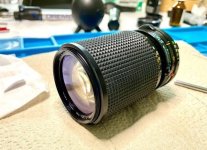
Here are a few tips for buying used lenses, in no particular order and not exhaustive. Feel free to add to the list, or I will expand it if I think of anything else.
As with purchasing electromechanical SLRs, you should rely on your intuition in addition to a quick inspection.
There should be a right of return so that the lens can be tested at leisure on your own SLR with a test film.
- Lenses are easier to check than SLRs but often more difficult to service and repair. The reason for the former is that you can look at their optics and check their settings on an SLR.
- To quickly check a lens, you can shine an LED light through the front and back of the optics and check for irregularities. Be careful not to shine the light directly into your eyes, as this can cause glare. When shining LED light through lenses, each lens behaves differently, so proceed with caution to protect your eyes. Ken Rockwell's “Flashlight Test“ describes the process.
- Furthermore, the aperture blades should be checked for oil and quick response. A perfect aperture is dry and snaps instantly to the set value.
- All lens rings should turn smoothly with a little resistance.
- All mechanical and electronic coupling elements on the lens mount must be undamaged and clean, the latter applying in particular to electronic contacts. Levers should not be bent, as can happen when attaching and coupling the SLR carelessly.
- Zoom lenses in particular are complex optical-mechanical constructions for which, unfortunately, there are often no service instructions. In this case, you have to rely on yourself when opening and disassembling them. Such lenses should be serviced/repaired by specialists.
- Spare parts, such as lenses or plain bearings, can almost always only be obtained from spare parts donors of the same type.

- Not all lenses can be accessed, either because they are pressed into plastic mounts or because they are part of a composite lens. In this case, if separation (detachment of composite lenses, see picture above) or fungus occurs, only the complete unit can be replaced.
- The usual problems with lenses are dust, fog (haze), oil, fungus, separation (see above) and scratches.
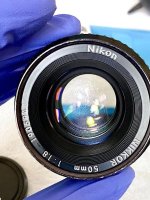
- Dust is always present and should only be removed if it occurs in large quantities.
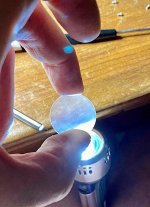
- Fogging (haze) can form from the evaporation of lubricants in the lenses. The helicoids are the usual suspects here. These are worm gears or cylinders with plain bearings in the tube that can be twisted against each other and are lubricated with grease. After decades, the grease can become liquid and form fogging or oily drops on the lenses, but also contaminate the aperture blades. A lasting solution is only possible by completely disassembling, cleaning, and re-lubricating the lens. Alternatively, the aperture blades and lenses can be cleaned at intervals, but this is only a temporary solution.
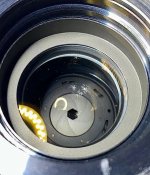
- Fungus forms from fungal spores that need moisture and warmth to grow. Fungus should always be removed, as it can irreversibly etch the lens surfaces after prolonged exposure. However, fungus is not contagious like a virus and does not jump from one lens to another, as horror stories on the web claim.
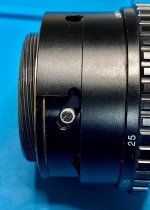
- Zoom lenses have plain bearings built into their tubes, which enable zooming by extending or shortening the distance between the optical units. These plain bearings consist mostly of small cylinders that are screwed in and coated with plastic.
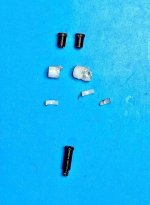
Aging and/or use can cause the plastic to break. This causes the zoom mechanism to jerk or jam. The only solution is to replace it.
- Scratches on the front lens are less critical than on the rear lens, with wide-angle lenses being the most susceptible due to their large depth of field.
- All problems with lenses - dust, fog (haze), oil, fungus, separation, scratches - should be assessed according to their extent. If the artifacts are pronounced, image quality may be impaired. However, the resulting lack of contrast and sharpness can be compensated for with electronic image processing to a certain extent. Therefore, you should not immediately discard an affected lens, but test it in your workflow to see if it is still usable. Such lenses are often inexpensive to buy.
- The infinity setting on lenses can be misaligned, especially if the lens has been tampered with. This means that infinity can no longer be focused. This can be corrected by adjustment, but requires specialist knowledge and equipment and should be left to professionals.
- The same applies to the distance indicator on the tube, which may be misaligned.
- I would not buy lenses with severe dents on the barrel. This indicates that strong force has been applied, which may have misaligned the optical system.
- Newer lenses have built-in electronics that are not critical, but heavy use and/or lack of care can lead to contact problems due to wear respectively contamination. Here, you have to rely on the overall impression that a lens makes. Heavily worn and/or dirty lenses can have problems here.
- Valuable lenses should always be left to specialists for service and repair. Without experience, DIY can quickly cause damage.
 A word of caution
Please keep in mind that you’ll be using highly flammable solvents for service work, and their fumes are harmful to your health. Soldering also produces fumes that should not be inhaled. Dangerous high voltages can be present when handling electronics, especially in conjunction with electronic flash units and mains. Therefore, familiarize yourself with the safety regulations beforehand and ensure your safety. Depending on the activity, protective gear may be advisable.
All information is provided without guarantee. Any action you take upon the information in this report is strictly at your own risk.
This report describes my personal experience and approach; it does not constitute a professional or certified repair instruction. I am not liable for any property damage or personal injury resulting from actions taken based on the information provided in this report.
Acknowledgments
Without the work of Master Larry Lyells, in particular, we wouldn’t have the detailed technical information we need today for service/repair of electromechanical SLRs.
The SPT Journal and The Camera Craftsman, which he helped shape significantly as an author, and which contain all the necessary information and instructions are available for a fee through Learn Camera Repair.
We owe our access to them to Eugene Pate, the founder of Learn Camera Repair.
As a Shodan in Jiu-Jitsu, I view camera repair as part of my Do, the Way. I am grateful to my revered Grandmaster, Erich Ebetshuber, 10th Dan in Jiu-Jitsu, for everything I have been privileged to learn from him.
Last edited: