

Very basic manual focus/depth of field question

  • Thread starter Thread starter osh
  • Start date Start date

osh

Messages
391
Edit My Images
Yes
I know this may come across as basic, but hope somebody can clarify things for me. Basically I want to take landscape pictures with my Bronica with things in the foreground and background in focus (so for example some flowers with mountains in the distance).

Until now, using an aperture of f16 for example, I have been focusing the lens until the background is in focus in the viewfinder, i.e. all the way until the infinity stop as in the picture below:
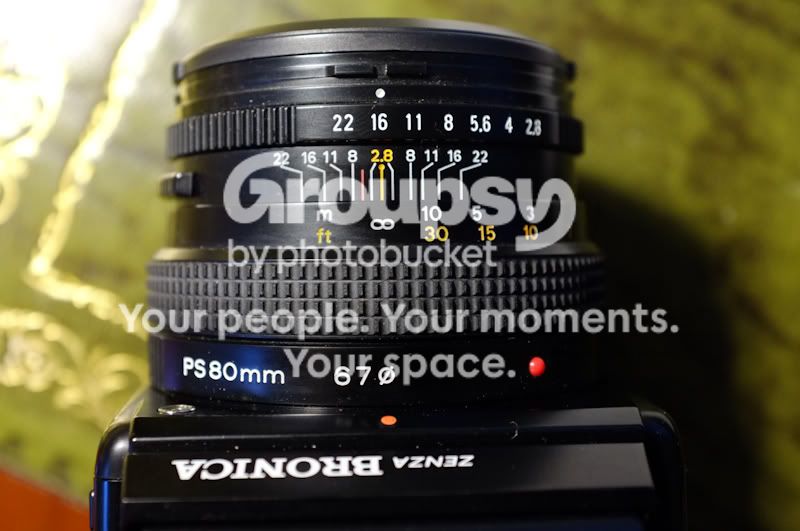
DSCF1196.jpg


Am I right in thinking though that as the aperture does not shut down until the shutter is pressed that what I am seeing is the correct focus for f2.8, i.e. with a shallow depth of field, and that turning the lens all the way is merely going to cause my foreground to be blurred?

Is the correct approach to focus until the infinity symbol is adjacent to f16 on the depth of field scale as in the picture below, with the effect that everything from around 4 meters onwards should be in focus?
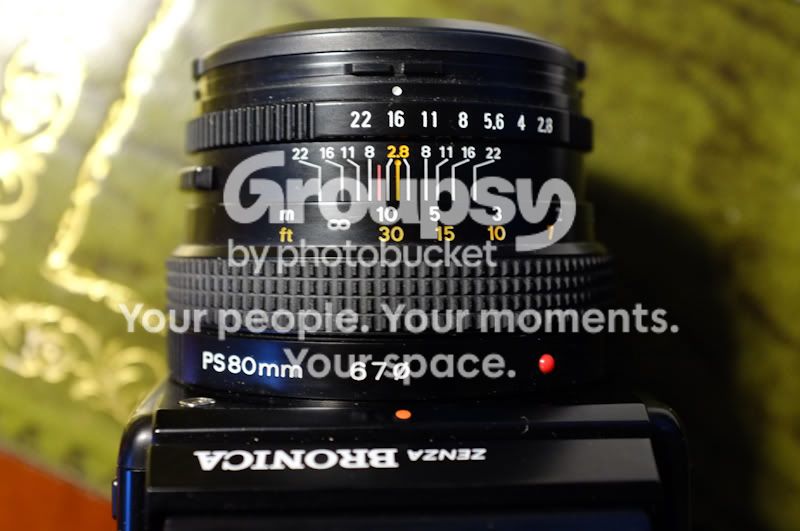
DSCF1197.jpg


Am I right in thinking that it might also be helpful to use the depth of field preview, even though with the lens stopped down it's quite dark, even in good light?

Sorry for the length of this post, and I hope the question makes sense!

Many thanks!
 
Most of your ramblings are correct. However, there is a method of focus using the hyperfocal distance to achieve the highest proportion of your image being within the depth of focus.
See here

Bob
 
Depth of field preview is your friend here. does it have a flip up magnifier to help with the focusing?

And yes your second example would be better.

Thanks, yes there is a magnifier - I will try and use that.
 
Most of your ramblings are correct. However, there is a method of focus using the hyperfocal distance to achieve the highest proportion of your image being within the depth of focus.
See here

Bob

Thanks Canon Bob, sorry if the question came across as rambling! I'm guessing that from the depth of field scale that the hyperfocal distance for the 80mm at f16 is around 4 meters then? The link is useful but relates to 35mm format which I understand is different from 120 6x6?
 
Very few lenses these days have a depth of field scale, but your assumptions in the second image you posted is correct. If you are going to shoot at f/16, setting the infinity symbol on one side against 16 will show you how much will be in acceptable focuse by reading the distance against the 16 on the opposite side of the scale. The hyperfocal distance is the one adjacent to the normal focus index; again from your second picture this is about 9m.
 
The link is useful but relates to 35mm format which I understand is different from 120 6x6?

Try here...

http://www.dofmaster.com/doftable.html

(Go down the Film / Format etc list until you find your format and put your focal length in too.)

Or you could try this alternative to hyperfocal but I don't knw how it'll look with your format...

http://www.northlight-images.co.uk/article_pages/hyperfocal_distance.html

and also here...

http://www.trenholm.org/hmmerk/DOFR.html
 
Last edited:
Try here...

http://www.dofmaster.com/doftable.html

(Go down the Film / Format etc list until you find your format and put your focal length in too.)

Or you could try this alternative to hyperfocal but I don't knw how it'll look with your format...

http://www.northlight-images.co.uk/article_pages/hyperfocal_distance.html

and also here...

http://www.trenholm.org/hmmerk/DOFR.html

Thanks so much - those links are very helpful. The chart explains a lot and I will try and digest the articles! :)
 
If you want to shoot classic landscapes with deep focus, you'd be better off with a wider lens.

Thanks yes I think you're right. My intention one day is to get a 50mm lens or even a 40mm if I can find one at a reasonable price!
 
Very few lenses these days have a depth of field scale, but your assumptions in the second image you posted is correct. If you are going to shoot at f/16, setting the infinity symbol on one side against 16 will show you how much will be in acceptable focuse by reading the distance against the 16 on the opposite side of the scale. The hyperfocal distance is the one adjacent to the normal focus index; again from your second picture this is about 9m.

Thanks for this!
 
Merklinger's approach has a lot going for it.

IMVHO regardless of any image quality advantages one thing it has going for it is that it doesn't require you to either memorise DoF tables or take them with you, all it requires is a little mental arithmetic.
 
StewartR said:
Merklinger's approach has a lot going for it.
woof woof said:
IMVHO regardless of any image quality advantages one thing it has going for it is that it doesn't require you to either memorise DoF tables or take them with you, all it requires is a little mental arithmetic.
Absolutely. And it avoids that air of spurious precision, which can't be a bad thing!
 
Absolutely. And it avoids that air of spurious precision, which can't be a bad thing!

At the risk of sparking yet another argument about the validity and accuracy of DoF tables and circles of confusion and being called a troll as these things are carved in stone and must not be questioned...

What I would say is that DoF tables and CoF's are AFAIK calculated for a specific image size viewed at a specific distance by someone with a certain level of eyesight and perception. Deviate from those rather rigid parameters and the table numbers change. However, a perfectly valid path is to decide what your own CoF and acceptable image parameters and composition should be for the image size and viewing circumstance or even viewing audience you have in mind. There is nothing to stop a photographer deciding to deviate from DoF tables.

There's also nothing to stop a photographer deciding to reject the idea of front to back sharpness (that is sharpness within certain limits, hyperfocal focusing doesn't really give front to back sharpness) and deciding to let near or far image elements be less sharp or indeed clearly not within the DoF at all.
 
These are GREAT resources. Merklinger's approach has a lot going for it. The original article is harder going but the Northlight article is very readable and very persuasive.

It's a bonkers method. No wonder it hasn't exactly caught on.

It just doesn't work in practice, and you find yourself wandering around looking the pebbles/objects of a certain size that often are just not there, and there is a lot more mental gymnastics invloved than reading a few numbers off a simple table.

I agree though that there is a lot of 'spurious precision' in DoF calcs, but there have to be precise measures and set standards in order to understand the changes. In practise it's much more rough and ready.
 
Back
Top