Will This Work ?

Messages
3,548
Name
Wayne
Edit My Images
No
Poor mans Zone system

camera in auto with spot meter selected
take a reading of highlight and dark region
Calculate stop difference in scene
Switch to manual and select middle of the road for shutter speed.

I am quite pleased with myself for coming up with this.

I can see this being a bit more effective for very shady scenes. I think It is a step towards understanding the Zone system and implementing it.
 
Yes, but why not just meter from a mid tone in the first place? AKA zone 5

I am not experienced enough to confidently identify the midtone,

I have not even considered the luminance range of the scene before, always just used my incident meter, so seems a massive step forward for me.
 
just used my incident meter, so seems a massive step forward for me.

I will admit, I sometimes just meter from the pavement, grass or the palm of my hand ..... :ROFLMAO:
Indeed, I would use incident meter if I wasn't sure of the reflective accuracy. Otherwise, what he said or a grey card of course or a khaki Billingham bag.
If one side of the street is in sun and the other shade I take a reading from a mid tone in the sun if I want to see the sunny side of the street or off the shady side if that is the side that holds my interest.
 
Why select spot metering? The other metering modes already bias/average the exposure in some way. And no, it won't work; the Zone System is not (and never was) just about metering/exposure... theoretically, metering the exposure as you are suggesting could cause both the shadows and the highlight to clip.

To use the zone system:
  1. Meter the darkest region where you want to retain detail... the metered reading will place it in zone 5.
  2. Decide what zone you want it to be in instead, say it's zone 3 (visible detail).
  3. Shift the metered exposure towards underexposure as required (2 stops).
  4. Take picture.
  5. Meter the brightest area you want to retain; note the difference from the shadow exposure.
  6. If those highlights meter 3 stops higher, they would fall in zone 6.
  7. If you want the highlight to be in zone 7 instead, push the development 1 stops.
  8. If highlights metered above the desired zone you would pull the development time instead.
By doing this you decide which parts of the scene records as black/white (with detail), and the available tonal/dynamic range is then spread between those in the print. There are really only 5 zones that provide good detail (3-7)... which is probably why most camera meter scales only show 5 stops (middle, +/-2). If you are not doing all of that you are not using the zone system, just forget about it... people who purport that they are using the zone system with their metering are just wrong (I've seen the explanations/videos/etc).

What you can, and should do is adjust the metered exposure so that your subject is properly exposed. I.e. your subject is a black bird... it should be exposed about 2 stops below middle. If you are not pushing/pulling/dodging/burning then you can't do anything about the other parts of the exposure/image.
 
Last edited:
Thanks for advice and tips guys. Its the first time I have thought about this and did not wake up this morning an expert.

I have just shot half a dozen test shots, see if my middle guess ends up middle.
 
I am not experienced enough to confidently identify the midtone,

I have not even considered the luminance range of the scene before, always just used my incident meter, so seems a massive step forward for me.
I'm not convinced that it's easier to identify an appropriate shadow and highlight area than it is to identify a zone V area.

And there is no reason to assume that the mid-point between the two will give an appropriate exposure. This is going to depend on how far apart the highlight and shadow readings are AND where, within that range you want to have subject detail.

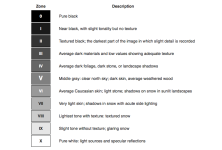
This is how Adams describes the zones

1779551224725.png

Bear in mind that while Zone X represents pure white on the print, in terms of meter readings in the field it might be 10, 11, 12, 13.... stops brighter than Zone 0. So the mid point may or may not be, anywhere near Zone V.

There are various ways to meter using the zone system, but the starting point is to select the part of the subject that you consider the most important for exposure.

So, for example, measuring a Caucasian flesh tone, which Adams suggests should be Zone VI on the print, then giving 1stop more than the meter says, ie 1 stop more than needed for a Zone V exposure.

Once you have decided on the exposure, you can then take meter readings from other areas in the scene to see where they will "fall" on the zone system at that exposure.

Depending on where these other Zones fall, you need to start making decisions,on how you deal with it. Accept the initial exposure decision, bias the exposure towards the shadows or highlights, or use colour filters, or adjust development times or the developer used.
 
I'm not convinced that it's easier to identify an appropriate shadow and highlight area than it is to identify a zone V area.

And there is no reason to assume that the mid-point between the two will give an appropriate exposure. This is going to depend on how far apart the highlight and shadow readings are AND where, within that range you want to have subject detail.

This is how Adams describes the zones

View attachment 483036

Bear in mind that while Zone X represents pure white on the print, in terms of meter readings in the field it might be 10, 11, 12, 13.... stops brighter than Zone 0. So the mid point may or may not be, anywhere near Zone V.

There are various ways to meter using the zone system, but the starting point is to select the part of the subject that you consider the most important for exposure.

So, for example, measuring a Caucasian flesh tone, which Adams suggests should be Zone VI on the print, then giving 1stop more than the meter says, ie 1 stop more than needed for a Zone V exposure.

Once you have decided on the exposure, you can then take meter readings from other areas in the scene to see where they will "fall" on the zone system at that exposure.

Depending on where these other Zones fall, you need to start making decisions,on how you deal with it. Accept the initial exposure decision, bias the exposure towards the shadows or highlights, or use colour filters, or adjust development times or the developer used.

Thanks for that, I had not considered that the highlight could be above X.

I will rethink it until I get it. The way you explain it makes it seem simple.
 
If I remember correctly this was targeted towards printing on fixed contrast paper. MG paper removes some of the problems and scanning even more so, always good to experiment though if you are enjoying it, I went crazy testing so now follow - I lost detail then expose more, my whites are all off - change dev next time
 
If I remember correctly this was targeted towards printing on fixed contrast paper. MG paper removes some of the problems and scanning even more so, always good to experiment though if you are enjoying it, I went crazy testing so now follow - I lost detail then expose more, my whites are all off - change dev next time
The fixed contrast paper still came in multiple contrast grades, and you would work in producing negatives with an optimum contrast for a Grade 2 paper (or whatever you decided upon). A grade 2 with one paper maker, might not have the same contrast as a grade 2 paper from another maker.

And then refine the contrast, by changing paper grade (grade 0 to grade 5, but not all papers were available in all grades).

Even fully implemented, the Zone system was never an "exact" science: not that any science is "exact", but that is a discussion for another day :-)
 
I've experimented with spot metering. I have reservations. I still meter the palm of my hand and give one stop more. It's been accurate enough for me for 60 years, and I don't see any need to change. But then, I'm very conservative - one developer, one or two films, one developing time for the films. It just means I always know what I'm going to get; experiments are almost by definition capable of giving unexpected results - although many dismiss unexpected results as experimental error if they go against the theory.
 
I've experimented with spot metering. I have reservations. I still meter the palm of my hand and give one stop more. It's been accurate enough for me for 60 years, and I don't see any need to change. But then, I'm very conservative - one developer, one or two films, one developing time for the films. It just means I always know what I'm going to get; experiments are almost by definition capable of giving unexpected results - although many dismiss unexpected results as experimental error if they go against the theory.
My every day exposure leaned heavily on incident metering, but like you, and all the professionals I knew, apart from the occasional experiment, I also stuck with the same couple of film types and one developer.

But "learning" the zone system gave me insights into exposure and development that I would never have achieved without spending the time on it.
 
I think the main thing to learn from the zone system is that how something meters, and how it appears to you at the moment, are not reality. I.e. something that is middle gray can appear/record anywhere from black to white based upon how much light it is reflecting, and how long the exposure is. And if it can appear as any tonal value based upon the intensity of light falling on it, and all of those tones can be "real," then the only thing that really matters is how you want it to appear in the photograph you are making.

I.e. photography as an art is not documentary, it is not about recording what you see... it is about timing and manipulating the exposures (light/duration/etc/etc) in order to generate the image you want to create. And that is one of the reasons Ansel (and the Zone technique) became famous; because he was one of the first to create images and not simply document what he saw. E.g. in some images the sky is unnaturally dark because he used a red color filter. He believed an image is created; not taken... and he helped establish (some) photography as an accepted fine art form.

There are certainly other areas of photography that I don't think qualify as art perse... those other areas are where I am strongest, because I am more of a technician than I am an artist (but I do try).
 
Last edited:
Why select spot metering? The other metering modes already bias/average the exposure in some way. And no, it won't work; the Zone System is not (and never was) just about metering/exposure... theoretically, metering the exposure as you are suggesting could cause both the shadows and the highlight to clip.

To use the zone system:
  1. Meter the darkest region where you want to retain detail... the metered reading will place it in zone 5.
  2. Decide what zone you want it to be in instead, say it's zone 3 (visible detail).
  3. Shift the metered exposure towards underexposure as required (2 stops).
  4. Take picture.
  5. Meter the brightest area you want to retain; note the difference from the shadow exposure.
  6. If those highlights meter 3 stops higher, they would fall in zone 6.
  7. If you want the highlight to be in zone 7 instead, push the development 1 stops.
  8. If highlights metered above the desired zone you would pull the development time instead.
By doing this you decide which parts of the scene records as black/white (with detail), and the available tonal/dynamic range is then spread between those in the print. There are really only 5 zones that provide good detail (3-7)... which is probably why most camera meter scales only show 5 stops (middle, +/-2). If you are not doing all of that you are not using the zone system, just forget about it... people who purport that they are using the zone system with their metering are just wrong (I've seen the explanations/videos/etc).

What you can, and should do is adjust the metered exposure so that your subject is properly exposed. I.e. your subject is a black bird... it should be exposed about 2 stops below middle. If you are not pushing/pulling/dodging/burning then you can't do anything about the other parts of the exposure/image.

There is a lot of information there Steve, thanks.

I had been wondering a couple of things and was reading through the thread again, when we are moving the exposure times up and down will the whole roll have to have the same treatment ? It strikes me that we wont be able to mix and match on the roll. I suppose for 4x5 exposures we could get by making individual notes.
 
If it's just exposure, you can do whatever you want as many different ways as you like on the same roll. If it's developing times, then everything gets the same treatment, appropriate or not.

Paraphrasing my book, if you photograph a step wedge, by adjusting the exposure, you can make the blackest square a pure white or the whitest square a pure black. By adjusting the developing time (since that affects the contrast) you can produce as many tones as you like, from 2 upwards. Or, in the case of long development and over exposure, just 1.

Not many people find photographing stop wedges creative, although I expect there's a market for the photos somewhere. On the other hand, if you prefer to master the smallest details, and prefer that to actually producing photographs...
 
Last edited:
There is a lot of information there Steve, thanks.

I had been wondering a couple of things and was reading through the thread again, when we are moving the exposure times up and down will the whole roll have to have the same treatment ? It strikes me that we wont be able to mix and match on the roll. I suppose for 4x5 exposures we could get by making individual notes.
With roll film cameras, many came with interchangeable film magazines, so you could keep one magazine for say+2 development and another for -2 (or whatever you wanted). You could do the same with 35mm bodies, and just change lenses between bodies.
 
With roll film cameras, many came with interchangeable film magazines, so you could keep one magazine for say+2 development and another for -2 (or whatever you wanted). You could do the same with 35mm bodies, and just change lenses between bodies.
I suppose you could also make note of the last exposed frame and then rewind/reload a roll (with enough care), or even cut a roll into segments for separate development...
But yeah, I guess that's a major reason why the zone system is more of a historical note rather than common practice.
 
I suppose you could also make note of the last exposed frame and then rewind/reload a roll (with enough care), or even cut a roll into segments for separate development...
But yeah, I guess that's a major reason why the zone system is more of a historical note rather than common practice.
Zone system apart, it was common practise to increase or decrease the development time for B/W wedding photographs, depending on whether it was a dull or a bright day. In Scotland it was rare to reduce development time :-(

Films (roll films, no one used 35mm in those days) would be marked up with the processing time (+1min, etc), and you would batch them according to the processing times, adding them to the tank (deep tank development) in sequence depending on how each film was marked up.

Away from weddings You would also sometimes sacrifice the perfect development of the less important pictures, to give the correct development for the more important ones.

And, on occasions, just sacrifice an entire film by taking a partially used film out of the camera, to replace it with a new one. I would never have reloaded that partially used film for fear of scratches. I would do that with Industrial photographs, but normally these would be 5x4 so not an issue

This is where professionals were probably at an advantage, as they were unlikely to carry film over in a camera to a fresh day, and more likley to see wasted film as a necessary job cost
 
With roll film cameras, many came with interchangeable film magazines, so you could keep one magazine for say+2 development and another for -2 (or whatever you wanted). You could do the same with 35mm bodies, and just change lenses between bodies.

That's a great Idea Graham. (y)

Thanks
 
I suppose you could also make note of the last exposed frame and then rewind/reload a roll (with enough care), or even cut a roll into segments for separate development...
But yeah, I guess that's a major reason why the zone system is more of a historical note rather than common practice.


XP2 super has an EI of 50 to Ei 800 at same development time.
 
the Zone System is not (and never was) just about metering/exposure.
What sk66 says is quite correct and when I worked in retail, I had conversations basically the same as that post a hundred times over. If you are using roll film then you are not using the Zone system. Consumers would get variously defensive/cross about this.

I think on reflection I would see this in two parts.

What works for someone in the OP’s position on a practical level given they are using (I believe) a roll film camera, I include 35mm in that definition.

Back “in the day” cameras that could take around eight spot reading and average them out were a thing. The joke often said is any eight readings averaged out will result in 1/125 at F8! Metering from a grey tone set in the light of the subject you are interested in is by and large what we are all doing. With high contrast subjects or lighting, one may wish to consider sacrificing highlights or shadows by biasing the exposure one way or the other. In many cases a grey or ND grad filter may well help. If you are photographing the ride I would suggest metering from their face and let the white dress do what it’s going to do exposure wise!


Then there is the Zone system. Sure, if you are not matching development to exposure etc then you are not truly using the Zone system. However the Zone system was not meant to be the ultimate definitive way of working. It was a way of thinking and if you wanted to of working devised by Mr Adams as a way of helping his students understand exposure/photography. A starting point to gain a deeper understanding if you will. So if the OP is thinking about exposure/photography with reference to the Zone system in any way it could be argued that they are using the Zone system as it was intended as an educational way of thinking about things.
 
XP2 super has an EI of 50 to Ei 800 at same development time.
I would say it has an exceptionally large exposure latitude. The film speed rating is whatever you decide it is; it is/was quite common to shift away from the official rating as "your default." E.g. many say ISO 200 is best with XP2.

But that does make for a unique case for applying the zone system without needing to adjust development times as you would with silver halide film.
 
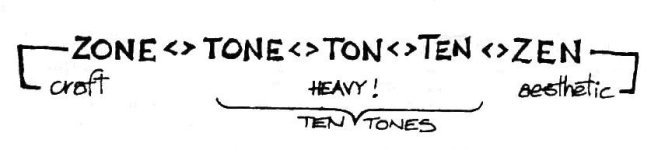
As the late Peter Goldfield wrote in "The Goldfinger Craftbook For Creative Photography":

1779620110814.jpeg

The Zone System is just a practical way of exposing for the Shadows and processing for the Highlights.Peter was essentially saying the Zone System gives you the craft to control the aesthetic. I've used it for 40 years, although I largely pay lip service to it these days, I started using a Weston Euromaster, a technique Adams mentions in The Negative, later buying a Spot meter.

Probably the photographer with the greatest mastery of the Zone System was John Blakemore.

The most important part is determining your base point, effective film speed, and then optimal development time for Normal usage. I did this with 35mm film, as I could expose a few frames, cut these exposed frames off in the darkroom, process, shoot again and adjust development as needed.

Initially it is worth keeping a Zone System log, just notes on Film, EI, Dev time, but most importantly what you placed on specific Zones. It's also worth making a large print and marking the Zones on the relevant areas of it, that help with understanding how it works. John Blakemore's Black and White Workshop book as example prints with Zones marked,

It is also about accuracy of exposure, I was also shooting 5x4 E6 back in the late 80s, early 90s, and there's no room for inaccuracy, so that carried through to B&W as well.

Ian
 
The most important part is determining your base point, effective film speed, and then optimal development time for Normal usage. I did this with 35mm film, as I could expose a few frames, cut these exposed frames off in the darkroom, process
Did you find 35mm was a good enough approximation for other formats? I stopped testing 4x5 as it burned a hole in my pocket
 
Did you find 35mm was a good enough approximation for other formats? I stopped testing 4x5 as it burned a hole in my pocket
In the late 1960s, my first boss started trading in his 5x4 kit for Hasselblads and Rolleiflexes.

It was great not having to cart a couple of hundredweight of kit around! I still remember the pleasure of making my first 20x16 from a 6x6 negative!
 
What sk66 says is quite correct and when I worked in retail, I had conversations basically the same as that post a hundred times over. If you are using roll film then you are not using the Zone system. Consumers would get variously defensive/cross about this.
I'm going to be a bit defensive about this as well, as I suggested earlier, and as I (and Ansel Adams) did, you could use the development part of the zone system by using multiple film magazines and assigning specific development times to each magazines.
I think on reflection I would see this in two parts.

What works for someone in the OP’s position on a practical level given they are using (I believe) a roll film camera, I include 35mm in that definition.

Back “in the day” cameras that could take around eight spot reading and average them out were a thing. The joke often said is any eight readings averaged out will result in 1/125 at F8! Metering from a grey tone set in the light of the subject you are interested in is by and large what we are all doing. With high contrast subjects or lighting, one may wish to consider sacrificing highlights or shadows by biasing the exposure one way or the other. In many cases a grey or ND grad filter may well help. If you are photographing the ride I would suggest metering from their face and let the white dress do what it’s going to do exposure wise!

I agree with what you say below, as there is a lot more to the zone system than the development part. For example, as an industrial photographer, I would use the zone system to decide how much additional light was needed to bring up shadow areas to a desired level of detail, even if I still used a "standard" development time. And when using colour filters for landscape, having an idea about how a particular colour filter might affect the picture in terms of zones was extremely useful.

Even, when developing an entire film, knowing how a reduced or increased development might affect particular zones, allowed you to decide in advance how you might want to develop the entire film, and expose or light subjects appropriately that were going to end up on that film.

As you say, and I said something similar earlier, the value for many people from learning the zone system isn't necessarily in the details of practising it, but in the insights it brings to your understanding of exposure.
Then there is the Zone system. Sure, if you are not matching development to exposure etc then you are not truly using the Zone system. However the Zone system was not meant to be the ultimate definitive way of working. It was a way of thinking and if you wanted to of working devised by Mr Adams as a way of helping his students understand exposure/photography. A starting point to gain a deeper understanding if you will. So if the OP is thinking about exposure/photography with reference to the Zone system in any way it could be argued that they are using the Zone system as it was intended as an educational way of thinking about things.
 
Did you find 35mm was a good enough approximation for other formats? I stopped testing 4x5 as it burned a hole in my pocket

Although I had been using 5x4 for about 10 years my camera a big De Vere Whole plate monorail, also with half plate & 5x4 backs was far too heavy and impractical for landscape worked.

Initial tests were 35mm, but then serious shooting was with a Mamiya 1000S, although I bought a Wista 45DX a few months later. I began by photographic a small old river footbridge made by apprentices at a nearby iron works. I spent a year, going there occasionally, different times of day, seasons, weather, snow, fog, etc. It was a very useful learning curve, it was honing the Zone System, but in a way that gave a consistence to the images shot there. I had a framed diptych one image shot on a foggy frosty winter day, the other a late summer sunny evening and they worked together.

I shoot 10x8 as well as 5x4, I did test Fomapan 100 & 200 using 120, and they were purely visual tests as I was living abroad at the time, but they printed exactly as expected on my next trip home.

Ian
 
Just reading the text of Ansells book changed my views on exposure, without any understanding hardly, I am now looking with deliberation at areas of the scene in a way I have not done before.
I am looking to see if there is detail in a highlight area.

If I can see detail in a bright highlight can the film record it ?
 
If I can see detail in a bright highlight can the film record it ?
Film can probably record detail you cannot see; in highlight or in shadow. The only questions are if the detail exists (there is any contrast), and if it can be resolved (it is large enough).

I.e. just because the contrast (detail shadows/color) is overexposed to your eye does not mean it does not exist. However, if the highlight is showing no detail due to frontal (on axis) lighting, then the details probably do not exist at that moment (shadows are filled in).

And it is quite possible that the film cannot record both the highlight detail and shadow detail with a singular exposure.
 
Last edited:
And it is quite possible that the film cannot record both the highlight detail and shadow detail with a singular exposure.

The whole point of the Zone System is it allows you to make the necessary adjustments to cope with both ends of the tonal scape,

Having worked a lot with extremes in Turkey and Greece I've had to deal with deep shadows and delicate highlight details, an example is a theatre entrance at Patara, where you have bright sunlight bouncing of marble and deep shadow in the entrance. Choice of developer helps enormously.

Ian
 
Last edited:
The whole point of the Zone System is it allows you to make the necessary adjustments to cope with both ends of the tonal scape,

Having worked a lot with extremes in Turkey and Greece I've had to deal with deep shadows and delicate highlight details, an example is a theatre entrance at Patara, where you have bright sunlight bouncing of marble and deep shadow in the entrance. Choice of developer helps enormously.

Ian
Within how many stops? It's not unlimited... (typically 7-9 stops). And there's not much benefit of going beyond that as you probably can't print it.
 
Back
Top