How do you practise spotting better compositions?

Messages
7
Name
william
Edit My Images
No

When you’re out with a camera, how do you train yourself to notice stronger compositions in ordinary places?

Do you use exercises such as sticking to one focal length, looking for a particular shape or colour, or photographing the same location in different light? I’d love to hear which exercises you’ve found useful.
 
Best start with a book on composition.
 
This is a great question, and one I think about a lot.

I've always said I don't consider myself as someone who has a 'good eye' for a picture, I have to spend some time and walk around, looking at different angles etc. to try and find a good shot.

My wife on the other hand, who has no real interest in photography, will literally just rock up and say 'ooooh that would be a good shot', and she's generally always right. :ROFLMAO:

So I try my best but find if I'm alone and have time in a location then I will find a good shot.
 
  • Like
Reactions: zx9
The short answer is all of your ideas help.

I think a good way to develop your own style is to try and decode what makes you look at an image somebody else has taken, what makes you like it or makes it feel good and then apply it to something you take. Eg position of elements in the frame, where the shadows are, how the colours work together, was it taken wide or tight, deep depth of field or shallow. And then try and mix it up, see if doing something different makes it better or worse, more or less interesting… And just keep doing it.

Go out with your camera every day that you can, even if it’s just for a walk down the street and try and take the best image of just random stuff that you can. Doing this helps train the eye so when you do see something genuinely interesting, it feels natural, second nature on how to fill and balance the frame.

I’ve been a keen photographer for well over 2 decades and I still do this, and I still learn something each time I do it
 
I'm yet to figure it out, and it's an area that frustrates me a lot. I feel that I'm a technically competent photographer but I don't have an "artistic eye". I've tried forcing myself to go out with a single focal length lens (35mm) and this hasn't really helped. I've read several books on composition and I look at others photos but it's still not helped me unfortunately.

I do often think that you either have an artistic eye or you don't, and if you don't you can use "rules" to be slightly more artistic/creative but I'm not sure it will ever be natural. Now that doesn't mean that I will stop trying, and I hope that one day it'll click and I'll prove this statement wrong. :p
 
There's no practice.

What grabs your eye walking past? If nothing does then is there anything about other peoples photos that grabs your attention? If nothing works then just read a few articles about composition and try to apply the guidelines in abstract.
 
I try not to overthink things when I'm shooting, rather I use intuition and 'feeling'. I find, for me, it's better to be in the moment and react to whatever is going on

However, I'll try to learn stuff before shooting and hope it sinks into my subconscious and then I'll also reflect after shooting. This is when I'll do my thinking and learning..
 
I think a good way to develop your own style is to try and decode what makes you look at an image somebody else has taken, what makes you like it or makes it feel good and then apply it to something you take.
You can't force a style on yourself, all you can do is take lots of photos and the style will emerge on its own.

The same applies to improving your pictures, take lots (look at lots too) and try to understand what you are aiming for with them. Eventually your pictures will get better.
 
I'm yet to figure it out, and it's an area that frustrates me a lot. I feel that I'm a technically competent photographer but I don't have an "artistic eye". I've tried forcing myself to go out with a single focal length lens (35mm) and this hasn't really helped. I've read several books on composition and I look at others photos but it's still not helped me unfortunately.

I do often think that you either have an artistic eye or you don't, and if you don't you can use "rules" to be slightly more artistic/creative but I'm not sure it will ever be natural. Now that doesn't mean that I will stop trying, and I hope that one day it'll click and I'll prove this statement wrong. :p
This is 100% me as well.

One thing I do try is to try and find a different perspective, so shoot lower, higher or through something....but I have to work at it :)
 
I got a bit fed up with being told 'composition can't be taught, either you've got it or you haven't' - so I set about learning. This is what helped me:

Read books on composition which are aimed at painters. There are lots. Most have a few nuggets.

Read 'Pictures on a Page' by The Times editor Harold Evans. Utterly invaluable.

Read Harald Mante's book 'The Photograph'. Hard work, needs serious study but worth it.

Have a look at Dynamic Symmetry. Then bin most of it.

Disect photos in magazines, paintings, movie stills.. work out what you like in them.

But ultimately: Think about what you are trying to do or say with a picture before you press the button. That'll guide the composition.
 
When you’re out with a camera, how do you train yourself to notice stronger compositions in ordinary places?

Do you use exercises such as sticking to one focal length, looking for a particular shape or colour, or photographing the same location in different light? I’d love to hear which exercises you’ve found useful.
I would spend as much time as possible "studying" photographs, paintings and sculptures by people recognised as being at the top of their art/craft.

And for me, preferably in books, magazines, or on art gallery walls. I find books easier as they allow a more contemplative approach, but, especially for paintings and sculptures, it isn't the same as seeing the real thing.

There is also merit, especially in terms of access and lack of expense, in looking at these same things on the computer screen, but I'm not a fan of this, especially as there is a greater tendency to "skim" through pictures on a screen.

As long as you spend time studying the picture that you enjoy looking at and thinking through what makes them work for you, I think you can build a visual memory of what a "good " photograph looks like and "intuitively" apply this to your own photographs. And the more time you spend taking photographs, the quicker you will develop an eye for a photograph. Photographers like Cartier Bresson and Ralph Gibson speak about needing to take photographs every day to keep their "eye in".

The next stage is to read up about composition and develop an understanding of how studies have discovered some common patterns and characteristics in pictures that people find most pleasing to the eye and mind.

Philosophers, artists, and psychologists have been studying this for centuries; here is some recent research in this area.


These studies are, of course, based on observations and can only ever explain a small part of why a picture might be visually successful or not.

However, taken together, I believe that an understanding of composition theory ("rules") can be useful in explaining why some pictures work and some don't.

At the time of taking pictures, I don't think you should consciously apply any "rules" of composition, as "feeling" a picture looks right at the time of taking should be more intuition-based.

Cartier Bresson has commented on analysing all his photographs after printing (using dynamic symmetry principles) but never (consciously) thinking about it when taking pictures.

This ignores the importance of the subject choice, which is a different but equally important topic.

 
You need to start by analysing the images you are making, and be quite self critical, asking yourself what is wrong. Then you begin learning, you will probably also give your photography a direction.

A book worth reading is "Achieving Photographic Style" by Michael Freeman. its only about £6 or £7 secondhand. It is not about his own work, rather pages (short chapters) showing how some well known photographers worked.

Ian
 
In my opinion, the first rule of recording an interesting picture is to find an interesting subject; after that, it's all about how you present it.

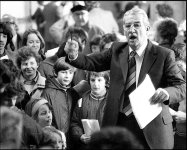
I was lucky enough to leave school, as the saying goes, on the Friday and start a job in newspaper advertising on the Monday. (Okay, that's a bit of an overstatement, but actually not much) The main thing is that I was sent on various courses, where I learned all sorts of useful things, one of which was the "rule of recession". This was something current in the 1960s and it simply said that you place the most important content of a picture in the foreground and for preference to one side. Then the less important items further back, in the order of their unimportance. Anything, which has no importance at all, shouldn't be there.

Ever since then I've practiced that rule, where possible, and ignored it, where it interfered with getting the picture. I see a lot of people doing this here, whether they're conscious of it or not.

Auctioneer.jpg
 
How about... Look at pictures and decide what you like and decide what sort of pictures you want to take?

I wouldn't bother reading books on composition though as unless you're selling pictures or chasing likes and attention on line it doesn't matter what other people do or think and you can take pictures to suit yourself. Other than deciding what you want to photograph and how, I sometimes I find that the composition is influenced by the environment, for example I might not want a waste bin, lamp post or group of people in the shot so I'll alter my framing to keep them out.

My advice and what I try and do is look at the thing you're thinking about photographing and try to imagine how the picture will look. Really look and really try to understand what it is and what's in the scene.
 
Last edited:
How about... Look at pictures and decide what you like and decide what sort of pictures you want to take?
Agree
I wouldn't bother reading books on composition though as unless you're selling pictures or chasing likes and attention on line it doesn't matter what other people do or think and you can take pictures to suit yourself. Other than deciding what you want to photograph and how, I sometimes I find that the composition is influenced by the environment, for example I might not want a waste bin, lamp post or group of people in the shot so I'll alter my framing to keep them out.
Mmmm, I'm struggling with this :-(

I see learning composition is about helping me better understand why some of my pictures work better than others, and to learn what I might do to improve them.

I don't understand the connection between studying composition and selling pictures, chasing likes, or what other people think. I'm not interested in any of those things, but I'm very interested in using the principles of composition to help me make photographs that feel the way I want them to feel.

Isn't all composition influenced by the environment? What you keep in and what you leave out is the most basic of all the compositional decisions a photographer needs to make. Do I crop out that bin, or do I try to incorporate it into the composition?

I think I know what you are saying, ie that sometimes there is an unavoidable constraint on how you can frame a picture, but I just see that as part of deciding on the composition.

I find that a lot of pictures have this kind of constraint. i.e if I am photographing trees, there is only one position that aligns foreground and background trunks so they don't overlap, but from that position the lighting isn't right, or the tall ferns hide the fallen tree in the foreground that I want to dominate the foreground. By moving further back or closer, these relationships change, as does the amount of the subject I can include in the picture. All these things constrain how you can frame the picture, and I find all compositions are compromises.
My advice and what I try and do is look at the thing you're thinking about photographing and try to imagine how the picture will look. Really look and really try to understand what it is and what's in the scene.
Agree. With few exceptions, I try to visualise the scene through the viewfinder as a print on my wall, and compose to suit.
 
How about... Look at pictures and decide what you like and decide what sort of pictures you want to take?

I wouldn't bother reading books on composition though as unless you're selling pictures or chasing likes and attention on line it doesn't matter what other people do or think and you can take pictures to suit yourself. Other than deciding what you want to photograph and how, I sometimes I find that the composition is influenced by the environment, for example I might not want a waste bin, lamp post or group of people in the shot so I'll alter my framing to keep them out.

My advice and what I try and do is look at the thing you're thinking about photographing and try to imagine how the picture will look. Really look and really try to understand what it is and what's in the scene.
I'm not sure about not reading books etc, it can often give inspiration that you can then use to take a picture you want. I often wonder how I can take an interesting and/or artistic photo of something but don't know how, and it often just looks like a reference picture. Sometimes I've seen an idea that I can then apply and it looks better.
 
Go out without a camera and spend time looking to see what grabs your eye.
 
I feel generally that framing & composition is an organic process and should come from how you feel about what you're seeing - emotion rather than thinking. Analyse it afterwards if it helps, but whilst taking, trust your gut. You'll be aware of the light, of course ...
 
Agree

Mmmm, I'm struggling with this :-(

Good for you but if you look at what's in front of you and you know what you want your end result to be what do you need someone elses opinion in a book for? And it is just their opjnion. That's what I don't really understand. Maybe I'm too much of a rebel or more likely I just don't care what someone's wrote in a book. It's not like learning exposure, composition is just opinion.

I think my points about being paid or not or chasing likes are perfectly clear. My point is that if these aren't your goals you can please yourself and I don't need a book on composition to enjoy my own photography. I urge people to try and really see what's in front of them and think about the end result they want to achieve but good luck to anyone who feels they need somone elses opinion in a book for that.

I'm not sure about not reading books etc, it can often give inspiration that you can then use to take a picture you want. I often wonder how I can take an interesting and/or artistic photo of something but don't know how, and it often just looks like a reference picture. Sometimes I've seen an idea that I can then apply and it looks better.

Inspiration Yes, but photography or rather what we like the end result to look like is not an exact science and I can't see myself reading a book telling me how to compose my own pictures. I can see what's in front of me and I have a good idea what I want the end result to be.

Go against the opinion of others and the current norm and you might just get a result more in line with what you want and might develop your own style rather than just being another rule of thirds (or whatever) follower.
 
Last edited:
I studied (and still study) photobooks by excellent photographers. I’ve got dozens of them, hundreds probably, and I’ve picked up so much from them. I’ve also read a couple of books on composition which gave me some great ideas too.

I also spent a great deal of time analysing my own photographs early on and still do to see how I could do things better.

I also spent some time in a camera club which was really useful for feedback albeit up to a certain point as I felt I didn’t want to progress down that route photographically or aesthetically.

I guess it’s all about becoming more visually literate, but what worked for me won’t work for everyone!
 
Good for you but if you look at what's in front of you and you know what you want your end result to be what do you need someone elses opinion in a book for? And it is just their opjnion. That's what I don't really understand. Maybe I'm too much of a rebel or more likely I just don't care what someone's wrote in a book. It's not like learning exposure, composition is just opinion.

I think my points about being paid or not or chasing likes are perfectly clear. My point is that if these aren't your goals you can please yourself and I don't need a book on composition to enjoy my own photography. I urge people to try and really see what's in front of them and think about the end result they want to achieve but good luck to anyone who feels they need somone elses opinion in a book for that.
I guess you and I have totally different views on what composition theory is all about, its value, and how it can be useful.

It's not at all clear to me what your point of chasing likes is about, nor how understanding some composition theory will affect someone's goals for a picture. The "goals" for a picture are entirely up to the photographer.

An understanding of composition theory is to help you achieve these goals, by giving you some insight into how people see and react to different colours, spatial and tonal patterns.


Inspiration Yes, but photography or rather what we like the end result to look like is not an exact science and I can't see myself reading a book telling me how to compose my own pictures. I can see what's in front of me and I have a good idea what I want the end result to be.

Go against the opinion of others and the current norm and you might just get a result more in line with what you want and might develop your own style rather than just being another rule of thirds (or whatever) follower.
 
I must admit that my rudimentary knowledge of composition I gained from YouTube. Adam Gibbs taught me the value of camera angles and Thomas Heaton about isolating objects. Things which I practice today. But in any case it's pretty fluid and my interests have evolved over time.
 
I try not to overthink things when I'm shooting, rather I use intuition and 'feeling'. I find, for me, it's better to be in the moment and react to whatever is going on

However, I'll try to learn stuff before shooting and hope it sinks into my subconscious and then I'll also reflect after shooting. This is when I'll do my thinking and learning..
Thanks, Ben. I like the idea of learning before a shoot, then letting intuition take over when you're out with the camera. I can see how trying to remember every composition rule could distract from what's happening in front of you.

When you look back at your photos afterwards, do you find it more useful to study the ones that worked, or the ones that didn't quite come together?
 
Inspiration Yes, but photography or rather what we like the end result to look like is not an exact science and I can't see myself reading a book telling me how to compose my own pictures. I can see what's in front of me and I have a good idea what I want the end result to be.
Yeah obviously I don't want to just replicate, I want to be able to 'visualise' what I want my image to be/look like and this is where my creativity stops, I don't 'see' a shot. I can say to myself, I wonder what it looks like from this angle or that angle, or what it looks like central rather than in the rule of thirds etc but I don't 'see' it. I just have to take a few shots based on theory and see what they look like.

I do sometimes wonder if it's because I'm aphantasic, but then my lack of creativity/artisticness (is that even a word?) shows itself in other areas. For example, I produce music but I find it far easier to remix something than come up with an original composition. I have done some original tracks but it's not been through having a melody in my head, it's been done by applying rules and experimenting. For example, I'll pick a key signature, try a few chord progressions, see which I like and then play about with notes until a melody surfaces.

Now some will call that creative, and I guess in some way it is, but like my photography I see it as applying rules and theory rather than having that natural artistic ability. I get frustrated by this which is why my photography and music production go through periods of not doing it.
 
Thanks, Ben. I like the idea of learning before a shoot, then letting intuition take over when you're out with the camera. I can see how trying to remember every composition rule could distract from what's happening in front of you.

When you look back at your photos afterwards, do you find it more useful to study the ones that worked, or the ones that didn't quite come together?
People who know what they're talking about (not me), will say you will learn most from the photographs that don't work out
 
People who know what they're talking about (not me), will say you will learn most from the photographs that don't work out
And this is where a lot of people who don't think they are creative fall down - they expect to make good photos all the time.

I've said it before, that the creative process is a form of play. Messing up is an important part of the process. You play about with ideas until something half decent emerges, then tweak it.

In photographic terms that means starting with something to point a camera at, selecting a viewpoint, and then framing the shot.
 
Yeah obviously I don't want to just replicate, I want to be able to 'visualise' what I want my image to be/look like and this is where my creativity stops, I don't 'see' a shot. I can say to myself, I wonder what it looks like from this angle or that angle, or what it looks like central rather than in the rule of thirds etc but I don't 'see' it. I just have to take a few shots based on theory and see what they look like.

I do sometimes wonder if it's because I'm aphantasic, but then my lack of creativity/artisticness (is that even a word?) shows itself in other areas. For example, I produce music but I find it far easier to remix something than come up with an original composition. I have done some original tracks but it's not been through having a melody in my head, it's been done by applying rules and experimenting. For example, I'll pick a key signature, try a few chord progressions, see which I like and then play about with notes until a melody surfaces.

Now some will call that creative, and I guess in some way it is, but like my photography I see it as applying rules and theory rather than having that natural artistic ability. I get frustrated by this which is why my photography and music production go through periods of not doing it.
Not that I should be seen as an oracle in these things, but did you read my earlier post, which might be relevant

 
I'm recommending this to almost everyone I speak to, so I'm like a broken record, but it's the first time i've mentioned it on here ;) Magnum have just released a free 'getting started in photography course' you need to sign up on the website and there's about 10 x 10ish minute videos plus several workbooks. The videos I've watched so far are great, and cover off some the themes we've mentioned in this thread so far..
 
And this is where a lot of people who don't think they are creative fall down - they expect to make good photos all the time.

I've said it before, that the creative process is a form of play. Messing up is an important part of the process. You play about with ideas until something half decent emerges, then tweak it.

In photographic terms that means starting with something to point a camera at, selecting a viewpoint, and then framing the shot.
This is one of the great benefits of digital; the scope for learning is tremendous.

It's also a benefit study photographers as well as looking at photographs, because you learn about all the failures and all the hard work that lie behind the pictures that make it into the public eye.

I think Ansel Adams said something like: "If you can get 12 good photographs in a year, and 12 great photographs in a lifetime, you will have done well.
 
I'm interested in how many try things out just to see if it works for them. Note that if you're the type of photographer who must 'get it right in camera' then it probably won't help.
 
Not that I should be seen as an oracle in these things, but did you read my earlier post, which might be relevant

I did, and I did take note. However maybe I struggle because of my aphantasia, i.e. I can’t make mental images :thinking:
 
I think that applies to most things, i.e. you learn more from your mistakes than your successes.
Yes! But only if you take the time to actually study your mistakes & think about what works and what doesn't. Blindly repeating mistakes won't help.

One of the things I got from learning physical skills (acrobatics, juggling) to a high level as an adult; I learned how to learn. Kids do it intuitively and have more time; most adults need to put concentrated effort in.

Similarly, I don't see a downside from learning from others who've been down the path already. Reading books can't do any harm and may provide invaluable shortcuts.
 
Last edited:
IMO there is a difference between emulating and learning.

To paraphrase an old saying......'there is a photographer in all of us but more in some than most' and of that paraphrased 'saying', I still think that how folk see the world can inform what & how they compose a subject/scene to photograph.

Above all, photograph what catches your eye and IMO always be curious about the world around you.
Be self critical and if you want an unbiased opinion don't rely on family or friends.
 
It's also a benefit study photographers as well as looking at photographs, because you learn about all the failures and all the hard work that lie behind the pictures that make it into the public eye.
Contact sheets are also informative into a photographer's way of thinking. Although not something that exists to any great extent these days - but why I don't delete all my 'near misses'.
 
Good composition comes with experience.

Experience comes from bad composition.

(Tom Watson, ex head of IBM misquoted)

I would also suggest looking at the video Crush the Composition by Scott Kelby
 
Last edited:
I'm interested in how many try things out just to see if it works for them. Note that if you're the type of photographer who must 'get it right in camera' then it probably won't help.
I do it all the time. Now that I have digital, but even in the film days I did the same, but more constrained by cost.

But it is still driven by trying to get as much right in the camera as possible.
 
Back
Top