Bird photography - metering

And that's kinda my point, I don't understand what difference it makes which metering method we choose to use to get a correct exposure? You keep implying that using evaluative metering is somehow inferior to spot metering, and that it would be almost impossible to get any consitency between shots, I respectfully disagree, I do it all the time.

No. I am implying that using evaluative (or any) metering mode combined with autoexposure will perhaps have you chasing the EC up and down when, if you have constant lighting, locking the exposure manually will stop all that inconvenience. The metering mode is, up to a point, less of the issue. You just have to arrive at the initial exposure by whatever means you like. The reason I choose spot is because I can select the exact target/tone from which to meter and I can decide whereabouts within the camera's dynamic range to place that tone. If the camera was evaluating the whole scene I would not be sure of exactly how the camera would interpret the tones.

Oh, and what if the whole scene is not important? When birding you often end up cropping as you may well be focal length limited. There isn't much point having the camera evaluate parts of the scene which you intend to crop out, or are simply not important to the end product. Spot allows me to choose what is important and ignore what isn't.

Several posts ago, I think in this thread, I said that when manual is not working for me and I do switch to Av mode then I also switch metering from spot to evaluative. It's just that whereas you spend 99% of your time in matrix/Av, for your own good reasons, I spend 99% of my time in spot/manual, for mine. I've simply tried to illustrate the reasons for my preference. I'm not suggesting everyone else should do the same. They might like to try it though. Some have, as recently as yesterday. You could ask them what they think if you like. Just ask starrider and suggs. Yesterday they seemed impressed. Perhaps today they will have had second thoughts. I have no idea.
 
Last edited:
That's fine, I think we actually agree then, I do use spot metering on occasion I just find I like evaluative. Even when in Av mode I will sometimes use exposure lock instead of switching to manual. The nice thing about that is once you've locked exposure you can change aperture and ISO and the shutter speed will change along with you so you can change say the DOF but exposure will be the same without counting stops or clicks on shutter speed etc.

But I think for someone starting out they have to be aware of what the camera is doing with something like this, it's a very useful tool to make my job easier, but it could hinder someones understanding if they don't realise what is happening.

I am actually in manual mode more often than not myself, I just find Av handy when running and gunning in available light, I mostly do people photography and use flash a lot, I don't like Av mode at all when using flash. I use Av when shooting available light only, and even them I often switch to manual if I'm shooting into the same direction with consistent light.
 
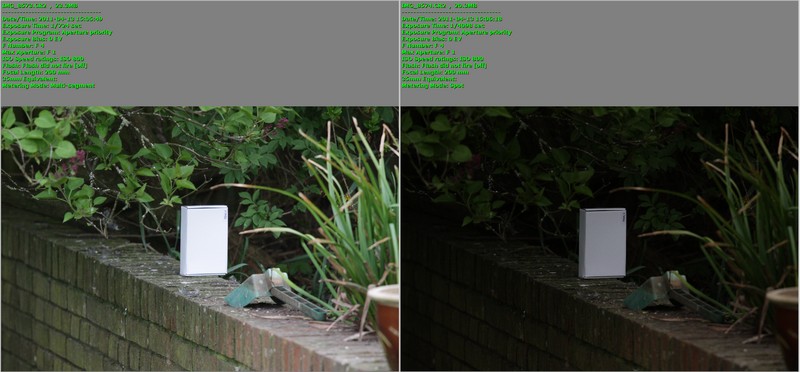
Which is evaluative and which is spot?

Eval%20vs%20Spot.jpg
 
Well I am going to guess that left hand side spot right hand side evaluative:shrug:
 
The right hand shot is a classic example of spot metering being no use at all unless you know what you're doing with it. By metering on the white object the meter has assumed the white to be mid (18%) grey and grossly under -exposed the image.

Your options were ....

Meter on the white object and add 3 stops extra exposure

Try to find a mid tone in the scene and use that spot reading directly.

Meter for the shadows and give 2-3 stops less exposure.

Take a number of spot readings from different tones in the scene and use an average setting.
 
bloody hell!! I've got a lot to learn....

LOL. You're not own your own - so has Frank. ;)

Seriously, there's nothing that clever about meters - whatever tone you meter on the meter is programmed to assume it's 18% grey, or mid grey however you care to think of it. It's up to you to decide how that tone relates to the actual scene and adjust (or don't adjust) the recommended exposure accordingly.

There's no doubt that evaluative metering does an excellent job for us in most situations, and when it's not quite there, it's usually very editable anyway, but sometimes it can get it badly wrong - good as it is it doesn't think. Spot metering is a very useful tool to have at your disposal.

To bring the subject back to birds which is where we started,- spot metering on a pretty uniformly mid toned bird such as a Sparrer or Dunnock wouldn't be far off the mark, and might be an advantage in some situations. Try spot metering on a Magpie though and the results would be disastrous whether you spot metered on a black bit or a white bit.
 
I know you guys are all very knowledgeable and all that, I appreciate that you are trying to help, but don't you think this is getting a bit heavy for talk basics?..........:)
 
CT said:
Try spot metering on a Magpie though and the results would be disastrous whether you spot metered on a black bit or a white bit.

They're not black, they're just very dark blue ;)

Sent from my iPad using TP Forums
 
I know you guys are all very knowledgeable and all that, I appreciate that you are trying to help, but don't you think this is getting a bit heavy for talk basics?..........:)

It perhaps is Frac - certainly as far as helping the OP is concerned, but apart from that - the fact is that it is pretty basic stuff. Tim started it anyway. :D

I'm going to leave this alone now, but can everyone please actually try this excercise. Photograph a white sheet of A4 printing paper or similar so that it fills the viewfinder using evaluative metering. You'll get a mid grey piece of paper in your shot as a result with a nice little spike right in the middle of the histogram corresponding with mid grey.

Now go and take the same shot with a black piece of paper and you'll get exactly the same result.

Why?

We said earlier that we don't know enough about evaluative or matrix metering, but it's a fair bet that readings are taken from each little segment of the metering pattern and initially pegged as 18% grey even though the readings are wildy different for each segment, then these different readings are compared to come up with an average for a good exposure.

When all the readings from the different segments are identical as with the white sheet of paper - the meter has only one tone to work with and says "This must be 18% grey then" and that's what you get :shrug:. In fact it wouldn't matter whether you spot metered the white paper or used evaluative, the result would be the same.

Evaluative metering is a great convenience, but it isn't foolproof - in fact it's very easily fooled in some situations. Sooner or later if you want to understand why some of your evaluative shots aren't hacking it you need to just spend a little time understanding the 18% grey bit and it's relationship to photography or forever be a a bit in the dark. See what I did there? :D
 
Yep I'm out too. But there is a lot of good information here, a few of us might have different methods, and nothing is set in stone, you can use different techniques for different situations.

The test shots on black and white objects are a really good way to start to make sense of this too.
 
Maybe a good idea to close it off and move it to the tutorials section ???

Sent from my iPad using TP Forums
 
Maybe a good idea to close it off and move it to the tutorials section ???

Sent from my iPad using TP Forums


Please god no.

Lots of very useful information - yes

A tutorial, most definitly not :)
 
Sorry - disagree. An evaluative reading is the cameras best attempt at choosing the best overall exposure for the tones in the scene. It will only place importance on the highlights proportionately with how much they occupy the frame. and it can be well wrong, so an evaluative reading
That is what I thought until the 7D came along - Evaluative on the 7D is very heavily biased towards the AF point and is not just trying to find the best overall exposure - absolutely ideal for bird photography IMO.
 
No. It's the camera's best attempt at choosing the best overall exposure for the subject in the scene.

I don't think that the camera can tell the difference between a bird and a clock, so it will be judging the tones in the scene.

Jim, the point with the 7D is that it is heavily biased towards the focus point so providing you have the bird in focus then it will try the best exposure for the subject and not the whole scene. This whole thing about evaluative being a general mode that tries to meter the whole scene is yesterdays technology IMO.
 
Last edited:
That is what I thought until the 7D came along - Evaluative on the 7D is very heavily biased towards the AF point and is not just trying to find the best overall exposure - absolutely ideal for bird photography IMO.

Roy, I know what the Canon bumf says, I'd just like to see some tangible evidence that this actually works rather than just accept it's so. I've done some test shots of the same scene with a light object to the right and a right AF point enabled and a dark object to the left with a left AF point enabled and I've not seen a blind bit of difference.

Go and point the camera up at a tree against the sky and tell me you're getting anything different to the same old silhouette or gross under-exposure I'm struggling to see any improvement at all. I'd love to be wrong about this, but show me some tangible proof. :shrug:
Cedric, you obviously know far more than me on the subject I will readily concede (and Canon by the sounds of it ;) only joking mate) but all I can say is that with my 7D I most definitely get different metering depending on where the AF point is.

I just tried it on the neighbours house - it is a cream wall with a blue fire alarm box on it. when I have the AF point over the wall with the blue box to one side (but still fully in the shot) I am getting 1/1000 sec but when I move the focus point over the box it drops to 1/500 sec. I also tried by keeping the the Camera in the same position but just changing the single focus point from the middle one to an outer one and the results were exactly the same. This to me indicates that the Camera must indeed take into account the AF point as the tones in both instance are identical. In this instance it is a full stop difference.

More important to me is in the field. Up to about 6 months ago I had all but given up on evaluative as a general metering option for birds and was mostly using manual but since re-trying evaluative on the 7D after reading several posts by some very good bird photographers I cannot believe just how good it is - I am not saying that you do not need to apply some Ev comp on occasions but certainly nothing like I used to on pre 7D cameras. No matter what mode you use you will need Ev comp at times and knowing when/how much is all part of the learning curve IMHO.
I use evaluative +1/3 Ev as my 'standard' setting for birds and am amazed as to how well this works for the majority of shots (providing you have the AF point over the bird of course). I have noticed on many occasions, taking shots of a dark bird on a light background and then from the same spot a light coloured bird and the same background and more or less the same size in the frame and they both turn out exposed correctly - bloody amazing if you ask me !!!

BTW Cedric, your example of the dark bird in the treetop against a light sky was the reason why I switched from evaluative in the first place - on my older Cameras there was only two stops of Ev comp availably if I remember correctly and at times +2 Ev was not enough to expose the bird correctly.
Now I find that in a similar situation on the 7D that you may still need to apply some Ev comp it is nowhere near as much as with previous Cameras, depending on the size of the bird in the frame but in most cases Ev +1 is thereabouts for shooting in RAW.
 
Last edited:
Well it seems to me Roy that while the AF point does affect the exposure, the overall exposure is still considered, as indeed it needs to be as anything else could be a disadvantage for other genres - landscape for example, in which case it's a welcome improvement, but that's a long way from completely negating the inherent shortcomings in evaluative metering in some situations or making the metering methods Tim favours redundant. If the system ignored the rest of the scene in favour of the bird, we'd never take a bad bird exposure in evaluative, but I certainly still get my share. :D

I'm a huge fan of evaluative and the 7D and use evaluative metering most of the time. While some of the exposure stuff we've been discussing here is something that serious photograohers should be aware of imho- I don't spend time agonising or worrying about this stuff when I'm out there . I'm happy to rely on evaluative with compensation added when needed and get on with capturing the birds. it's no big deal for me to spend a bit of time in processing either if needed.

That doesn't mean that Tim's method or any other method is right or wrong - all these methods have a place and usefulness - pick the method you prefer and as long as you get the results who cares, it's the destination which counts- not the journey. :)

And on that note - I really am leaving this thread now - I hope some people have found it useful, but i doubt it's been of much use to the OP so it's lost it's way a bit in that respect.

I have made no reference to Tim, Tom, Dick or Harry's method (I have left that one for the wolves to fight over :lol:) but just pointed out to a few that the assumption that evaluative metering just meters the whole scene is absolute rubbish - it is a lot smarter than many people realise by the sound of it on this thread.

I would also stand by the statement that the vast majority of the very best bird photographers use evaluative with Ev comp most of the time(including you by the sound if it Cedric!) - If its good enough for them it is good enough for me. And yet a lot less gifted bird photographers seem to rubbish evaluative as being just a general metering option with little or no merit for bird snappers.

BTW if you read my earlier post in this thread I did say that IMO the method the 7D evaluative uses is not particularity good for the likes of Landscapes because it does not give a general exposure over the whole scene.
 
Well I am going to guess that left hand side spot right hand side evaluative:shrug:

Nope. On the right-hand image, by using spot metering I've told the camera that the white box is the thing I want it to expose as grey. And the camera has done a great job of making it grey. To get a correct exposure I'd need to guess how much exposure compensation I'd need, dial it in, take another shot, examine it on the rear LCD, change the EC if required and repeat. A fine method for shooting boxes, not so good for shooting birds as they tend to b****r off halfway through the process.

The left-hand image uses Evaluative Metering. The camera knows what the subject is - because it's what I focussed on. It then takes meter readings from 63 different areas of the image and plugs those readings into a complicated algorithm that examines them against a database of example images and somehow tries to get the image exposed properly. I think that it does a bloody good job on the latest models and I tend to use it a lot. I can take a quick shot and stand a good chance of getting a decent image first go. If the bird doesn't b****r off then I can fiddle about to try and get something better.

I've tried to keep this basic. If nothing else I hope the images speak for themselves - Evaluative Metering can do a good job, even under difficult circumstances.
 
Back
Top