Zone System

Given that different films convert different subject luminances and hues differently, and the eyes/brain perceive tonality differently again, I'm not sure there is any such thing as "natural" tonality.

The rationale behind learning the zone system is to understand how different films, exposure, and development techniques (processing and printing) affect how tones reproduce with different combinations of subjects, materials, and processes.

This understanding is used to develop techniques that allow you to manipulate these processes so that the tones on the print match the tones your eyes/brain visualised at the time of taking the picture.

I consider understanding the curve and the straight line sections for different films, to be a subset of understanding the zone system, and it's this need for an understanding of basic photographic science, along with the time needed to measure and calibrate every aspect of the photographic process, that puts most people off using the zone system.

But as I've said in several other posts, you don't "need" the zone system to make "good" prints, nor do you need to spend weeks/months of testing and measuring your equipment and materials to make good prints.

I ended up only fully applying the zone system for difficult/important subjects, and for everyday photography relied on a Weston + invercone, albeit using the things I learned in setting up the zone system to tweak what the meter told me, when I thought it necessary.
The natural tonality is the one that can be measured from the lit subject itself . It is quite different from what we see, as our eye brain interpretation can see any particular grey at varying light level. we can perceive a mid grey in both sunlight and overcast conditions, but if measured they will be entirely different.

The zone system has only two actual variables, one is the over all exposure which determines it's position, brightness range, on the characteristic curve.
And by choice of development time, which determines the contrast Gamma, or angle, of the curve.
None of the other tonal visualisations, have any effect at all on the actual silver image of the negatives or print.

Of course the zone system was invented long before the advent of variables contrast paper, with the expectation of producing an image that could be printed on Kodak grade two paper which also came in contrast ranges of 1 to 4 and possibly grade 5 in some surfaces.

Today it is possible to print with areas burnt in at different contrasts, while his system had no such expectations, or abilities.

Before the digital era, and the collapse of film manufacturing, Kodak. Ilford and Fuji, provided full data sheets covering every aspect of the exposure, and development and printing of their films for every imaginable purpose. These include colour sensitivity, speed, granularity, contrast, development, all with detailed tables explanations and instructions, covering every field from general photography to scientific. These data sheets were available on request.
There was no need at all to rely on pseudoscience of which the zone system is an example.

The zone system does not even offer any ability to make use of the toe or shoulder of the films curve, to take advantage of the rapid compression of tones at those regions. It relies on the equal proportional density to exposure of the straight line portion of the curve. Though his prints suggest that he often took advantage of the full black of the toe to extend dark tones into full black portions of his images. To day we are more likely to aim to retain detail very close to full blacks. But that is always a personal choice.
 
Film companies still provide full datasheets for their films, that has never changed, these days they are available online rather than bing printed.

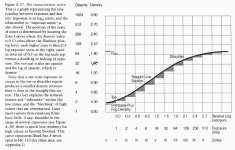
There's nothing pseudo-scientific about the Zone system, at one extreme it's based solidly on sensitometry, at the other practical testing.

1781447142677.png

By the time Adams and Minor White published the Zone System variable contrast papers were available. Renwick announced Ilford Multigrade in May 1940, however DuPont Varigram was released in the US first, which was Multigrade under licence, the RAF delayed Multigrade production here in the UK, they also cancelled all colour research. By 1942 it was thought Multigrade have been improved. A V-2 damaged the emulsion production lab in early 1945.

In Feb 1953 a new version on Multigrade was introduced. In the US Dupont quickly swapped the dye sensitisers around to the modern Magenta for higher Contrast and Yellow for lower.

Ian
 

or

 
Last edited:
The natural tonality is the one that can be measured from the lit subject itself . It is quite different from what we see, as our eye brain interpretation can see any particular grey at varying light level. we can perceive a mid grey in both sunlight and overcast conditions, but if measured they will be entirely different.
So you don't mean the "natural" tonality i.e. what we actually see, but the scientifically measured tonality that we never actually see. The Zone system tries to bring you a tool to help match the tones you see when you take the photograph to the tones you present in the print.
The zone system has only two actual variables, one is the over all exposure which determines it's position, brightness range, on the characteristic curve.
And by choice of development time, which determines the contrast Gamma, or angle, of the curve.
None of the other tonal visualisations, have any effect at all on the actual silver image of the negatives or print.
But when setting up the zone system, you also consider the effects of film characteristics, filters. paper grades. type of paper, paper toning, enlarger light source, the choice of developer, and development times. It is a complete tonal management system, not just a system concerned only with exposure and development times.

Never perfect, but still brings more control and understanding than relying on "traditional" exposure approaches.
Of course the zone system was invented long before the advent of variables contrast paper, with the expectation of producing an image that could be printed on Kodak grade two paper which also came in contrast ranges of 1 to 4 and possibly grade 5 in some surfaces.
Testing different paper grades, and different papers was a core aspect of setting up the zone system
Today it is possible to print with areas burnt in at different contrasts, while his system had no such expectations, or abilities.
There is guidance on using variable contrast papers in his books.
Before the digital era, and the collapse of film manufacturing, Kodak. Ilford and Fuji, provided full data sheets covering every aspect of the exposure, and development and printing of their films for every imaginable purpose. These include colour sensitivity, speed, granularity, contrast, development, all with detailed tables explanations and instructions, covering every field from general photography to scientific. These data sheets were available on request.
There was no need at all to rely on pseudoscience of which the zone system is an example.
Indeed there were, and are essential reading for anyone wanting to fully understand and apply the zone system. Some of the clearest and most thorough explanations of interpreting a film characteristic curve I have seen came from Zone System publications.
The zone system does not even offer any ability to make use of the toe or shoulder of the films curve, to take advantage of the rapid compression of tones at those regions.
See my comment above on using the manufacturer's technical data sheets. Understanding what happens in the toe and shoulder is still part of the broader learning about film and developer characteristics that underpin applying the Zone system.
It relies on the equal proportional density to exposure of the straight line portion of the curve. Though his prints suggest that he often took advantage of the full black of the toe to extend dark tones into full black portions of his images. To day we are more likely to aim to retain detail very close to full blacks. But that is always a personal choice.
Over several posts, I have tried to explain the benefits of using the Zone System as a valuable addition to "normal" professional exposure practices. At least the normal practices I was taught at photography college and as a trainee professional photographer. Which, from what you have written, very much matches the approach you are promoting.

It has become obvious that your perception of the "Zone System" is very different to the "Zone System" that I put a lot of time and effort into learning.

I have no argument with the vast majority of your posted content. It's only your misunderstanding of the Zone System that is giving me a problem.

So, after several obviously failed attempts in trying to explain how it works and the benefits of using it, I think I have to give up, accept defeat in trying to improve your understanding, and stop posting.

I won't post on this again.

EDIT: I now realise the last couple of lines may sound aggressive; I didn't mean them to be, it's just that I think it's time to agree to disagree.
 
Last edited:
Y0
Film companies still provide full datasheets for their films, that has never changed, these days they are available online rather than bing printed.

There's nothing pseudo-scientific about the Zone system, at one extreme it's based solidly on sensitometry, at the other practical testing.

View attachment 485009

By the time Adams and Minor White published the Zone System variable contrast papers were available. Renwick announced Ilford Multigrade in May 1940, however DuPont Varigram was released in the US first, which was Multigrade under licence, the RAF delayed Multigrade production here in the UK, they also cancelled all colour research. By 1942 it was thought Multigrade have been improved. A V-2 damaged the emulsion production lab in early 1945.

In Feb 1953 a new version on Multigrade was introduced. In the US Dupont quickly swapped the dye sensitisers around to the modern Magenta for higher Contrast and Yellow for lower.

Ian
Multi grade papers available in the uk in the 50s were almost unusable, the results were variable in the worst sense. The batch to batch consistency could not be relied on.
I did not start using it for professional work till the 70s. I have seen nothing to suggest that Adams used multi grade papers for his more famous national park photographs in 41 42. I suspect that he might have used it later. but I have not seen it mentioned in his early printing notes.

Your table showing the relationship between zones and densities on a characteristic curve, depend on the fact that you have previously established the correct exposure.
They only give names to various portions of the curve, they say nothing about exposure or development.
If you wish to favour highlight or shadows you can do that any way.
In the 168 images I have of his work . He clearly favours capturing detail in the highlights and letting the shadows approach black. In fact shadow and black dominate in most of them. Which clearly suits his printing style, however it is very different to that of a majority old modern landscape workers.

He published the full details of the method in book form long after he had been using the system himself. So long in fact that it was already well known.
Most of his books were retrospective of his key working life.
 
Last edited:
So you don't mean the "natural" tonality i.e. what we actually see, but the scientifically measured tonality that we never actually see. The Zone system tries to bring you a tool to help match the tones you see when you take the photograph to the tones you present in the print.

But when setting up the zone system, you also consider the effects of film characteristics, filters. paper grades. type of paper, paper toning, enlarger light source, the choice of developer, and development times. It is a complete tonal management system, not just a system concerned only with exposure and development times.

Never perfect, but still brings more control and understanding than relying on "traditional" exposure approaches.

Testing different paper grades, and different papers was a core aspect of setting up the zone system

There is guidance on using variable contrast papers in his books.

Indeed there were, and are essential reading for anyone wanting to fully understand and apply the zone system. Some of the clearest and most thorough explanations of interpreting a film characteristic curve I have seen came from Zone System publications.

See my comment above on using the manufacturer's technical data sheets. Understanding what happens in the toe and shoulder is still part of the broader learning about film and developer characteristics that underpin applying the Zone system.

Over several posts, I have tried to explain the benefits of using the Zone System as a valuable addition to "normal" professional exposure practices. At least the normal practices I was taught at photography college and as a trainee professional photographer. Which, from what you have written, very much matches the approach you are promoting.

It has become obvious that your perception of the "Zone System" is very different to the "Zone System" that I put a lot of time and effort into learning.

I have no argument with the vast majority of your posted content. It's only your misunderstanding of the Zone System that is giving me a problem.

So, after several obviously failed attempts in trying to explain how it works and the benefits of using it, I think I have to give up, accept defeat in trying to improve your understanding, and stop posting.

I won't post on this again.

EDIT: I now realise the last couple of lines may sound aggressive; I didn't mean them to be, it's just that I think it's time to agree to disagree.

Your posts here are valuable, and I 100% agree.

I have to question Terry because many of his comments don't add up. Yes sure Ansel Adams was probably mentioned in the weekly BJP or Amateur Photographer magazine, or one of the monthly magazines but the first major article on Ansel Adams in a UK photographic publication was in late 1964, and it's a reprint of a Nancy Newhall 1963 article "The Eloquent Light" published in the 1965 BJP Annual.

Minor white's Zone System Manual, The Ansel Adam Zone System as a Basis for Intuitive Photography, is definitely not an intuitive read. I have the 1967 4th edition 1970 reprint.

I have the large 1958 Focal Press Encyclopedia of Photography and there's no mention of Ansel Adams or the Zone System.

And he's not mentioned in the 1960 2 volume Focal Press Encyclopedia of Photography either. I'm fairly sure it was this 2 volume version I read cover to cover after I got my first camera.

1781455630655.jpeg
Well maybe not that camera :D

I'd always have one volume, and Kurt Jacobson's Developing or Enlarging, out on loan from the school library.
Y0
Multi grade papers available in the uk in the 50s were almost unusable, the results were variable in the worst sense. The batch to batch consistency could not be relied on.
I did not start using it for professional work till the 70s. I have seen nothing to suggest that Adams used multi grade papers for his more famous national park photographs in 41 42. I suspect that he might have used it later. but I have not seen it mentioned in his early printing notes.

Your table showing the relationship between zones and densities on a characteristic curve, depend on the fact that you have previously established the correct exposure.
They only give names to various portions of the curve, they say nothing about exposure or development.
If you wish to favour highlight or shadows you can do that any way.
In the 168 images I have of his work . He clearly favours capturing detail in the highlights and letting the shadows approach black. In fact shadow and black dominate in most of them. Which clearly suits his printing style, however it is very different to that of a majority old modern landscape workers.

He published the full details of the method in book form long after he had been using the system himself. So long in fact that it was already well known.
Most of his books were retrospective of his key working life.

You so obviously have little to no understanding of the simplicity of Zone System.

As Graham says it's not worth arguing,

Ian
 
Your posts here are valuable, and I 100% agree.
Thanks :-)
I have to question Terry because many of his comments don't add up. Yes sure Ansel Adams was probably mentioned in the weekly BJP or Amateur Photographer magazine, or one of the monthly magazines but the first major article on Ansel Adams in a UK photographic publication was in late 1964, and it's a reprint of a Nancy Newhall 1963 article "The Eloquent Light" published in the 1965 BJP Annual.

Minor white's Zone System Manual, The Ansel Adam Zone System as a Basis for Intuitive Photography, is definitely not an intuitive read. I have the 1967 4th edition 1970 reprint.
I can't remember how well known Adams and/or the Zone system was. As I think I said, a colleague who had learned about him and the zone system at photography college introduced me to him. I'm not sure if I had heard of him before then.

I have the same Minor White book, but the 1972 reprint. I also have "The new zone system manual" from 1976 by White, Zakia and Lorenz, which wasn't exactly an easy read either. I seem to remember that Fred Pickers Zone VI manual was one of the easiest to follow.
I have the large 1958 Focal Press Encyclopedia of Photography and there's no mention of Ansel Adams or the Zone System.

And he's not mentioned in the 1960 2 volume Focal Press Encyclopedia of Photography either. I'm fairly sure it was this 2 volume version I read cover to cover after I got my first camera.

View attachment 485036
Well maybe not that camera :D

I'd always have one volume, and Kurt Jacobson's Developing or Enlarging, out on loan from the school library.


You so obviously have little to no understanding of the simplicity of Zone System.

As Graham says it's not worth arguing,

Ian
 
Ilford was the key contractor to the RAF during the war and into the 50s.
The were also responsible for training RAF photographers.
Multi grade was largely produced to print in roll and sheet form from aerial cameras.
The exposures produced on aerial cameras were highly variable as the camera setting were rarely if ever changed in flight.
Multi grade paper made the best of often bad negatives at speed. At one time I was chief photographer for sky photos, who specialised in the photographing of shipping.
We use ex RAF equipment throughout. However we mostly used graded paper for printing as it gave far better results. Our chief technician was RAF trained.
In reality exposures rarely changed during a flight of an hour or so. The biggest problem was in patchy sunlight. It was always a poor compromise.
 
Your posts here are valuable, and I 100% agree.

I have to question Terry because many of his comments don't add up. Yes sure Ansel Adams was probably mentioned in the weekly BJP or Amateur Photographer magazine, or one of the monthly magazines but the first major article on Ansel Adams in a UK photographic publication was in late 1964, and it's a reprint of a Nancy Newhall 1963 article "The Eloquent Light" published in the 1965 BJP Annual.

Minor white's Zone System Manual, The Ansel Adam Zone System as a Basis for Intuitive Photography, is definitely not an intuitive read. I have the 1967 4th edition 1970 reprint.

I have the large 1958 Focal Press Encyclopedia of Photography and there's no mention of Ansel Adams or the Zone System.

And he's not mentioned in the 1960 2 volume Focal Press Encyclopedia of Photography either. I'm fairly sure it was this 2 volume version I read cover to cover after I got my first camera.

View attachment 485036
Well maybe not that camera :D

I'd always have one volume, and Kurt Jacobson's Developing or Enlarging, out on loan from the school library.


You so obviously have little to no understanding of the simplicity of Zone System.

As Graham says it's not worth arguing,

Ian

I bought the earlier vast single version of the focal Encyclopedia of Photography. Before going to college in 1955, folllowinng 3 years in the artillery. I read it cover to cover many times. and virtually memorised it, Developer formulas and all. I did the same with the Ilford and Kodak manuals as well.

I do not remember seeing Adams mentioned either, though it is likely he could have been mentioned in the pictures as many contemporary American photographers were.
Some of his images were almost certainly shown in the BJP Photographic almanac. As were articles on his work. I had read at school or had bought every copy between 1920 and 1970


I have never felt the need for the "simplicity" of the zone system. As it sits on top of basic exposure and processing theory and practice, which I understand very well ...

In college we were thoroughly steeped in the works of all contemporary and historic photographers. Via lectures, London exhibitions and talks. Adams was amongst them.
Though the likes of Cartier Bresson were more to our taste. As was the influence of graphic art and fashion on photography of the time. By that time we considered Adams and his style virtually historic.

A majority of Adam's major work was completed between 1916 and 1950. He did little original work after that.
The people in the 40s and 50s especially photographers and students were well aware of his work.
Articles about him in the sixties were virtually retrospectives.
Arguments about the zone system were well established by my college days starting in late1955. That is long before his published books.
 
Last edited:
Y0

In the 168 images I have of his work . He clearly favours capturing detail in the highlights and letting the shadows approach black. In fact shadow and black dominate in most of them. Which clearly suits his printing style, however it is very different to that of a majority old modern landscape workers.
Thanks for that observation Terry, I can see the contradiction in many of the photos and I cant understand the particular attention to a shadow under the root of a tree. I have been told on here that the eye is drawn to the brightest part of an image so surely it is of critical importance that this is percieved by the eye/brain correctly and as realistically as possible.

I think that if that aspect is at variance the brain will reject it as an anomaly and there would, I believe, be little value in having beautifully detailed shadows in that instance as rejection has first been established.

Being uninitiated to Adams theories until a couple of weeks ago it seems patently obvious his focus first was highlight detail and secondly contrast between the tones. His proposed method of putting things where you want on the flat portion of the curve surely is the most simplistic, excluding detailed scientific instrument analysis, with most scenes, that I have analyzed falling in the range three to five stops it is simple.
 
I bought the earlier vast single version of the focal Encyclopedia of Photography.
I've still got the two volume set of "The Modern Encyclopedia of Photography" edited by S. G. Blaxland Stubbs, F. J. Mortimer and Gordon S. Malthouse.

It was published just before World War 2 and what it lacks in technical information, it more than makes up for with umpteen interesting pictures from the period and sometimes much earlier. It also includes fascinating surveys of the various types of camera, materials and chemistry available at the time. There's more than enough formulae in the latter section to keep the committed film worker busy for years.

Modern Encyclopedia of Photography A65 DSC03431.JPG
 
Thanks for that observation Terry, I can see the contradiction in many of the photos and I cant understand the particular attention to a shadow under the root of a tree. I have been told on here that the eye is drawn to the brightest part of an image so surely it is of critical importance that this is percieved by the eye/brain correctly and as realistically as possible.

I think that if that aspect is at variance the brain will reject it as an anomaly and there would, I believe, be little value in having beautifully detailed shadows in that instance as rejection has first been established.

Being uninitiated to Adams theories until a couple of weeks ago it seems patently obvious his focus first was highlight detail and secondly contrast between the tones. His proposed method of putting things where you want on the flat portion of the curve surely is the most simplistic, excluding detailed scientific instrument analysis, with most scenes, that I have analyzed falling in the range three to five stops it is simple.
Absolutely
Exposure is simple... If you peg the highlights so that they do not burn out, all the other tones must fall along the straight line portion of the curve , nothing else is possible.
If the subject matter is in high contrast light, The darkest tones are likely to fall off the toe of the curve, producing blacks with no details.
This can be countered to some extent by reducing the contrast by reducing the development time .
However this will usually produce a flat looking image. That will need more manipulation in printing by dodging and burning and , if printing with multigrade. Then local manipulation of contrast. This is more easily done with digital printing than wet prints..

Lowering the contrast by development, flattens all the tones including the important middle tones, this can not e avoided, and unless manipulated at the printing stage, will result in dull looking images with muddy greys. Even if the image contains good blacks.

The zone system attempts to formalise this, but in my mind just complicates what is logical and simple.

Black an white photographers ,, especially those shooting landscapes, would be well advised to buy a set of colour filters. The most important is perhaps the yellow green
Which lightens grass and foliage, and orange and red which massively darkens blue sky's... Light and medium yellow are less dramatic but useful.
All filters are given a numerical factor in stops which must be used to correct the exposure. A fair idea can be obtained by looking through them with half closed eyes this wiill gives some idea of their effect. I see this as distinct from the zone system.

I used a yellow green filter on all my cameras as a starting point, I only took it off when I wanted to use a specific one. I used it all the time,, even for happy snaps.
It lightened greenery added a little tone to the sky and slightly darkened skin tones to give better separation.
Red filters were very dramatic and produced nearly black sky's, however they tested your technique in keeping your negative dust free, as prins could be a nightmare to spot otherwise.
 
Last edited:
I've still got the two volume set of "The Modern Encyclopedia of Photography" edited by S. G. Blaxland Stubbs, F. J. Mortimer and Gordon S. Malthouse.

It was published just before World War 2 and what it lacks in technical information, it more than makes up for with umpteen interesting pictures from the period and sometimes much earlier. It also includes fascinating surveys of the various types of camera, materials and chemistry available at the time. There's more than enough formulae in the latter section to keep the committed film worker busy for years.

View attachment 485066

Unfortunately my mother threw out all my early photographic books and other stuff when I went to live in Spain.
 
You are digging a hole. Please stop.

DuPont had been a key supplier for Ilford film base etc before WW2, that was why Renwick spent 3 years working for them 1922-25. When the war ended the UK Government wanted Ilford to have a fully British supply chain, Wiggins Teape for paper, another company for film base. DuPont turned Multigrade into an excellent Varigram Variable Contrast paper, but the UK Government had broken all ties.

Sure early Ilford Multigrade was poor, but DuPont Varigram quickly gained a good reputation, and Ansel Adams mentions it in publications. It took Ilford over 3 decades for Ilford to surpass it with Ilfospeed Multigrade.

I bought the earlier vast single version of the focal Encyclopedia of Photography. Before going to college in 1955, folllowinng 3 years in the artillery. I read it cover to cover many times. and virtually memorised it, Developer formulas and all. I did the same with the Ilford and Kodak manuals as well.

I do not remember seeing Adams mentioned either, though it is likely he could have been mentioned in the pictures as many contemporary American photographers were.
Some of his images were almost certainly shown in the BJP Photographic almanac. As were articles on his work. I had read at school or had bought every copy between 1920 and 1970

I have almost all the BJP Almanacs going back to 1910, and a few earlier, I'm missing very few but after 1920 only 1925. No mention of Ansel Adams, and you couldn't have an Almanac after 1963, they just don't exist. In 1964, it became quite a different publication the BJP Annual, and totally changed direction, and as I mentioned in the 1965issue had Nancy Newhall's 1963 article on Adams.

Ian
 
You are digging a hole. Please stop.

DuPont had been a key supplier for Ilford film base etc before WW2, that was why Renwick spent 3 years working for them 1922-25. When the war ended the UK Government wanted Ilford to have a fully British supply chain, Wiggins Teape for paper, another company for film base. DuPont turned Multigrade into an excellent Varigram Variable Contrast paper, but the UK Government had broken all ties.

Sure early Ilford Multigrade was poor, but DuPont Varigram quickly gained a good reputation, and Ansel Adams mentions it in publications. It took Ilford over 3 decades for Ilford to surpass it with Ilfospeed Multigrade.
Just as a point of information Adams briefly discusses Kodak Polycontrast and Ilfospeed Multigrade in the third edition of The Print. Including using a Ferrante Codelite dual light source enlarger head to adjust the contrast, the need to be careful with safelight spectrums, and that he now rarely uses multi-contrast papers.
I have almost all the BJP Almanacs going back to 1910, and a few earlier, I'm missing very few but after 1920 only 1925. No mention of Ansel Adams, and you couldn't have an Almanac after 1963, they just don't exist. In 1964, it became quite a different publication the BJP Annual, and totally changed direction, and as I mentioned in the 1965issue had Nancy Newhall's 1963 article on Adams.

Ian
 
Back
Top