- Messages
- 8,247
- Name
- Terry
- Edit My Images
- Yes
The natural tonality is the one that can be measured from the lit subject itself . It is quite different from what we see, as our eye brain interpretation can see any particular grey at varying light level. we can perceive a mid grey in both sunlight and overcast conditions, but if measured they will be entirely different.Given that different films convert different subject luminances and hues differently, and the eyes/brain perceive tonality differently again, I'm not sure there is any such thing as "natural" tonality.
The rationale behind learning the zone system is to understand how different films, exposure, and development techniques (processing and printing) affect how tones reproduce with different combinations of subjects, materials, and processes.
This understanding is used to develop techniques that allow you to manipulate these processes so that the tones on the print match the tones your eyes/brain visualised at the time of taking the picture.
I consider understanding the curve and the straight line sections for different films, to be a subset of understanding the zone system, and it's this need for an understanding of basic photographic science, along with the time needed to measure and calibrate every aspect of the photographic process, that puts most people off using the zone system.
But as I've said in several other posts, you don't "need" the zone system to make "good" prints, nor do you need to spend weeks/months of testing and measuring your equipment and materials to make good prints.
I ended up only fully applying the zone system for difficult/important subjects, and for everyday photography relied on a Weston + invercone, albeit using the things I learned in setting up the zone system to tweak what the meter told me, when I thought it necessary.
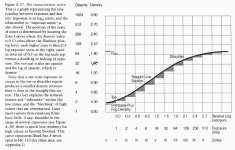
The zone system has only two actual variables, one is the over all exposure which determines it's position, brightness range, on the characteristic curve.
And by choice of development time, which determines the contrast Gamma, or angle, of the curve.
None of the other tonal visualisations, have any effect at all on the actual silver image of the negatives or print.
Of course the zone system was invented long before the advent of variables contrast paper, with the expectation of producing an image that could be printed on Kodak grade two paper which also came in contrast ranges of 1 to 4 and possibly grade 5 in some surfaces.
Today it is possible to print with areas burnt in at different contrasts, while his system had no such expectations, or abilities.
Before the digital era, and the collapse of film manufacturing, Kodak. Ilford and Fuji, provided full data sheets covering every aspect of the exposure, and development and printing of their films for every imaginable purpose. These include colour sensitivity, speed, granularity, contrast, development, all with detailed tables explanations and instructions, covering every field from general photography to scientific. These data sheets were available on request.
There was no need at all to rely on pseudoscience of which the zone system is an example.
The zone system does not even offer any ability to make use of the toe or shoulder of the films curve, to take advantage of the rapid compression of tones at those regions. It relies on the equal proportional density to exposure of the straight line portion of the curve. Though his prints suggest that he often took advantage of the full black of the toe to extend dark tones into full black portions of his images. To day we are more likely to aim to retain detail very close to full blacks. But that is always a personal choice.