Zone System

Messages
3,994
Name
Wayne
Edit My Images
No
Often I read that we should place the shadows in zone three but Adams in his most famous image used the luminance of the moon as the set point for the exposure.
I think that I am starting to get my head around the problems and choices that are faced. It seems so counter intuitive, meter for the darkest area and stop down two or meter for the lightest and open up three. It all seems so straightforward when the EV spread of the scene is only five or six stops.
I have read that 90% reflectance white card is zone nine - is that correct ?

If the EV spread of the scene is seven stops or eight then reading the white card and opening up four stops leaves us with zone two perfect if the film allows doesn't it. But if there is a need to drop the zone nine to eight then overall we might get a bit bright. What is the point at which we start to develop at N- or N+ ?

And finally to my point, are there any published development times for N+ or N- developments for the various films ?
 
For that particular shot my guess would be whatever happened he didn't want to blow the moon out so metered on it to ensure the detail was kept, and in fact with some reading he used the moon light as a fixed reading which he then used to meter the rest of the scene off as he had no meter at that time. https://articles.anseladams.com/a-legend-in-light/?doing_wp_cron=1780694214.1063311100006103515625 - that shot was more of an exception than the rule

N+ N- is usually when you've passed the printing range of the paper you use 5 stops (7 including pure black and white), if you scene has only 4 stops of difference then you'll want to extend and if you have 8 stops between you light and dark subjects you'll want to contract.

No published times, you can start at +-25% dev time each side as an approximation. If you have the time and patience there are plenty of tests over on photrio that discuss this involving densitometers

Having fallen down this path myself , from other forums users over on photrio I follow the guide now of highlights too dense, reduce time, shadows too dark increase exposure and try and take more pictures

Bon chance on this rabbit hole if you follow it!
 
For that particular shot my guess would be whatever happened he didn't want to blow the moon out so metered on it to ensure the detail was kept, and in fact with some reading he used the moon light as a fixed reading which he then used to meter the rest of the scene off as he had no meter at that time. https://articles.anseladams.com/a-legend-in-light/?doing_wp_cron=1780694214.1063311100006103515625 - that shot was more of an exception than the rule

N+ N- is usually when you've passed the printing range of the paper you use 5 stops (7 including pure black and white), if you scene has only 4 stops of difference then you'll want to extend and if you have 8 stops between you light and dark subjects you'll want to contract.

No published times, you can start at +-25% dev time each side as an approximation. If you have the time and patience there are plenty of tests over on photrio that discuss this involving densitometers

Having fallen down this path myself , from other forums users over on photrio I follow the guide now of highlights too dense, reduce time, shadows too dark increase exposure and try and take more pictures

Bon chance on this rabbit hole if you follow it!

Thanks for that !

I had thought it was related to the film and not the paper. Doh !

Also been thinking that the contraction was only of the highlights and expansion only of the shadows. Double doh !

I found this after googling which seems to be thorough, apart from differing recipe contents re the KBr


N+4 and N-6 seem a little extreme considering your comments on the paper.

I will be happy just getting a decent exposure to start off with, but a densitometer had crept into my thoughts a week or two ago. :ROFLMAO:
 
Yeah I've read you’ll probably never go over 2 in either direction, with multigrade and scanning it matters less than it use to

Pictorial planet on youtube does a lot of this testing and talks more about it all than I could

Youll be on youtube soon looking for densitometers and step wedges

Im still waiting for someone with more patience than I to release a modern sensitometer for 4x5
 
Last edited:
Found some of the Photrio stuff.

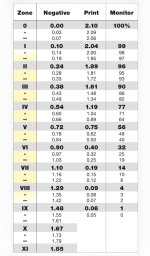
Now I need to know what density is Zone five. This can get incredibly accurate.
 
I'll just point out that photographers were making wonderful photographs long before Ansel Adams and Minor White articulated the zone system. Edward Weston inter alia developed by inspection; you'll have seen the comment in the sidebars of the Film Developing Cookbook from one of his sons (Brett, I think) about why he didn't use a meter. You should be able to find comments from AA himself about different light in some regions, that suggest he saw more than just the amount of light - the property that meters meter.
 
I'll just point out that photographers were making wonderful photographs long before Ansel Adams and Minor White articulated the zone system. Edward Weston inter alia developed by inspection; you'll have seen the comment in the sidebars of the Film Developing Cookbook from one of his sons (Brett, I think) about why he didn't use a meter. You should be able to find comments from AA himself about different light in some regions, that suggest he saw more than just the amount of light - the property that meters meter.
Morning Stephen

I have been saying that to the Mrs for years, Greece, Turkey and some parts of Spain the light is just better, crisper and cleaner, if that's what your after. I came to the conclusion that one of the reasons it is so different than much of the UK light is down to refraction caused by the humidity and moisture content of the air. Probably complete poppycock but it satisfied my need to know. I also prefer Bowens light when compared to elinchrom so to me it is a tangible thing. If Ansel Adams method, as scientifically imperfect as it is, helps me get "more correct" exposures then that will be good enough for me and excellent for my my photography.
There really have been some wonderful photographers, how they did it and worked it all out on their own with, what we would now call, limited resources and limited channels of communication is mind blowing.
 
I came to the conclusion that one of the reasons it is so different than much of the UK light is down to refraction caused by the humidity and moisture content of the air.


Partly that but also because the light has less atmosphere to fight through the closer to the equator you get. IMO&E, while there's more light in Greece, it's also a lot harsher so can be less than ideal at the height of the day. There's also a lot of haze when it heats up.
 
These threads whilst making for some interesting reading, are at times completely baffling to me. Do we feel this is all absolutely necessary to make good photos or is it purely for the theoretical knowledge (both of course are fine, it's whatever interests you and why photography is so rich in its diversity). I've seen these theories before and read some of them but never studied or practiced them in depth yet I seem to have had some pleasing results.

As Stephen said above, people were making wonderful imagery before these systems were pioneered.
 
These threads whilst making for some interesting reading, are at times completely baffling to me. Do we feel this is all absolutely necessary to make good photos or is it purely for the theoretical knowledge (both of course are fine, it's whatever interests you and why photography is so rich in its diversity). I've seen these theories before and read some of them but never studied or practiced them in depth yet I seem to have had some pleasing results.

As Stephen said above, people were making wonderful imagery before these systems were pioneered.
I had similar view a couple of weeks ago but people on here, who's opinions I respect, kept on telling me that something was not quite right with my images. So I bought a secondhand ex library copy of "The Negative" for a fiver , by the end of chapter two all the advice that I had previously been given started to fall into place and I thought to myself "he is onto something here" so I carried on reading and researching and over the last week or so it's slowly started to fall into place for me.

The methods that he advises, while not perfect, seems to have struck a chord with many and appear to have stood the test of time. The proof is in the pudding.

@trypdal - Is the density reading for middle grey particular to all films? or is each film different. I need to understand the times on the curve for adjusting densities to give me the N+ or N- values. Does that make sense?
 
Last edited:
Some people enjoy it, others not so much, many ways to skin a cat as they say

Of course. Totally agree with that. Was just trying to understand the reason why OP was asking.
I had similar view a couple of weeks ago but people on here, who's opinions I respect, kept on telling me that something was not quite right with my images. So I bought a secondhand ex library copy of "The Negative" for a fiver , by the end of chapter two all the advice that I had previously been given started to fall into place and I thought to myself "he is onto something here" so I carried on reading and researching and over the last week or so it's slowly started to fall into place for me.

The methods that he advises, while not perfect, seems to have struck a chord with many and appear to have stood the test of time. The proof is in the pudding.

I see. Fair enough. So many thoughts but I'm not articulate enough to put them into written words. It does make me think about my own images and wonder if there's something distinctly wrong with them (so many issues with that statement) as I've never followed anything of the like.
 
These threads whilst making for some interesting reading, are at times completely baffling to me. Do we feel this is all absolutely necessary to make good photos or is it purely for the theoretical knowledge (both of course are fine, it's whatever interests you and why photography is so rich in its diversity). I've seen these theories before and read some of them but never studied or practiced them in depth yet I seem to have had some pleasing results.

As Stephen said above, people were making wonderful imagery before these systems were pioneered.

I think it depends on where your interests (and specific needs) lie. Some people really enjoy the physics, chemistry, and mechanics of photography, others the artistic side, or anywhere in between. I think I'm like yourself, in that I just need to know enough to get the pictures I want. Everything else is surplus to requirements until such a time that I have to solve a problem or use a new technique. If I tried to learn everything, most of it would simply be forgotten through lack of usage anyway, and I'm not interested enough in that low-level detail to learn it for its own sake.

As long as I know how to operate the camera to the level I need and understand the capabilities of the film I'm using (or the digital sensor), again to the level I need, then it really just comes down to three things: subject, composition, and light (and even those are subjective to what I want). For me, at least, perfection is the enemy of good.

It probably says a lot about my approach that almost every one of the many photography books I own is monograph, collection, or catalogue of photographs. I have very few technical photography books and tend to just go online to find that type of information when I need it. Looking at photographs is what fires my inspiration.
 
These threads whilst making for some interesting reading, are at times completely baffling to me. Do we feel this is all absolutely necessary to make good photos or is it purely for the theoretical knowledge (both of course are fine, it's whatever interests you and why photography is so rich in its diversity). I've seen these theories before and read some of them but never studied or practiced them in depth yet I seem to have had some pleasing results.

As Stephen said above, people were making wonderful imagery before these systems were pioneered.


Necessary to make a good photo? Absolutely NOT!!!

These days, I have only a theoretical interest in film and processing thereof but since going d*g*tal have bought a couple of AA's books as well as others on film use, purely for interest.
 
I think it depends on where your interests (and specific needs) lie. Some people really enjoy the physics, chemistry, and mechanics of photography, others the artistic side, or anywhere in between. I think I'm like yourself, in that I just need to know enough to get the pictures I want. Everything else is surplus to requirements until such a time that I have to solve a problem or use a new technique. If I tried to learn everything, most of it would simply be forgotten through lack of usage anyway, and I'm not interested enough in that low-level detail to learn it for its own sake.

As long as I know how to operate the camera to the level I need and understand the capabilities of the film I'm using (or the digital sensor), again to the level I need, then it really just comes down to three things: subject, composition, and light (and even those are subjective to what I want). For me, at least, perfection is the enemy of good.

It probably says a lot about my approach that almost every one of the many photography books I own is monograph, collection, or catalogue of photographs. I have very few technical photography books and tend to just go online to find that type of information when I need it. Looking at photographs is what fires my inspiration.
Yes I'm very similar in a lot of that. Even with the photo books. Very few of mine have any technical information in there. I do like Magnum Contact sheets as it shows how many photos photographers took and some of the thought process in different compositions and how they settled on the final, famous image.

Necessary to make a good photo? Absolutely NOT!!!

These days, I have only a theoretical interest in film and processing thereof but since going d*g*tal have bought a couple of AA's books as well as others on film use, purely for interest.

Yes perhaps in the future as I get a bit older I may read a little more just for information but I know enough to get the results I want without having to go as in depth as some of the information here. I get a little why some would like to know it, though.
 
  • Like
Reactions: Nod
I had similar view a couple of weeks ago but people on here, who's opinions I respect, kept on telling me that something was not quite right with my images. So I bought a secondhand ex library copy of "The Negative" for a fiver , by the end of chapter two all the advice that I had previously been given started to fall into place and I thought to myself "he is onto something here" so I carried on reading and researching and over the last week or so it's slowly started to fall into place for me.

The methods that he advises, while not perfect, seems to have struck a chord with many and appear to have stood the test of time. The proof is in the pudding.

@trypdal - Is the density reading for middle grey particular to all films? or is each film different. I need to understand the times on the curve for adjusting densities to give me the N+ or N- values. Does that make sense?

@Barney, great to hear "The Negative" is clicking for you. It's, I think, a decent book once you get past the dated/verbose language.

To your question: the target density for Zone V is not film-specific. It's a constant determined by your printing/scanning system. For a diffusion enlarger it's roughly 0.75 above base+fog. What differs per film is how much development time it takes to get there, and how the film responds to expansion and contraction. Think of characteristic curves as a map: you need a family of curves at different development times, and you read off which time gives which density range for N, N+1, N-1, etc.

However (and I say this with genuine respect for how much effort you're putting in) I think you might be running before you can walk here. I've seen your recent threads and images, and you're shooting multiple films, multiple developers, and your scanning routine is still in flux. That's a lot of variables moving at once. Densitometry is incredibly useful precisely because it eliminates guessing, but it only works when you control your variables.

My honest suggestion: pick one film, one developer, nail your metering discipline (use always one meter!) and get your scanning/inversion workflow consistent and repeatable. Shoot that combination for a couple of months. Then start testing N+/N- with some confidence that the results you're seeing are actually about development and not about five other things shifting underneath you.
 
As Trypdal implies: one camera, one meter, one film, one developer and one paper.

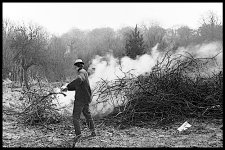
When I started in the 1960s that was all I had and it was adequate to my needs. This was part of my portfolio for the CSE photography exam and it fooled the assessor into giving me a grade one... ;)

Feeding large bonfire at Kent youth hostel 1960s Pentacon FM 67-9020.jpg
 
These threads whilst making for some interesting reading, are at times completely baffling to me. Do we feel this is all absolutely necessary to make good photos or is it purely for the theoretical knowledge (both of course are fine, it's whatever interests you and why photography is so rich in its diversity). I've seen these theories before and read some of them but never studied or practiced them in depth yet I seem to have had some pleasing results.

As Stephen said above, people were making wonderful imagery before these systems were pioneered.
They did, and still are.

But Adams went down this path because he was frustrated that he couldn't get his prints to match the print he had "visualised" when making the exposure.

By experimenting, he was able to measure how tones and tonal relationships were affected by the use of filters, choice of developer, choice of development time, choice of paper type, choice of paper grade, choice of enlarger light source, choice of exposure, choice of toning, there may well be more but these are the ones that come to mind.

From these experiments, he developed a structured approach to the technical aspects of making photographs

It's about intent, control, and understanding your medium. And it's about "consistency" and "confidence" in what you are going to be able to produce.

And really, he was just "formalising" the skills that many black and white photographers informally pick up along the way.

It's probably important to realise that Adams was originally a professional concert pianist, and used to spending hours and hours practising the piano to perfect his technique allowing him to concentrate on the emotional connection with the music unhampered by technical limitations.

This was also his approach to photography, as he wanted to reach a level of technical skill that would "free him from the technical" and allow him to concentrate on the expressive and creative.

Apparently, against the advice of "everyone" he gave up a very promising career as a pianist for photography because it was impossible to devote the time needed to be good at both, and his first choice was photography.

It certainly isn't necessary, especially for many pictures where it's all about the subject and the "photographic object" ie the print, where subtle tones and textures make up a large part of its value, are of much less importance.

As, a professional industrial photographer (in the film days) I found his teachings on technique invaluable.

But more importantly, the way he approached technique as only a means to achieving an expressive and creative print, and of no value in itself, changed the way I viewed photography.
 
They did, and still are.

But Adams went down this path because he was frustrated that he couldn't get his prints to match the print he had "visualised" when making the exposure.

By experimenting, he was able to measure how tones and tonal relationships were affected by the use of filters, choice of developer, choice of development time, choice of paper type, choice of paper grade, choice of enlarger light source, choice of exposure, choice of toning, there may well be more but these are the ones that come to mind.

From these experiments, he developed a structured approach to the technical aspects of making photographs

It's about intent, control, and understanding your medium. And it's about "consistency" and "confidence" in what you are going to be able to produce.

And really, he was just "formalising" the skills that many black and white photographers informally pick up along the way.

It's probably important to realise that Adams was originally a professional concert pianist, and used to spending hours and hours practising the piano to perfect his technique allowing him to concentrate on the emotional connection with the music unhampered by technical limitations.

This was also his approach to photography, as he wanted to reach a level of technical skill that would "free him from the technical" and allow him to concentrate on the expressive and creative.

Apparently, against the advice of "everyone" he gave up a very promising career as a pianist for photography because it was impossible to devote the time needed to be good at both, and his first choice was photography.

It certainly isn't necessary, especially for many pictures where it's all about the subject and the "photographic object" ie the print, where subtle tones and textures make up a large part of its value, are of much less importance.

As, a professional industrial photographer (in the film days) I found his teachings on technique invaluable.

But more importantly, the way he approached technique as only a means to achieving an expressive and creative print, and of no value in itself, changed the way I viewed photography.
Appreciate you taking the time to explain that and it does make me understand the 'why' a little more, especially with the type of subjects Adams was photographing.

I guess some people just love to embrace the technical side. For the type of things I photograph, I don't think it's a route I'll go down. I tend to only use FP4/HP5 and just one developer. 8x10 is too big for me to do at home yet but I feel I've got a decent technique now with 4x5 where I'm getting even development and no scratches and my negatives seem to be exposed well. However if I posted them here some of the more technical amongst the forum would probably disagree.
 
Interesting thread. Here's one more take.

I think there's an important distinction between learning technique for its own sake and learning enough to diagnose problems correctly. I, like many of us on here, collect monographs (in fact I need to order a new bookshelf, MACK and Steidl keep coming out with fantastic releases!) I find inspiration in images, not so much in chemistry textbooks.

But I've seen too many cases where a film stock gets blamed for grain, or a scanner gets blamed for e.g. uneven tonality, when the real culprit is a development regime that was probably not fit for purpose, or sloppy exposure, or problematic scanning. Regarding development, specifically: without understanding what development actually does to the silver (how agitation, dilution, time, and temperature shape the grain structure and density distribution) we simply don't have the tools to tell the difference between a film problem, a developer problem, or a technique problem.

An example - a few people on here I believe were, a while ago, experimenting with Foma 400 in Rodinal 1:100 stand - letting the film sit for a couple of hours and hoping for the best. That's a recipe where almost nothing is precisely controlled: exhaustion patterns, bromide migration, local vs. global agitation effects. It might produce lovely results, but if it doesn't, good luck working out why. Was it the film having QC issues? The dilution? Uneven exhaustion across the sheet? Without a controlled baseline, there's no way to isolate the variable. That's not artistry vs. science the way I see it, but just flying blind vs. having a reference point.

It's absolutely possible to make great photographs without caring about any of this. But troubleshooting is a different activity. Saying "that film is just grainy" or "that's just how it scans or how it prints" requires having ruled out the variables within one's control. Otherwise it's just guessing out loud, and that's not helpful to anyone trying to improve.
 
Last edited:
The critical factor is establishing your "Standard" that's the "N" for your chosen film & developer combination in terms of effective Exposure Index, and development time. This is also dependent on how you are going to output, condenser or diffuser enlarger, scanning, or for alt processes.

@myotis sums up the value of the Zone System well, I'd add that in practice I to only use N, and N-2, or N+2, variable contrast papers are so flexible you don't really need to use N+/-1 development.

Ian
 
Appreciate you taking the time to explain that and it does make me understand the 'why' a little more, especially with the type of subjects Adams was photographing.

I guess some people just love to embrace the technical side. For the type of things I photograph, I don't think it's a route I'll go down. I tend to only use FP4/HP5 and just one developer. 8x10 is too big for me to do at home yet but I feel I've got a decent technique now with 4x5 where I'm getting even development and no scratches and my negatives seem to be exposed well. However if I posted them here some of the more technical amongst the forum would probably disagree.
You don't need to go down the whole route for the zone system to be useful.

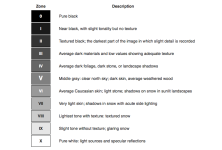
The concept of meters being calibrated (more or less) on an 18% grey (zone V, see table below), and visualising what that looks like, can be very useful for "pegging" the best exposure and getting a feeling for where other tones might "fall".

For example, If you look at the table below, it shows that if you take a meter reading from a grey card (Zone V, 18% grey) being held by a person with Caucasian skin, and make a print where the grey card in the print matches the "actual" card, then the Caucasian skin will appear in the print as one stop lighter than the grey card: which is the tone that looks about right for this skin tone.

Equally, if you take a meter reading from Caucasian skin, the meter will assume you want the skin tone to match an 18% grey, and if you follow the exposure given by the meter you will underexpose the film by one stop.

But as a Caucasian skin tone might be more readily available than a grey card, it can be useful to take a reading from a Caucasian skin tone, and give one stop more exposure than the meter says. This "places" the skin tone on zone VI, and allows all the other tones in the picture to "fall" into zones centred around the zone you have determined as being the most important.

Once you have determined your exposure based on the skin tone, you can then measure the light being reflected from other "important" tones within the picture and see where they are likely to "fall".

You can do this by knowing there is approximately a stop of exposure between zones, and if an important shadow area falls into an unacceptably dark zone, you know that you probably need to add a bit of lighting into the shadow area, or increase the exposure knowing it's going to overexpose the skin tones. This might just mean using a softer paper for printing, or it might mean you blow some important highlights.

This is less of an issue with black and white film than it is with digital, but it can also suggest where a small reduction or increase in development might be useful to keep detail across important tonal areas.

Simply "thinking" in terms of zones isn't a foolproof approach, but it gives a framework to help structure (and discuss) how you decide upon the "best" exposure.


1781003539231.png
 
Interesting thread. Here's one more take.

I think there's an important distinction between learning technique for its own sake and learning enough to diagnose problems correctly. I, like many of us on here, collect monographs (in fact I need to order a new bookshelf, MACK and Steidl keep coming out with fantastic releases!) I find inspiration in images, not so much in chemistry textbooks.

But I've seen too many cases where a film stock gets blamed for grain, or a scanner gets blamed for e.g. uneven tonality, when the real culprit is a development regime that was probably not fit for purpose, or sloppy exposure, or problematic scanning. Regarding development, specifically: without understanding what development actually does to the silver (how agitation, dilution, time, and temperature shape the grain structure and density distribution) we simply don't have the tools to tell the difference between a film problem, a developer problem, or a technique problem.

An example - a few people on here I believe were, a while ago, experimenting with Foma 400 in Rodinal 1:100 stand - letting the film sit for a couple of hours and hoping for the best. That's a recipe where almost nothing is precisely controlled: exhaustion patterns, bromide migration, local vs. global agitation effects. It might produce lovely results, but if it doesn't, good luck working out why. Was it the film having QC issues? The dilution? Uneven exhaustion across the sheet? Without a controlled baseline, there's no way to isolate the variable. That's not artistry vs. science the way I see it, but just flying blind vs. having a reference point.

It's absolutely possible to make great photographs without caring about any of this. But troubleshooting is a different activity. Saying "that film is just grainy" or "that's just how it scans or how it prints" requires having ruled out the variables within one's control. Otherwise it's just guessing out loud, and that's not helpful to anyone trying to improve.
While I agree with this, I think this more about understanding basic photographic techniques, rather than understanding the zone system.
 
While I agree with this, I think this more about understanding basic photographic techniques, rather than understanding the zone system.
Fair point, but I'd argue the Zone System is at its core those basics formalised. Without it, where else do most people encounter this material systematically?
 
Interesting thread. Here's one more take.

I think there's an important distinction between learning technique for its own sake and learning enough to diagnose problems correctly. I, like many of us on here, collect monographs (in fact I need to order a new bookshelf, MACK and Steidl keep coming out with fantastic releases!) I find inspiration in images, not so much in chemistry textbooks.

But I've seen too many cases where a film stock gets blamed for grain, or a scanner gets blamed for e.g. uneven tonality, when the real culprit is a development regime that was probably not fit for purpose, or sloppy exposure, or problematic scanning. Regarding development, specifically: without understanding what development actually does to the silver (how agitation, dilution, time, and temperature shape the grain structure and density distribution) we simply don't have the tools to tell the difference between a film problem, a developer problem, or a technique problem.

An example - a few people on here I believe were, a while ago, experimenting with Foma 400 in Rodinal 1:100 stand - letting the film sit for a couple of hours and hoping for the best. That's a recipe where almost nothing is precisely controlled: exhaustion patterns, bromide migration, local vs. global agitation effects. It might produce lovely results, but if it doesn't, good luck working out why. Was it the film having QC issues? The dilution? Uneven exhaustion across the sheet? Without a controlled baseline, there's no way to isolate the variable. That's not artistry vs. science the way I see it, but just flying blind vs. having a reference point.

It's absolutely possible to make great photographs without caring about any of this. But troubleshooting is a different activity. Saying "that film is just grainy" or "that's just how it scans or how it prints" requires having ruled out the variables within one's control. Otherwise it's just guessing out loud, and that's not helpful to anyone trying to improve.

That's the problem with where I am at, at the moment. Trying to concentrate on exposure, as that is one of the deficiencies I have been made aware of.
I think that I am measuring the scene correctly but how do I know that measurement is transferring to development?
I must be honest that, as my research progresses and my understanding increases, I am not a fan of the try loads of development times until it looks right "for me" process.
If I calculate a reading for zone seven, I want to know that it is landing on Zone seven when I develop it.
 
That's the problem with where I am at, at the moment. Trying to concentrate on exposure, as that is one of the deficiencies I have been made aware of.
I think that I am measuring the scene correctly but how do I know that measurement is transferring to development?
I must be honest that, as my research progresses and my understanding increases, I am not a fan of the try loads of development times until it looks right "for me" process.
If I calculate a reading for zone seven, I want to know that it is landing on Zone seven when I develop it.

Your instinct is right. "Try it until it looks right" is going to be slow and painful at best.

But once again, and in all honesty, IMO verification comes later. Right now, trust the published times for your chosen film/developer combination, be precise with temperature and agitation, and shoot consistently. If the basics are locked in, the zones take care of themselves, that's the whole point of the system. Verification with density readings is for when you have a stable baseline to verify against, otherwise there are too many variables in play to know what you're actually measuring.
 
Your instinct is right. "Try it until it looks right" is going to be slow and painful at best.

But once again, and in all honesty, IMO verification comes later. Right now, trust the published times for your chosen film/developer combination, be precise with temperature and agitation, and shoot consistently. If the basics are locked in, the zones take care of themselves, that's the whole point of the system. Verification with density readings is for when you have a stable baseline to verify against, otherwise there are too many variables in play to know what you're actually measuring.

I think I am starting to get a rudimentary understanding of where the zones will fall when I have selected where to place a reading. I am giving up with automatic cameras for the moment and sticking with full manual until I get it repeatable and boxed off.
 
Fair point, but I'd argue the Zone System is at its core those basics formalised. Without it, where else do most people encounter this material systematically?
Well, I agree with the first part of this (indeed I said almost the same thing), but...

Going back many years, I learned all the things you mentioned from books, magazines and other photographers before I knew anything about Ansel Adams and the zone system. I also went five years to photography college (part time) and I can't remember any mention of Ansel Adams and the Zone system.

Nonetheless, even without the Zone system, the things you mention were taught and available to read about.

I do however, agree that learning the zone system and working through setting it up would be a good way of learning the basics, but not essential.
 
Well, I agree with the first part of this (indeed I said almost the same thing), but...

Going back many years, I learned all the things you mentioned from books, magazines and other photographers before I knew anything about Ansel Adams and the zone system. I also went five years to photography college (part time) and I can't remember any mention of Ansel Adams and the Zone system.

Nonetheless, even without the Zone system, the things you mention were taught and available to read about.

That's true historically, but I'd argue the learning landscape today is completely different. In the past, dodgy advice was confined to the walls of a photo club and quickly corrected by someone with a working darkroom. Now a YouTuber with confident delivery and slick editing can broadcast fundamentally wrong information to thousands, and it gets amplified by Reddit threads and forum posts repeating it as fact. The formalized framework matters more now, I suspect, precisely because there's no quality filter on the informal channels that replaced those older, and often better validated learning paths.
 
I agree that understanding why things turn out as they do is very important.

However, I think it much more important to understand, as the successful painters always did, that the image has to be interesting, first and foremost. While most viewers will forgive poor technique, if the image grabs their attention, very few will say: "who cares what it's about - just look at that range of tones!"
 
Well, I agree with the first part of this (indeed I said almost the same thing), but...

Going back many years, I learned all the things you mentioned from books, magazines and other photographers before I knew anything about Ansel Adams and the zone system. I also went five years to photography college (part time) and I can't remember any mention of Ansel Adams and the Zone system.

Nonetheless, even without the Zone system, the things you mention were taught and available to read about.

I do however, agree that learning the zone system and working through setting it up would be a good way of learning the basics, but not essential.

That was the same for me. In fact the only references I saw for Ansel Adams, and also Edward Weston, were their images in the Focal Encyclopedia of Photography. I can't remember when I first heard of the Zone System, late 1970s, I think.

Ian
 
That's true historically, but I'd argue the learning landscape today is completely different. In the past, dodgy advice was confined to the walls of a photo club and quickly corrected by someone with a working darkroom. Now a YouTuber with confident delivery and slick editing can broadcast fundamentally wrong information to thousands, and it gets amplified by Reddit threads and forum posts repeating it as fact. The formalized framework matters more now, I suspect, precisely because there's no quality filter on the informal channels that replaced those older, and often better validated learning paths.
Yes, if your learning is restricted to photographic forums, YouTube and ghastly AI search results.

But I am still buying books, and paying for structured (online) courses, which, despite people often pushing YouTube as a learning platform, I still find proper courses to be a much better way of learning than the majority of stuff you find on YouTube.

As a retired university lecturer, I'm particularly aware of how important it is to learn the "boring" but "important" stuff, but it's not a good approach for a successful YouTube channel !
 
Last edited:
I agree that understanding why things turn out as they do is very important.

However, I think it much more important to understand, as the successful painters always did, that the image has to be interesting, first and foremost. While most viewers will forgive poor technique, if the image grabs their attention, very few will say: "who cares what it's about - just look at that range of tones!"
I can't see anyone disagreeing with that in principle, but for some photographs, it's the range of tones, the textures, and the geometry that grabbed the attention of the photographer that makes it an interesting picture.

And these types of photographs often rely on a high level of technical expertise to turn what the photographer saw and felt into something the viewer will also find interesting.

However, any photograph that immediately stimulates a technical response, "great tonal range", "a bit noisy", "not sharp", etc probably reflects a failing with both the photographer and the viewer. :-)
 
That was the same for me. In fact the only references I saw for Ansel Adams, and also Edward Weston, were their images in the Focal Encyclopedia of Photography. I can't remember when I first heard of the Zone System, late 1970s, I think.

Ian
I was lucky in that I worked with someone who had gone through a very different photographic education than my own (one of his lecturers was John Blakemore), and he introduced me to a whole new world of photographers I had never heard of. Which, by coincidence, I also think was in the late 1970s.
 
I was lucky in that I worked with someone who had gone through a very different photographic education than my own (one of his lecturers was John Blakemore), and he introduced me to a whole new world of photographers I had never heard of. Which, by coincidence, I also think was in the late 1970s.

I was showing the OP some prints by John Blakemore last week, as well as his Black & White Photography Workshop book. Oh, and the Dewi Lewis monograph of his work. I had friends at Derby & Trent in the late 1970s and early 80s.

Ian
 
Hello Ian,

My name is Wayne or Barney not OP
 
Hello Ian,

My name is Wayne or Barney not OP

OK, Barney/Wayne, OP just means the thread starter :D It's not a derogatory term :)

Unfortunately John Blakemore's Workshop book is now rather expensive.

1781024323611.png

It's a superb book but it was extremely poorly marketed by the publisher, I bought 2 copies when it was remaindered, £5 a copy.

The other book

1781024750491.png

Can still be bought new, £395 from Dewi Lewis, £95 secondhand is a bargain. The paperback listed is an entirely different book.

Ian
 
Back
Top