Zone System

Messages
3,670
Name
Wayne
Edit My Images
No
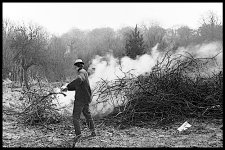
Often I read that we should place the shadows in zone three but Adams in his most famous image used the luminance of the moon as the set point for the exposure.
I think that I am starting to get my head around the problems and choices that are faced. It seems so counter intuitive, meter for the darkest area and stop down two or meter for the lightest and open up three. It all seems so straightforward when the EV spread of the scene is only five or six stops.
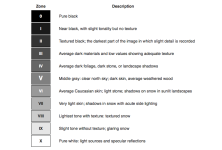
I have read that 90% reflectance white card is zone nine - is that correct ?

If the EV spread of the scene is seven stops or eight then reading the white card and opening up four stops leaves us with zone two perfect if the film allows doesn't it. But if there is a need to drop the zone nine to eight then overall we might get a bit bright. What is the point at which we start to develop at N- or N+ ?

And finally to my point, are there any published development times for N+ or N- developments for the various films ?
 
For that particular shot my guess would be whatever happened he didn't want to blow the moon out so metered on it to ensure the detail was kept, and in fact with some reading he used the moon light as a fixed reading which he then used to meter the rest of the scene off as he had no meter at that time. https://articles.anseladams.com/a-legend-in-light/?doing_wp_cron=1780694214.1063311100006103515625 - that shot was more of an exception than the rule

N+ N- is usually when you've passed the printing range of the paper you use 5 stops (7 including pure black and white), if you scene has only 4 stops of difference then you'll want to extend and if you have 8 stops between you light and dark subjects you'll want to contract.

No published times, you can start at +-25% dev time each side as an approximation. If you have the time and patience there are plenty of tests over on photrio that discuss this involving densitometers

Having fallen down this path myself , from other forums users over on photrio I follow the guide now of highlights too dense, reduce time, shadows too dark increase exposure and try and take more pictures

Bon chance on this rabbit hole if you follow it!
 
For that particular shot my guess would be whatever happened he didn't want to blow the moon out so metered on it to ensure the detail was kept, and in fact with some reading he used the moon light as a fixed reading which he then used to meter the rest of the scene off as he had no meter at that time. https://articles.anseladams.com/a-legend-in-light/?doing_wp_cron=1780694214.1063311100006103515625 - that shot was more of an exception than the rule

N+ N- is usually when you've passed the printing range of the paper you use 5 stops (7 including pure black and white), if you scene has only 4 stops of difference then you'll want to extend and if you have 8 stops between you light and dark subjects you'll want to contract.

No published times, you can start at +-25% dev time each side as an approximation. If you have the time and patience there are plenty of tests over on photrio that discuss this involving densitometers

Having fallen down this path myself , from other forums users over on photrio I follow the guide now of highlights too dense, reduce time, shadows too dark increase exposure and try and take more pictures

Bon chance on this rabbit hole if you follow it!

Thanks for that !

I had thought it was related to the film and not the paper. Doh !

Also been thinking that the contraction was only of the highlights and expansion only of the shadows. Double doh !

I found this after googling which seems to be thorough, apart from differing recipe contents re the KBr


N+4 and N-6 seem a little extreme considering your comments on the paper.

I will be happy just getting a decent exposure to start off with, but a densitometer had crept into my thoughts a week or two ago. :ROFLMAO:
 
Yeah I've read you’ll probably never go over 2 in either direction, with multigrade and scanning it matters less than it use to

Pictorial planet on youtube does a lot of this testing and talks more about it all than I could

Youll be on youtube soon looking for densitometers and step wedges

Im still waiting for someone with more patience than I to release a modern sensitometer for 4x5
 
Last edited:
Found some of the Photrio stuff.

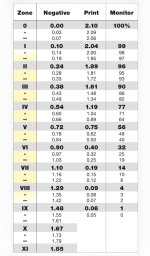
Now I need to know what density is Zone five. This can get incredibly accurate.
 
I'll just point out that photographers were making wonderful photographs long before Ansel Adams and Minor White articulated the zone system. Edward Weston inter alia developed by inspection; you'll have seen the comment in the sidebars of the Film Developing Cookbook from one of his sons (Brett, I think) about why he didn't use a meter. You should be able to find comments from AA himself about different light in some regions, that suggest he saw more than just the amount of light - the property that meters meter.
 
I'll just point out that photographers were making wonderful photographs long before Ansel Adams and Minor White articulated the zone system. Edward Weston inter alia developed by inspection; you'll have seen the comment in the sidebars of the Film Developing Cookbook from one of his sons (Brett, I think) about why he didn't use a meter. You should be able to find comments from AA himself about different light in some regions, that suggest he saw more than just the amount of light - the property that meters meter.
Morning Stephen

I have been saying that to the Mrs for years, Greece, Turkey and some parts of Spain the light is just better, crisper and cleaner, if that's what your after. I came to the conclusion that one of the reasons it is so different than much of the UK light is down to refraction caused by the humidity and moisture content of the air. Probably complete poppycock but it satisfied my need to know. I also prefer Bowens light when compared to elinchrom so to me it is a tangible thing. If Ansel Adams method, as scientifically imperfect as it is, helps me get "more correct" exposures then that will be good enough for me and excellent for my my photography.
There really have been some wonderful photographers, how they did it and worked it all out on their own with, what we would now call, limited resources and limited channels of communication is mind blowing.
 
I came to the conclusion that one of the reasons it is so different than much of the UK light is down to refraction caused by the humidity and moisture content of the air.


Partly that but also because the light has less atmosphere to fight through the closer to the equator you get. IMO&E, while there's more light in Greece, it's also a lot harsher so can be less than ideal at the height of the day. There's also a lot of haze when it heats up.
 
These threads whilst making for some interesting reading, are at times completely baffling to me. Do we feel this is all absolutely necessary to make good photos or is it purely for the theoretical knowledge (both of course are fine, it's whatever interests you and why photography is so rich in its diversity). I've seen these theories before and read some of them but never studied or practiced them in depth yet I seem to have had some pleasing results.

As Stephen said above, people were making wonderful imagery before these systems were pioneered.
 
These threads whilst making for some interesting reading, are at times completely baffling to me. Do we feel this is all absolutely necessary to make good photos or is it purely for the theoretical knowledge (both of course are fine, it's whatever interests you and why photography is so rich in its diversity). I've seen these theories before and read some of them but never studied or practiced them in depth yet I seem to have had some pleasing results.

As Stephen said above, people were making wonderful imagery before these systems were pioneered.
I had similar view a couple of weeks ago but people on here, who's opinions I respect, kept on telling me that something was not quite right with my images. So I bought a secondhand ex library copy of "The Negative" for a fiver , by the end of chapter two all the advice that I had previously been given started to fall into place and I thought to myself "he is onto something here" so I carried on reading and researching and over the last week or so it's slowly started to fall into place for me.

The methods that he advises, while not perfect, seems to have struck a chord with many and appear to have stood the test of time. The proof is in the pudding.

@trypdal - Is the density reading for middle grey particular to all films? or is each film different. I need to understand the times on the curve for adjusting densities to give me the N+ or N- values. Does that make sense?
 
Last edited:
Some people enjoy it, others not so much, many ways to skin a cat as they say

Of course. Totally agree with that. Was just trying to understand the reason why OP was asking.
I had similar view a couple of weeks ago but people on here, who's opinions I respect, kept on telling me that something was not quite right with my images. So I bought a secondhand ex library copy of "The Negative" for a fiver , by the end of chapter two all the advice that I had previously been given started to fall into place and I thought to myself "he is onto something here" so I carried on reading and researching and over the last week or so it's slowly started to fall into place for me.

The methods that he advises, while not perfect, seems to have struck a chord with many and appear to have stood the test of time. The proof is in the pudding.

I see. Fair enough. So many thoughts but I'm not articulate enough to put them into written words. It does make me think about my own images and wonder if there's something distinctly wrong with them (so many issues with that statement) as I've never followed anything of the like.
 
These threads whilst making for some interesting reading, are at times completely baffling to me. Do we feel this is all absolutely necessary to make good photos or is it purely for the theoretical knowledge (both of course are fine, it's whatever interests you and why photography is so rich in its diversity). I've seen these theories before and read some of them but never studied or practiced them in depth yet I seem to have had some pleasing results.

As Stephen said above, people were making wonderful imagery before these systems were pioneered.

I think it depends on where your interests (and specific needs) lie. Some people really enjoy the physics, chemistry, and mechanics of photography, others the artistic side, or anywhere in between. I think I'm like yourself, in that I just need to know enough to get the pictures I want. Everything else is surplus to requirements until such a time that I have to solve a problem or use a new technique. If I tried to learn everything, most of it would simply be forgotten through lack of usage anyway, and I'm not interested enough in that low-level detail to learn it for its own sake.

As long as I know how to operate the camera to the level I need and understand the capabilities of the film I'm using (or the digital sensor), again to the level I need, then it really just comes down to three things: subject, composition, and light (and even those are subjective to what I want). For me, at least, perfection is the enemy of good.

It probably says a lot about my approach that almost every one of the many photography books I own is monograph, collection, or catalogue of photographs. I have very few technical photography books and tend to just go online to find that type of information when I need it. Looking at photographs is what fires my inspiration.
 
Back
Top