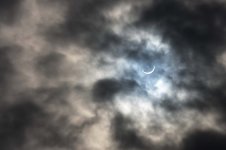
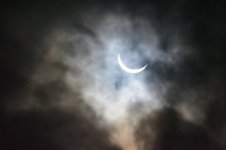
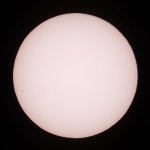
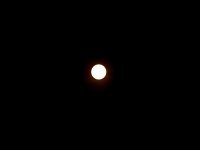
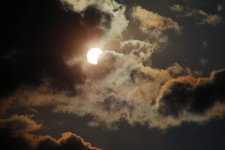
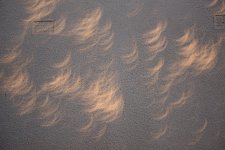
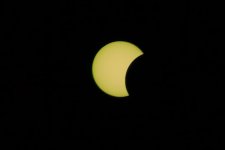
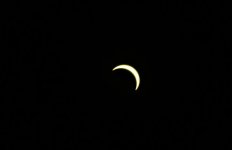
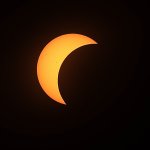
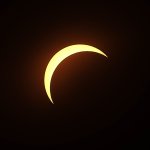
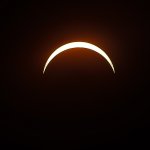
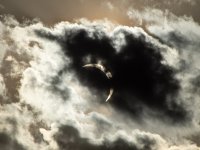
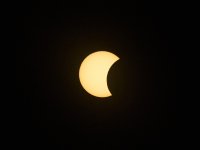
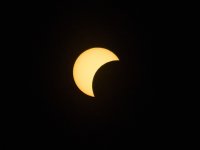
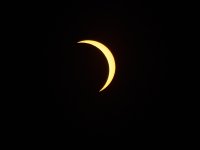
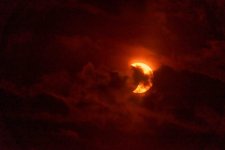
the eclipse

Jut had an idea. I have a tamron zoom 70-300mm. I was wondering can I get a x2 multiplier for this? I used extension rings years ago when I had a screw in lens type and a x2 and x3.
You absolutely need a solar filter. Do not try anything without. (Unless a projection)
 
Last edited:
I have bought some solar film, and stuck it to some old cokin filter rings - makes a great cheap filter. Went out to practice the other night. Couldn't find anything local to put in front of the sun though. Need a bit more practice to get it sharp - I will take a cloth to put over my head so I can actually see the live view screen properly (reflection of my face was too bright!)
My solar filter is made from a cereal packet......
I don't know what camera/lens you're using but with my Canon single point auto focus will lock on to the very edge of the sun, then I switch the lens to manual focus
 
My solar filter is made from a cereal packet......
I don't know what camera/lens you're using but with my Canon single point auto focus will lock on to the very edge of the sun, then I switch the lens to manual focus
I shall try that this evening! I struggled checking it back as I normally do as well - hence the need for a hood tonight. I shall look like one of those old fashioned camera me with the black cover and a puff of smoke....

It was also rather windy on the top of the hill, so I think that had something to do with the lack of sharpness. But that's the benefit of going out to practice - I hadn't realised the sun would be so high at 7pm, so I have chosen a calmer place to sit.
 
I've bought a Sonner solar filter, but I think that it's more for shooting straight at the sun with a long lens so I'm not sure I'll need it.

I've shot sunsets and sunrises before, so I'm just planning on using a similar method to that. I've been trying to think where a good location to shoot from would be around here, and I think I'm just going to go down by the river where I'll have an unobstructed view of the horizon.
Yes you will if you want to protect your eyes!
I've gone down to Spain for totality & have brought some dark welding glass for viewing the bits prior to totality. Unfortunately they're not big enough for my MTO 1000 so I'll have to see if I can get focus nailed with that in just a few seconds. Getting a larger solar filter a few months back would have made sense, but I've never been good at forward planning :(
 
  • Like
Reactions: Nod
I got this on Amazon. Can anyone tell me how this is variable?

It seems to have 2 groves. How can you get your fingers in to turn it? Is this what I need to do? Can I test it off camera to adjust it?
It use two polarisers which can be adjusted relative to each other. Like other variable / positional filters (star bursts etc), the outer frame has 2 parts one to screw into the thread below & the other to adjust the positions of the polarisers relative to each other. Variable ND filters are quite common - I have at least half a dozen! - They don't work well with wide angle lenses giving dark patches in the sky due to inconsistent polarisation of scattered light.

It is also NOT suitable for viewing/photographing the sun as it does not block IR...
Most normal ND filters suffer from this issue too
 
Last edited:
  • Like
Reactions: Nod
I have a 58mm eclipse filter left over from 1999, I think, so I got a 72 - 58 mm step down ring from t'internet and will be using that on either my 100-400 or 12-100 zoom on m4/3. . Only problem is I have no eclipse glasses. I will have to be very careful.

I tested the long lens set up yesterday evening and I was getting exposures of 1/25th to 0.4 secs at f5.6 and ISO 1600. Not what the advice is from youtube!

It must be a very dark filter.
 
Yes you will if you want to protect your eyes!
I've gone down to Spain for totality & have brought some dark welding glass for viewing the bits prior to totality. Unfortunately they're not big enough for my MTO 1000 so I'll have to see if I can get focus nailed with that in just a few seconds. Getting a larger solar filter a few months back would have made sense, but I've never been good at forward planning :(
I have solar glasses too :)
 
As posters mentioned earlier - cloud cover makes a difference. This was the March 2015 eclipse in Northumberland, handheld, with just a polarizer. It was something like 91-92%, so I think it will be similar up here this time around. 94% down in the south-west.

View attachment 490023


That's nice......
 
As posters mentioned earlier - cloud cover makes a difference. This was the March 2015 eclipse in Northumberland, handheld, with just a polarizer. It was something like 91-92%, so I think it will be similar up here this time around. 94% down in the south-west.

View attachment 490023
Indeed. I can't remember doing anything special myself other than pointing the camera in the right direction.

DSC_2464.jpg
 
I have a 58mm eclipse filter left over from 1999, I think, so I got a 72 - 58 mm step down ring from t'internet and will be using that on either my 100-400 or 12-100 zoom on m4/3. . Only problem is I have no eclipse glasses. I will have to be very careful.

I tested the long lens set up yesterday evening and I was getting exposures of 1/25th to 0.4 secs at f5.6 and ISO 1600. Not what the advice is from youtube!

It must be a very dark filter.
There were 2 main types of solar filters supplied, one for direct viewing & a weaker one for photography. IIRC the photographic kind gave 5 stops reduction of visual wavelengths (with more IR/UV reduction) the direct viewing type is darker in the visual band.

The welding glass I have are darker & probably have more imperfections,
IIRC shade 8 calculate to roughly ten stops reduction at the wavelength it transmits most (all welding glass block UV & IR beyond the visual):
Those I have with me are: Shade 9 about 11.5 stops, shade 13 about 13 stops & shade 14 about 18.5 stops

The sun is still clearly visible through the shade 14. I have photographed sun spots using the shade 13. in the past that were consistent with images from NASAs SOHO. NASA mananages better resolution & contrast, but their budget is somewhat bigger!
 
I have a 58mm eclipse filter left over from 1999, I think, so I got a 72 - 58 mm step down ring from t'internet and will be using that on either my 100-400 or 12-100 zoom on m4/3. . Only problem is I have no eclipse glasses. I will have to be very careful.

I tested the long lens set up yesterday evening and I was getting exposures of 1/25th to 0.4 secs at f5.6 and ISO 1600. Not what the advice is from youtube!

It must be a very dark filter.
With my 550D/Sigma 150-600 I'm iso 100 f8 and 1/800 to 1/1200 s with a full sun and mylar filter depending on how high the sun is. Today I'll be starting at 1/800s and working down from there. In 2015 I did a lot using a natural filter (cloud). Hoping not to have that today
 
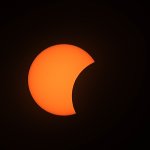
I've just had a quick practice in the garden with the filter on. Got a shot at 400mm (600 ff equiv), using 1/500 at F/8, ISO 160. I definitely could have gone faster I think, but there is a little bit of detail visible in the sun.

With the filter on literally the only thing that I could see through the EVF was the sun, everything else was pitch black. I think some of my confusion about what I've been reading has come from reading advice about taking a picture of the sun, when what I'm mainly planning is a photo that happens to include the sun. Having said that, since I've got the filter, I'll be taking a couple of longer shots too I reckon :)
 
I've just had a quick practice in the garden with the filter on. Got a shot at 400mm (600 ff equiv), using 1/500 at F/8, ISO 160. I definitely could have gone faster I think, but there is a little bit of detail visible in the sun.

With the filter on literally the only thing that I could see through the EVF was the sun, everything else was pitch black. I think some of my confusion about what I've been reading has come from reading advice about taking a picture of the sun, when what I'm mainly planning is a photo that happens to include the sun. Having said that, since I've got the filter, I'll be taking a couple of longer shots too I reckon :)


How do you plan to balance the exposure between the sun and your surroundings? That's what i'm puzzling over.
 
How do you plan to balance the exposure between the sun and your surroundings? That's what i'm puzzling over.
I'm thinking that any landscape shots will be exposed for the foreground so the sun will be overexposed, but hopefully still show as a crescent. Any shots I take with my 100-400 will have the filter on and will be exposed for the sun only, with no other detail (and will be cropped to just be a photo of the sun).

This is the practise shot I took a few minutes ago:
DSCF2705.jpeg
 
Couldn't source any glasses so I decided to use an old 400mm large format lens to project onto white card, should make a much larger viewing image than the pinhole method.
I shall see how it goes...
 
Last edited:
hmm well I'm very late to the party. In our pack of solar eclipse glasses they kindly provided a flimsy filter for my camera. I can't decide if I'm brave enough to use it.
 
Okay, so I get it now. Trying to shoot anything like a scene absolutely doesn't show that the sun is a crescent, so I've abandoned the 16-80. Only using the 100-400, and there's no way a normal ND filter would have been anywhere near dark enough.
 
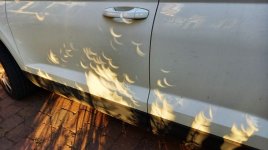
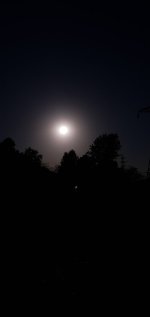
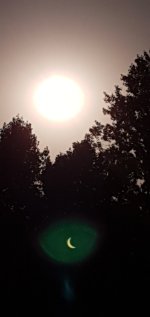
I took a snap with my phone as I am working and it's all I have with me. Not sure if the flare is showing the eclipse or not!
The second is maybe atmospheric.
Now I'll bow out and leave it to the real eclipse photographers!
20260812_192000.jpg
 

Attachments

  • 20260812_185538.jpg
    20260812_185538.jpg
    15.9 KB · Views: 2
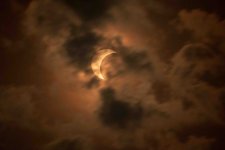
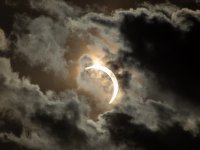
The cloud gathered here so maximum was just seen through cloud and guess how small the crescent is. I had my 600mm lens and 70mm solar scope and was also sketching, partner had his PST which I think is 40mm and a friend who was projecting with a small refractor. And my neighbours who came out for a look. I'm not looking at the images till tomorrow. I'm not sure they're any good. The camera was really struggling to grab focus. The drop in both light levels and temperature were really noticeable. Now I just need food!
 
Back
Top