Black spots on Scans

Messages
3,532
Name
Wayne
Edit My Images
No
Almost unbelievable but true, last night I was congratulating myself on the detail in my recent photographs and starting to think that I was really getting somewhere !

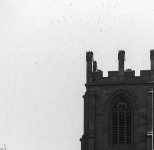
I thought I saw a flock of birds around a clocktower when to my absolute horror they, at first sight, appeared to be another kind of fault in my pathetic process.


Clock tower
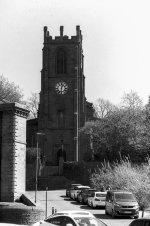
Darwen Market.jpg


Detail of chimneys at top right of clocktower
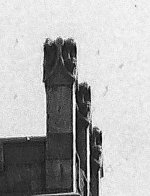

Clock tower detail.jpg


Black marks


Clock tower black marks.jpg
 
Well that needs sorting out, have you enlarged previous negs to see if there is a pattern for how you develope? Hmm I haven't dev negs for about 20 years and hope I don't have any problems restarting using B/W and home dev for my night shots.
 
Well that needs sorting out, have you enlarged previous negs to see if there is a pattern for how you develope? Hmm I haven't dev negs for about 20 years and hope I don't have any problems restarting using B/W and home dev for my night shots.
Its the first time I have noticed them Brian, its all going wrong at once, one thing after a flipping other.

I am going the get the looupe out at the weekend (bank holiday) and have a couple of happy hours checking over some of my negs in detail.
 
Well Wayne I sure an expert will probably have an answer as I haven't a clue to what went wrong..all I know is to be consistent when dev negs h'mm well that is if you get it right in the first place ;)
 
Dust would seem to be the most likely problem.

Just came across this guide to "things that can go wrong with scanned film"

 
Taking this example with your last one, my guess without seeing the negatives is that you're collecting dust and dirt on an industrial scale while your film is drying. My suggestion if you can't clean things up is this

 
Last edited:
Possibly contamination on the film, maybe from degraded light seal foam or some sort of particulates in the developer? If they're dark on the scan then they will be light / transparent on the actual negative.
Agreed, black spots on the positive image is going to be dust or fibres on the film when exposed or physical damage to the emulsion, I really don't think it is a film drying problem unlike the white spots earlier.
 
I think I have figure out what's going on.

A couple of months ago I changed my film drying routine.

Initially through my over enthusiasm I used to watch for the film drying and as soon as the film looked dry, to me, it was off the hooks and into the scanner. I scratched a couple of negs as the emulsion was probably still soft. So I made a conscious decision to attempt to try and hold back and leave the films overnight which I have been doing. This is where the marks seem to have appeared at roughly the same time, and no wonder with the bathroom door slamming open and shut dozens of times a day.

I am still going to build a drying box, but how long roughly before the emulsion is hard enough to ensure safe handling.

Thanks all for you considerable patience and advice and making me think along the right lines !
 
I think I have figure out what's going on.

A couple of months ago I changed my film drying routine.

Initially through my over enthusiasm I used to watch for the film drying and as soon as the film looked dry, to me, it was off the hooks and into the scanner. I scratched a couple of negs as the emulsion was probably still soft. So I made a conscious decision to attempt to try and hold back and leave the films overnight which I have been doing. This is where the marks seem to have appeared at roughly the same time, and no wonder with the bathroom door slamming open and shut dozens of times a day.

Anything getting on the negs while they're drying won't give you black spots on the scans though. It'll show as white spots, marks, and tiny hairs because the scanner will record them as opaque areas which will become white when inverted.

Something getting on the emulsion in the camera will give black spots as it'll block the light from hitting the negative, effectively causing a shadow during exposure. On the scans it will show up dark in the same way as any other shadows in the scene.
 
I think I have figure out what's going on.

A couple of months ago I changed my film drying routine.

Initially through my over enthusiasm I used to watch for the film drying and as soon as the film looked dry, to me, it was off the hooks and into the scanner. I scratched a couple of negs as the emulsion was probably still soft. So I made a conscious decision to attempt to try and hold back and leave the films overnight which I have been doing. This is where the marks seem to have appeared at roughly the same time, and no wonder with the bathroom door slamming open and shut dozens of times a day.

I am still going to build a drying box, but how long roughly before the emulsion is hard enough to ensure safe handling.

Thanks all for you considerable patience and advice and making me think along the right lines !
...but Wayne, as you know, an enlarged neg shouldn't look like the one you posted of the tower and that has to be sorted out.
 
...but Wayne, as you know, an enlarged neg shouldn't look like the one you posted of the tower and that has to be sorted out.

That's the first time I have seen that in my first few dozen rolls of film, I will sort out the dust issue first as that is causing the most consternation.
I have put in a roll of FP4 and will try to blast that off today.
 
how long roughly before the emulsion is hard enough to ensure safe handling?
I hang my negatives in the shower cabinet, usually for aroubd 3 hours, and that seems to be fine. Much less than that and sleeving becomes difficult, ie they are still damp. I can't leave them up for much longer as Mrs R will go in for her evening shower; she has threatened to drop them on the floor if they're still there! (I neither believe nor disbelieve this threat...)
 
Got my wood today (ooh er mrs)
Decide on a 300x200 cabinet approx 2m tall
Should be able to get 8x10 in there eventually

For heating was thinking of a 40 0r 60w light bulb.

Any better suggestions ?
 
A bloke I knew ( John @thedarkshed) used, IIRC, a computer fan and air filter to move the air....
 
Last edited:
A bloke I knew ( John @thedarksheed) used, IIRC, a computer fan and air filter to move the air....

Is creating circulation enough Chris or do I need some heat as well ?
 
Circulating CLEAN air should be enough. Warmth (rather than heat) can help speed the drying up.
 
Got my wood today (ooh er mrs)
Decide on a 300x200 cabinet approx 2m tall
Should be able to get 8x10 in there eventually

For heating was thinking of a 40 0r 60w light bulb.

Any better suggestions ?

I use a small bathroom in the basement. There are no curtains, no thick rugs, not a lot of furniture, so little that can produce thick dust when moved etc.

I run a hot shower for five minutes before hanging the strips to dry. The steam seems to capture any floating dust.

I leave the negatives hanging to dry overnight, and file them in the morning. I never have to do any PS spotting.
 
Last edited:
I use a small bathroom in the basement. There are no curtains, no thick rugs, not a lot of furniture, so little that can produce thick dust when moved etc.

I run a hot shower for five minutes before hanging to dry. The steam seems to capture any floating dust.

I leave the negatives hanging to dry overnight, and file them in the morning. I never have to do any PS spotting.
Sounds good, I would be happy with that type of process if my bathroom was not a communal area !

I will make a start on cabinet this evening and let the paint dry overnight, I have decided to go with warmth from a light bulb rather than forced air (potentially more dust).
 
Did not get as far as I would have liked last night, I had not realised the time.

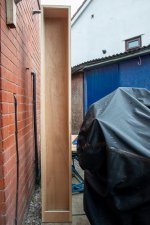
Story so far,

7' tall. 12"x8"

Drying Cabinet-2.jpg
 
Last edited:
I have decided to go with warmth from a light bulb rather than forced air (potentially more dust).
You'll still need some ventilation, surely? Gotta get that water vapour out somehow! So, a few holes in the sides near top and bottom, covered with some sort of basic filter?
 
You'll still need some ventilation, surely? Gotta get that water vapour out somehow! So, a few holes in the sides near top and bottom, covered with some sort of basic filter?

Thanks Chris for the reminder !

It's all in hand.
 
Progress

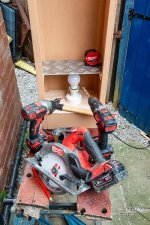
I am probably overthinking this a bit, I have put in a chequer plate shelf to absorb some of the heat from the light and act like a heat sink to keep the temperature more even across the cabinet, directing the warm air back and front and not directly at the film, also it will protect the bulb from any drips with added advantage that any drips will heat the warm plate and contribute to keeping the air moist adhering to any dust particles.

PS, I don't like De-Walt gear

Film Cabinet-2.jpg
 
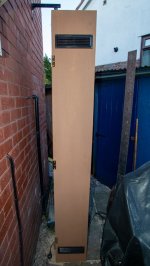
DA DAH !

One heated film drying cabinet.

Drying cabinet.jpg

Fingers crossed no more dusty negatives.
 
Last edited:
Well, a bit of drama

The hinges pulled out the door as it was only 6mm ply, I had to get nuts and bolts and fit through from the inside. Then I tried to get a bulb, Have you tried getting a regular tungsten filament bulbs? I ended up getting one off my Mam from an old table lamp.

Anyhow, warmed up the cabinet, gets to 31 degrees at the hot plate, while I developed, for the first time, a roll of FP4+ in FX55.

Wish me dust free luck. :)

I might make a new door out of 8mm.
 
Flipping heck, I cant believe it dry in 45 mins and I have cut the strips and seen something I have never seen before.

NO CURL at all, I didnt know film was so flat, hopefully will go through the scanner better than usual
 
On bulbs...

My safelight uses 25W bulbs. I knew that they would soon become unavailable by decree, so when my local hardware shop finally closed (uneconomic rent) and sold off their remaining stock cheap, I bought all the 25W bulbs they had.
 
On bulbs...

My safelight uses 25W bulbs. I knew that they would soon become unavailable by decree, so when my local hardware shop finally closed (uneconomic rent) and sold off their remaining stock cheap, I bought all the 25W bulbs they had.
I will check my safelight, didnt think of that. Thanks
 

Amazing what a second or 2 on Google can throw up!

Or you could source a Small Edison Screw lamp holder and use oven bulbs which will be available for a reasonably long time, I reckon.
 

Amazing what a second or 2 on Google can throw up!

Or you could source a Small Edison Screw lamp holder and use oven bulbs which will be available for a reasonably long time, I reckon.
FFS

I have been trapesing round the shops.

Thanks for the link and good Idea !
 
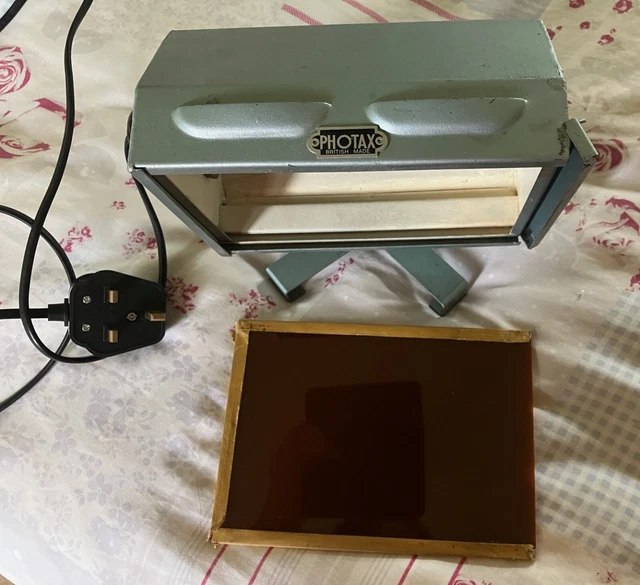
Modern safelights tend to be LCD or something like that. My Photax safelight (30/- in 1960) is rather before their time. The continued value to me is that it takes slide in glass filters, (7/- in 1960) and I've acquired a few more over the years including an ortho one.
 
Modern safelights tend to be LCD or something like that. My Photax safelight (30/- in 1960) is rather before their time. The continued value to me is that it takes slide in glass filters, (7/- in 1960) and I've acquired a few more over the years including an ortho one.

Whats that in todays money ?
 
30/- is £1.50; 7/- is 35p. Fillet steak in 1968 was 12/6 lb which is 62.5p. Waitrose price for 1 pound is £37.50. Waitrose was the first search engine result. Milk was 4p a pint in those days. A Nikon F was about £157 and a Hasselblad about £250. Camera prices not checked, just from memory.
 
If you're interested, the ebay second hand price is £50!

 
30/- is £1.50; 7/- is 35p. Fillet steak in 1968 was 12/6 lb which is 62.5p. Waitrose price for 1 pound is £37.50. Waitrose was the first search engine result. Milk was 4p a pint in those days. A Nikon F was about £157 and a Hasselblad about £250. Camera prices not checked, just from memory.

Flipping heck, what were wages like back then ?
 
I went to university in 1967 with a full grant. That meant tuition was fully covered, and I had £365 for the year to cover expenses. Student accommodation cost £110, which included a full cooked breakfast, rooms cleaned, beds made for us, linens changed etc. I started work in 1970 on what was a slightly above average graduate salary of £1200 a year, take home pay after tax £69 a month. And an annual season ticket Brighton to London was £100.
 
I went to university in 1967 with a full grant. That meant tuition was fully covered, and I had £365 for the year to cover expenses. Student accommodation cost £110, which included a full cooked breakfast, rooms cleaned, beds made for us, linens changed etc. I started work in 1970 on what was a slightly above average graduate salary of £1200 a year, take home pay after tax £69 a month. And an annual season ticket Brighton to London was £100.

Happy days !
 
Especially if you wanted to buy a house. We moved here in 1977. Our then next door neighbours told us they had paid £7,200 in 1972. I just looked up a market estimate for next door which was about 100 times that price.
 
Especially if you wanted to buy a house. We moved here in 1977. Our then next door neighbours told us they had paid £7,200 in 1972. I just looked up a market estimate for next door which was about 100 times that price.
Wow ! six years salary for a house, incredible !
 
If you like looking at what once was, my mother paid £800 for her house in 1961. :D

On the other hand, when I started work Computer Weekly advised readers not to buy a pocket calculator until the price dropped below £100. Not everything was cheap.
 
Back
Top